
For decades, the narrative of Indian manufacturing followed a predictable, albeit limited, script. We were the “back office of the world” for services, but in the realm of physical goods, we were often seen as a final-mile assembly hub. In the global value chain, India occupied the low-margin basement—importing sophisticated components, snapping them together with cost-effective labour, and shipping them out.
However, a quiet revolution is brewing. If the last decade was about “Make in India,” the next decade is about “Innovate and Add Value in India.” As of early 2026, India is no longer content with being the world’s screwdriver; it is positioning itself as the world’s laboratory and factory floor combined. At the heart of this structural shift is a catalyst that didn’t exist in previous industrial revolutions: Artificial Intelligence (AI).
The Structural Pivot: From Assembly to Value Addition
The data tells a compelling story of resilience and transformation. According to the Economic Survey 2025-26, medium and high-technology activities now account for a staggering 46.3 per cent of India’s total manufacturing value added. This is a significant departure from the labour-intensive, low-tech textile and basic assembly dominance of the early 2010s. The turning point came with the launch of the Production Linked Incentive (PLI) Scheme in 2020. Unlike traditional subsidies, PLI rewards incremental production and sales across strategic sectors including electronics, pharmaceuticals, automobiles, textiles and specialty steel.
By March 2025, investments worth over Rs 1.97 lakh crore had been approved across 14 sectors, generating significant production and employment momentum. The policy direction is clear: – India does not want to remain an assembly destination — it wants to deepen supply chains, strengthen R&D capability, and increase domestic content across production networks
It looks like the Production Linked Incentive (PLI) schemes which, rather than just incentivising volume, are now rewarding domestic component localisation in electronics, pharmaceuticals, and specialized chemicals and have started producing precision-engineered components that are strategically indispensable to global giants like Apple, Tesla, and Samsung.
AI: The Steam Engine of Cognition
While the first Industrial Revolution scaled muscle, and the second scaled electricity, this new era scales cognition. In the Indian context, AI is not just a tool for optimisation; it is the “accelerant” that allows India to leapfrog traditional industrial stages.
Here is how AI is specifically accelerating the shift toward a high-value economy:
- Predictive Intelligence vs. Reactive Maintenance
In a traditional assembly hub, downtime is expensive but expected. In a high-precision, value-added environment, it is unacceptable. Indian manufacturers are now leveraging AI-driven predictive maintenance. Using sensor data and machine learning, factories are predicting failures before they happen. McKinsey reports that this alone can reduce downtime by up to 30%. For an Indian SME, this efficiency gain is the difference between surviving on thin margins and having the capital to reinvest in R&D. - Generative Design and Prototyping
Value addition starts at the design stage. AI-powered generative design tools are allowing Indian engineers to create thousands of design iterations based on specific parameters like weight, strength, and cost. By the time a product reaches the assembly line, it has already been optimized for performance and sustainability. This moves the “brain” of the manufacturing process to India, ensuring that the highest portion of the profit margin—the intellectual property—stays within the country. - The Rise of “Agentic” Quality Control
India’s Achilles’ heel has historically been “consistency.” AI-based computer vision is solving this. From detecting micro-defects in solder joints in electronics to ensuring the molecular purity of chemicals, AI “agents” are performing quality checks with a precision that human eyes cannot match. This allows “Made in India” to become a global synonym for “Zero Defect” quality. - The “Democratisation” of the Supply Chain
The complexity of global value chains often intimidates smaller Indian firms. AI-led supply chain orchestration—recently demonstrated by pioneers like Tata Electronics—is reducing raw material holding costs and improving lead time efficiency by over 20%. By predicting demand spikes and logistics bottlenecks, AI allows even mid-sized Indian firms to integrate seamlessly into global just-in-time delivery systems.
A Confluence of Policy and Technology
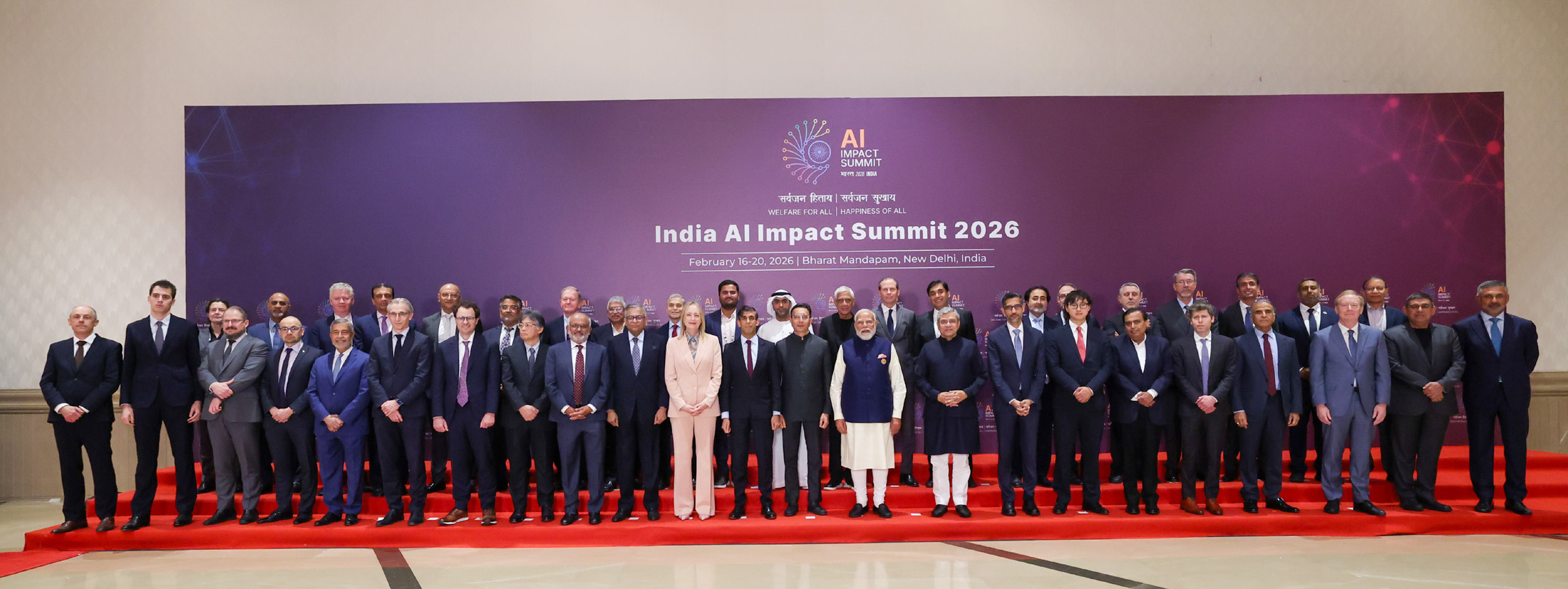
The shift is being fueled by a rare “rhythm” between policy and technology. The IndiaAI Mission, backed by a more than Rs 10,300 crore investment, is not just about chatbots. It is about deploying 38,000 GPUs to power industrial innovation.
In February 2026, the launch of the “AI for Manufacturing Engineering Technology (AI-MET)” white paper by the Union government signalled a formal commitment to embedding AI across the shop floor. The message is clear: To achieve the goal of a USD 1 trillion manufacturing economy, India must be “AI-first.”
The Human Element: Bridging the Skill Gap
The most contemporary challenge—and opportunity—is the workforce. As factories get smarter, the demand for traditional assembly labour is being replaced by a need for a “hybrid” workforce—people who understand both code and control systems.
Unlike the West, which faces an aging workforce, India’s demographic dividend is a digital-native generation. With over five million tech professionals already leading AI innovations globally, India is now “channelling its global expertise inward.” Programs are shifting toward dual apprenticeship models where students learn AI modelling alongside industrial engineering. The goal is to create a workforce that doesn’t just work on the machine, but with the AI.
The Road to 2030: A Global Third Force
The global manufacturing landscape is undergoing a “geopolitical realignment.” As firms look for alternatives to a China-only model, India stands as a resilient, green, and innovation-led alternative.
We are moving away from a “cost arbitrage” model (where we win because we are cheap) to a “strategic indispensability” model (where we win because we are the best). With AI as the backbone, India is building “Quantum Valleys” and “Green Hydrogen Valleys” that are lightyears ahead of simple assembly lines.
Conclusion
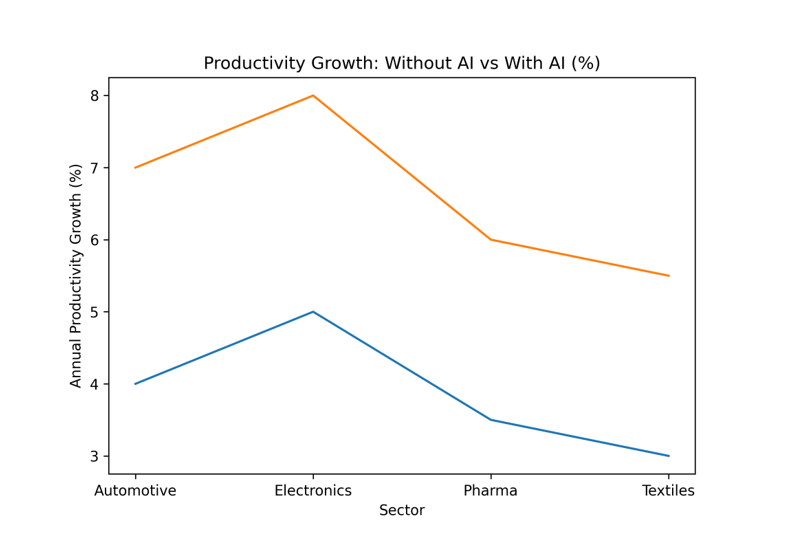
The transition from an assembly hub to a value-added manufacturing economy is no longer a “potential” future—it is a present reality. The integration of AI is providing the speed, precision, and cognitive scale required to compete in the 21st century. Global evidence suggests AI-enabled factories can improve productivity growth from roughly 3–4% annually to 6–8%, depending on sectoral adoption.
As India marches toward its vision of Viksit Bharat @ 2047, the factories of tomorrow will be defined not by how many hands are on the assembly line, but by how much intelligence is embedded in the process. India is no longer just putting the pieces together; it is designing the pieces, perfecting the process, and owning the future.
The debate is no longer about scale alone. It is about value addition, supply-chain depth, design capability, and now increasingly, the integration of Artificial Intelligence (AI) into industrial systems. India’s manufacturing transformation is intersecting with a digital revolution — and that convergence may define its long-term competitiveness.
(Dr. Bhavana Rai, author of this article, is an eminent Economist. Currently, she serves as Joint Director at the FHRAI Centre of Excellence for Research in Tourism and Hospitality (CERTH). She has previously been associated with reputed institutions such as ASSOCHAM, PHD Chamber of Commerce and Industry, and the Institute of Economic Growth)