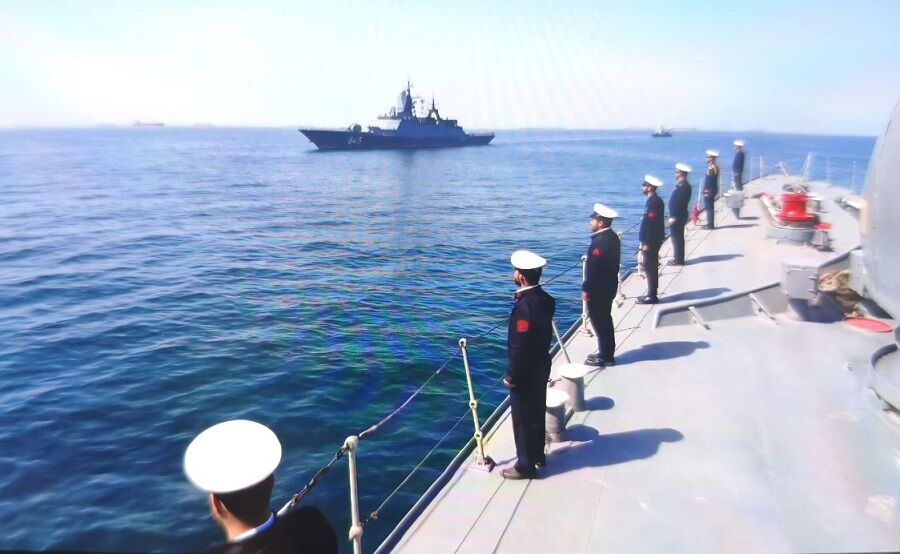
In a move underscoring Tehran’s deepening military ties with Moscow amid stalled nuclear negotiations, Iranian and Russian forces launched coordinated naval exercises in the Gulf of Oman on Thursday, just as a second US aircraft carrier group edged closer to Middle Eastern waters. Iranian officials have framed the joint drill as a routine exchange of expertise, yet it stands out as a clear demonstration of Tehran’s strategy to project resilience and deterrence while internal unrest lingers and international warnings intensify over the threat of wider conflict.”
Analysts view the Iran-Russia maneuvers not merely as annual protocol but as a calculated display of solidarity, potentially aimed at countering perceived US and Israeli aggression. With indirect talks in Geneva yielding scant progress, sources close to the negotiations reveal that Tehran is preparing a formal written proposal to address Washington’s core concerns—yet skepticism abounds over its sincerity, given Iran’s refusal to broaden discussions beyond its atomic activities. This development, gleaned from diplomatic channels, points to a high-stakes brinkmanship where both sides may be positioning for escalation rather than compromise.
The exercises, involving live-fire simulations and special forces operations, come against a backdrop of heightened US military posture. The USS Gerald R Ford, a nuclear-powered carrier accompanied by destroyers and support vessels, was tracked off Morocco’s coast earlier this week, poised for entry into the Mediterranean. Its potential deployment to the eastern flank would double U.S. carrier presence in the region, enabling rapid strikes on Iranian targets if ordered. Pentagon officials, speaking off the record, indicate that full operational readiness for any contingency could be achieved by mid-March, aligning with reinforcements including advanced fighter jets like F-35s and F-22s already enroute to Gulf bases.
President Donald Trump’s administration has maintained a dual-track approach: pursuing dialogue while amassing forces. “We want a deal, but it has to be real—no loopholes, no games,” Trump reiterated in remarks on Thursday, echoing his long-standing warnings of severe consequences should Iran renege. The president’s stance reflects years of impasse, rooted in US demands for curbs on Iran’s ballistic missiles and support for proxy militias, issues Tehran deems non-negotiable.
Last year’s U.S.-Israeli airstrikes, which targeted nuclear facilities and military installations, inflicted significant damage, though the extent remains opaque due to restricted access for inspectors from the International Atomic Energy Agency (IAEA).
Iran’s leadership, under Supreme Leader Ayatollah Ali Khamenei, has portrayed the drills as defensive, emphasizing operational coordination with Russia to safeguard vital sea lanes. State media footage depicted Revolutionary Guard naval commandos boarding simulated enemy ships, a tactic reminiscent of past incidents involving tanker seizures in the Strait of Hormuz. This chokepoint, through which 20% of global oil transits, remains a flashpoint; any disruption could spike energy prices and draw in major powers. Russian participation, involving warships from its Pacific Fleet, underscores Moscow’s strategic pivot toward Tehran, partly as a counterweight to Western sanctions on both nations.
Internally, Iran grapples with fragility. January’s widespread protests, sparked by economic grievances and calls for reform, were met with a forceful crackdown, resulting in dozens of deaths. Forty-day mourning ceremonies for the fallen demonstrators have morphed into focal points for dissent, with chants against the regime echoing in Tehran and other cities despite heavy security presence. Human rights monitors report arbitrary arrests and internet throttling, tactics that have only fueled resentment. Economically strained by sanctions and post-strike reconstruction costs, the Islamic Republic faces a populace increasingly disillusioned with its hardline policies.
European allies, traditionally mediators in US-Iran frictions, are signaling alarm. Polish Prime Minister Donald Tusk issued an urgent advisory on Thursday, imploring Polish nationals in Iran to evacuate immediately, citing intelligence suggesting that safe departure windows could close within hours or days. While details were sparse, this marks one of the starkest warnings from a NATO member, hinting at shared assessments of imminent peril. Germany, meanwhile, has relocated several dozen non-essential personnel from its training mission in northern Iraq, citing regional instability. These moves align with broader coalition adjustments, as forces in Erbil continue anti-ISIS training but with reduced footprints to minimize exposure.
The Soufan Center, a prominent security think tank, noted in its latest briefing that the influx of U.S. assets—now totaling hundreds of aircraft across the Arabian Peninsula—serves as a tangible enforcement of Trump’s rhetoric. “This isn’t posturing; it’s preparation,” said one analyst, who requested anonymity. The deployments evoke memories of the 2024 Gaza escalation, where U.S. carriers provided air defense umbrellas for Israel against Iranian-backed groups like Hamas and Hezbollah. Should hostilities erupt, experts predict a multi-front war: Iranian missiles targeting Israeli cities, proxy attacks on U.S. installations in Iraq and Syria, and potential closures of key waterways.
Israeli Prime Minister Benjamin Netanyahu, fresh from consultations with Trump, amplified the rhetoric. “Iran knows the price of aggression—we are ready for every eventuality,” he declared in Jerusalem. Netanyahu’s advocacy for a comprehensive accord mirrors longstanding Israeli intelligence assessments that Iran’s nuclear ambitions, despite denials, aim at weaponization. Tehran insists its program is civilian, halted enrichment post-strikes, and blames U.S. withdrawal from the 2015 JCPOA for the crisis. Yet, without IAEA verification, doubts persist, with satellite imagery suggesting covert rebuilding efforts at sites like Natanz and Fordow.
Broad geopolitical ripples are evident. China’s muted response, focused on oil supply stability, contrasts with India’s expressed concerns—highlighted in Ministry of External Affairs advisories and industry reports—over the safety of its diaspora in Iran and disruptions to targeted trade flows, such as basmati rice exports. New Delhi, balancing ties with Washington and Tehran, has quietly enhanced naval patrols in the Indian Ocean, wary of spillover from the Iran-Russia drills. Meanwhile, Arab Gulf states like Saudi Arabia and the UAE, historical adversaries of Iran, have ramped up air defenses, anticipating Houthi or other proxy incursions.”
Analysis of the nuclear talks reveals entrenched positions. The Geneva sessions, mediated by Oman and Qatar, have centered on uranium enrichment caps and sanctions relief. A senior U.S. diplomat, speaking anonymously, confirmed Iran’s commitment to a written counterproposal but cautioned against optimism: “History shows Tehran uses talks to buy time—building centrifuges, funding militias.” Indeed, since the 2025 strikes, Iran has accelerated missile tests, unveiling hypersonic variants capable of evading defenses.
This impasse raises questions about deterrence efficacy. Trump’s “maximum pressure” campaign, blending sanctions with military shows, has weakened Iran’s economy—GDP contraction estimated at 8% last year—but hardened its resolve. Pro-regime rallies in Tehran counterbalance protests, with state propaganda framing the U.S. as an existential threat. Russia’s involvement adds complexity; Moscow’s veto power at the UN Security Council could shield Iran from new resolutions, while arms transfers bolster its asymmetric capabilities.
Looking ahead, mid-March looms as a pivotal juncture. If Iran’s proposal falls short, U.S. options range from targeted strikes to comprehensive campaigns aimed at regime change, though the latter risks quagmire akin to Iraq 2003. Humanitarian fallout could be catastrophic: refugee flows into Turkey and Europe, oil shocks hitting global markets, and sectarian violence across the Levant.
In Tehran, defiance prevails. Foreign Minister Hossein Amir-Abdollahian dismissed U.S. threats as “bluster,” vowing retaliation that would “engulf the region.” Yet, whispers from reformist circles suggest internal debates over concessions, fearing economic collapse could topple the theocracy.
As carriers steam eastward and drills echo across the Gulf, the Middle East teeters on a knife’s edge. Diplomatic breakthroughs remain possible, but with each passing day, the specter of war grows. Stakeholders urge restraint, but entrenched mistrust may prove insurmountable.
This escalation encapsulates a perennial cycle: nuclear ambitions clashing with security imperatives, superpowers jockeying via proxies. For ordinary Iranians, caught between repression and external pressures, the stakes are personal—livelihoods, freedoms, lives. International observers, from Vienna’s IAEA headquarters to New York’s UN corridors, watch warily, hoping rhetoric yields to reason.
Yet, precedents abound for miscalculation. The 2019 tanker attacks, 2020 Soleimani strike, and 2025 nuclear raids all escalated from similar tensions. Today’s maneuvers and mobilizations may be posturing, but in a region scarred by conflict, posturing often precedes peril.
European evacuations underscore the urgency. Tusk’s alert, echoed by advisories from Britain and France, reflects intelligence sharing within NATO, possibly including SIGINT intercepts of Iranian military chatter. Germany’s partial withdrawal from Iraq signals a domino effect, as coalition partners recalibrate risks.
US domestic politics add layers. With midterm elections approaching, Trump faces pressure from hawks to act decisively, while doves warn of overstretch amid commitments in Ukraine and the Pacific. Public opinion polls show wariness toward another Middle East entanglement, yet support for Israel remains robust.
Iran’s alliances, beyond Russia, include Syria’s Assad and Yemen’s Houthis, forming an “axis of resistance” capable of asymmetric warfare. Hezbollah’s arsenal, estimated at 150,000 rockets, poses a direct threat to Israel, potentially drawing in Lebanon.
Economic analyses project dire scenarios: Brent crude surging past USD150/barrel on Hormuz closure, inflating global inflation. Developing nations, reliant on Gulf labor remittances, would suffer disproportionately.
Humanitarian agencies prepare for worst-case: mass displacements, aid blockades. UNHCR estimates up to 2 million could flee Iran if urban centers are hit.
In sum, the Iran-Russia drills serve as a bellwether for Tehran’s strategy—defiant, diversified, determined. As U.S. forces converge, the window for diplomacy narrows. Whether this leads to accord or apocalypse hinges on elusive trust.