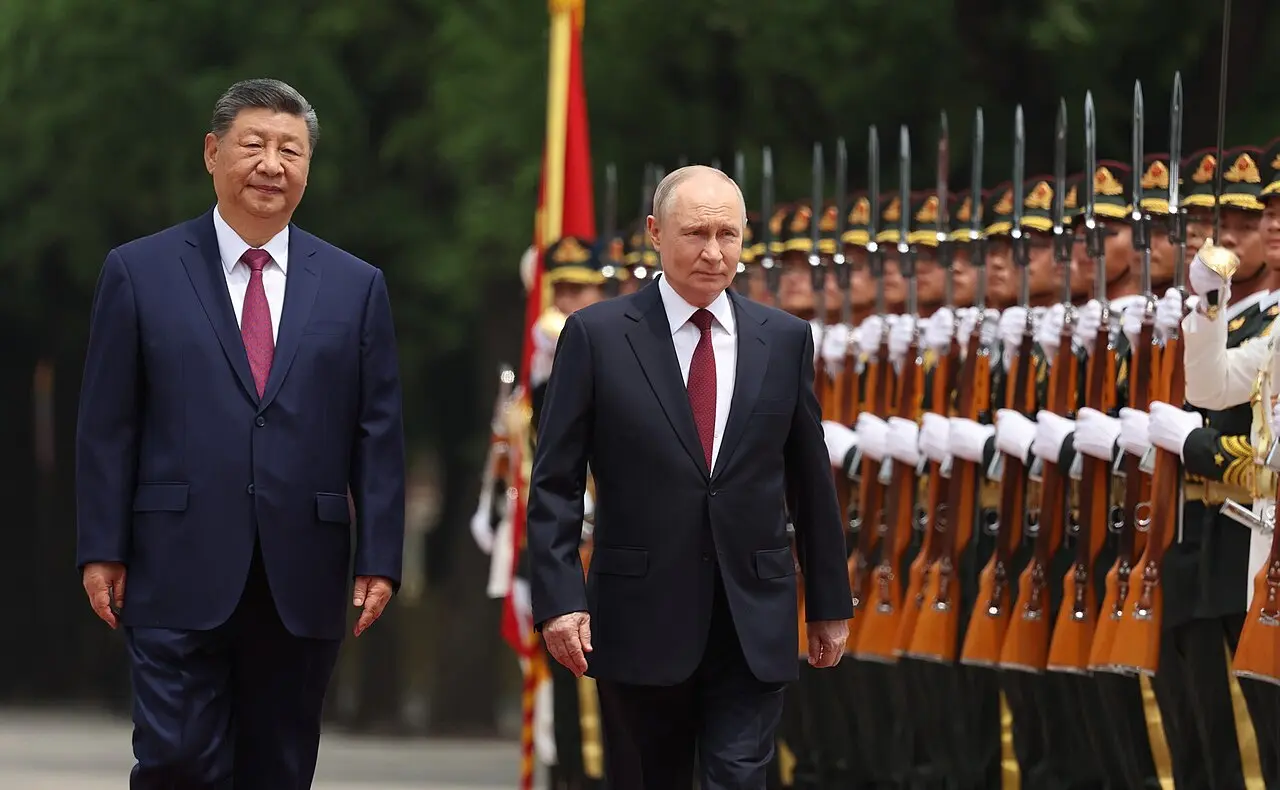
The images from the Great Hall of the People were unmistakable in their symmetry: military honours, cheering children, and two leaders projecting steadfast friendship. Just days after hosting Donald Trump, Xi Jinping welcomed Vladimir Putin for a state visit timed to mark the 25th anniversary of the 2001 Treaty of Good-Neighbourliness and Friendly Cooperation. The optics were deliberate. Beijing sought to demonstrate that China stands at the centre of global diplomacy — capable of engaging the world’s two foremost revisionist powers on its own terms, without being bound to either.
Yet beneath the ceremony lies a more nuanced reality. This summit was less about dramatic new breakthroughs and more about strategic signalling, continuity, and the careful management of asymmetry in the Sino-Russian relationship.
Signalling in the Shadow of Trump
The timing was no accident, even if both sides insisted it was long scheduled. Putin’s arrival so soon after Trump’s departure allowed Xi to project balance. With Trump, the tone was transactional and focused on trade, investment, and crisis management (Iran, Taiwan). With Putin, it was familiar, ideological, and reassuring — tea diplomacy, personal warmth, and repeated invocations of “comprehensive strategic coordination.”
The joint statement and package of roughly 20–40 agreements reaffirmed opposition to “hegemonic” behaviour, unilateral sanctions, and US missile defence plans (notably Trump’s “Golden Dome”). Both leaders warned of a world drifting toward the “law of the jungle” and positioned their partnership as a stabilising force for multipolarity.
Notably absent were major deliverables on the economic front that Russia most urgently sought. Despite expectations raised by the ongoing West Asia energy disruptions, no final breakthrough was announced on the long-stalled Power of Siberia 2 pipeline. China continues to hold the stronger negotiating position, leveraging its market power while diversifying suppliers. This pattern — Russia needing China more than the reverse — remains the defining feature of their economic ties.
Asymmetry and Strategic Calculus
The partnership is deep but not unlimited. China gains discounted energy, a reliable partner in diluting Western influence, and a useful distraction that keeps the US focused on Europe and Eurasia. Russia secures its most important economic lifeline and diplomatic cover amid isolation from the West. Yet Beijing carefully avoids actions that could trigger secondary sanctions or derail its broader economic objectives. Military cooperation advances steadily (joint exercises, technology sharing), but stops short of anything resembling a formal alliance that might compel China to choose sides in a direct US-Russia confrontation.
For Xi, the back-to-back summits reinforce a core strategic narrative: China is not aligned against the United States but is determined to shape a multipolar order where its interests are respected. Hosting both leaders in quick succession is a flex of diplomatic centrality. For Putin, the visit reassures domestic and international audiences that Russia is not isolated and maintains high-level access to its most powerful partner.
Implications for the Wider World
From an Indian perspective, the meeting reinforces the value of strategic autonomy. New Delhi benefits from a Russia that remains engaged with China (preventing total Sino-Russian alignment against India on the border or in the Indian Ocean) while continuing energy and defence cooperation with Moscow. Yet deepening Sino-Russian ties complicate India’s Quad partnerships and its border security challenges.
Taiwanese and Western observers note the contrast: Taiwan featured prominently in the Trump-Xi talks but was absent from the Putin-Xi readout, underscoring Beijing’s different priorities with each partner. Think-tank assessments across Washington, London, and Singapore highlight that while coordination on global governance, technology standards, and regional issues grows, practical limits persist — China’s economic interdependence with the West, differing threat perceptions, and Moscow’s junior status constrain how far the relationship can evolve.
What It Actually Means
This summit confirms that the Sino-Russian partnership has matured into one of the most consequential geopolitical facts of the era — a durable axis of convenience between two nuclear powers dissatisfied with the US-led order. It is not, however, an ironclad military alliance or an ideological monolith. China remains the senior partner, prioritising stability for its development goals. Russia, more revisionist and urgent, pushes for deeper alignment.
For the United States and its partners, the lesson is sobering but actionable. The relationship will endure as long as both see Washington as their primary strategic concern. Attempts to drive a wedge are likely to fail in the short term. The wiser course is to compete vigorously on technology, supply chains, and alliances while avoiding actions that push Beijing and Moscow even closer together.
In Beijing this week, Xi and Putin did not rewrite the global order. They reinforced an existing one — fragmented, competitive, and defined by overlapping networks rather than rigid blocs. In such a world, middle powers like India, and even the United States, retain considerable agency if they pursue clear-eyed, interest-based diplomacy rather than grand ideological confrontations.
The real test will come not in grand declarations, but in whether this partnership delivers tangible strategic gains for both sides — or exposes the limits of a relationship built more on shared grievances than aligned visions for the future. For now, continuity, not transformation, defines the outcome.