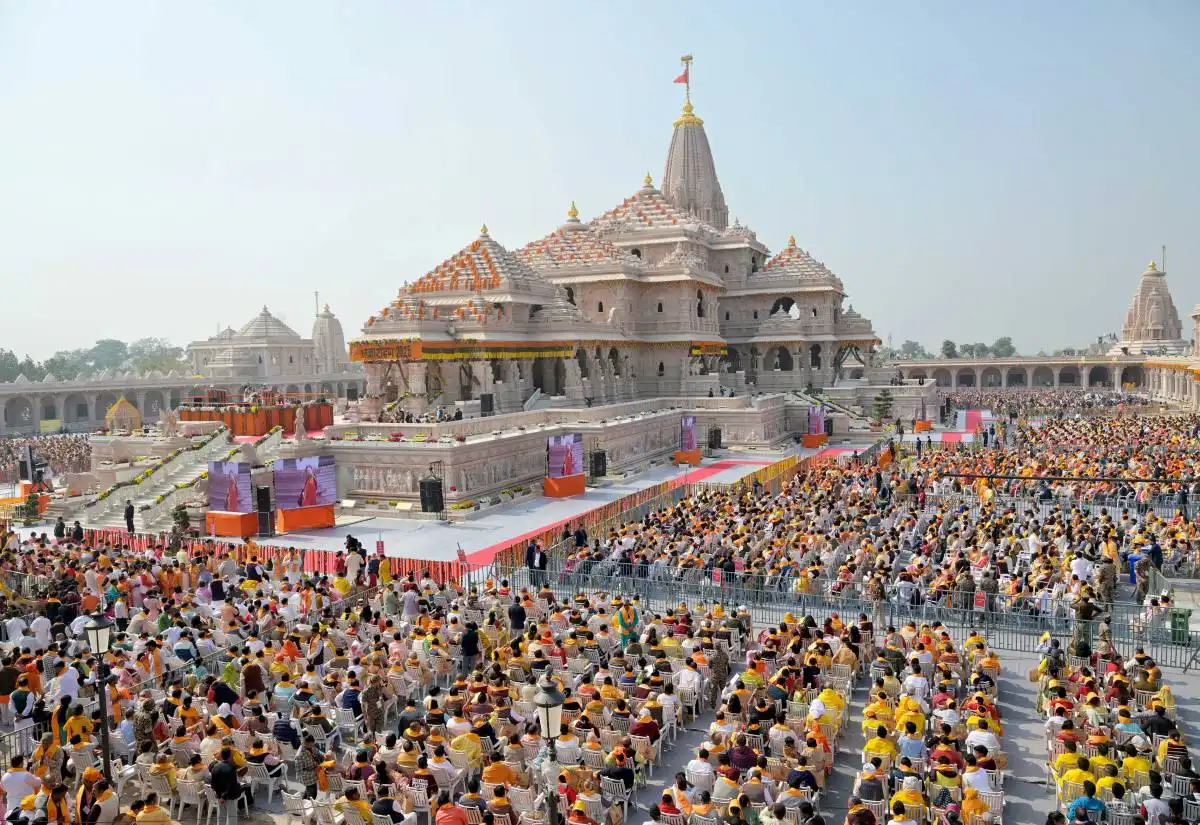
For more than five centuries, the dusty town of Ayodhya in Uttar Pradesh has been a crucible of Hindu yearning and Muslim grievance. At its heart lies a plot of land claimed as the birthplace of Lord Ram, the ideal king and avatar of Vishnu whose epic tale in the Ramayana still shapes the moral imagination of hundreds of millions. In January 2024, that longing appeared fulfilled with the consecration of a grand Ram Temple, a gleaming sandstone edifice that many Hindus regard as the triumphant resolution of a historic wrong. Yet even as devotees throng its halls—often more than 100,000 daily—the temple’s management now faces allegations of serious financial irregularities, prompting a Special Investigation Team (SIT) probe that has cast an unwelcome shadow over what was meant to symbolise national renewal.
The dispute’s roots stretch back to 1528, when a Mughal commander, Mir Baqi, is said to have built the Babri Masjid on the orders of Emperor Babur. Hindu tradition holds that the mosque was erected atop a temple marking Ram’s janmabhoomi (birthplace). Evidence for a prior temple remains contested among historians, but the belief took deep hold. By the 19th century, tensions were evident. In 1853 and 1855, clashes occurred. The British colonial authorities responded in 1859 by erecting a fence, allowing Muslims prayer inside the mosque and Hindus worship on a platform outside. Legal skirmishes began in earnest in 1885, when a Hindu mahant sought to build on adjacent land.
The modern political phase ignited after independence. On the night of 22-23 December 1949, Hindu activists placed idols of Ram Lalla inside the mosque, claiming divine intervention. The site was locked, declared disputed, and placed under government control. Litigation dragged on for decades. In the 1980s, the Vishva Hindu Parishad (VHP) and Bharatiya Janata Party (BJP) revived the campaign for a Ram Temple as a centrepiece of Hindu cultural resurgence. The movement gathered momentum under leaders like L.K. Advani, whose 1990 rath yatra (chariot procession) across India inflamed passions.
The climax came on 6 December 1992. A rally organised by the VHP and BJP drew some 150,000 kar sevaks (volunteers) to Ayodhya. What began as a symbolic protest turned into a frenzied demolition: the mob tore down the Babri Masjid with hammers, pickaxes, and bare hands while authorities largely stood by. The event triggered some of India’s worst communal violence since Partition. Riots swept the country, killing at least 2,000 people, mostly Muslims, with particularly horrific episodes in Mumbai. The demolition boosted the BJP’s electoral fortunes but left deep scars. It also led to criminal cases against senior BJP and VHP figures, though many were later acquitted or the cases faded.
For years, the site remained a legal battleground. In 2010, the Allahabad High Court divided the land three ways—a Solomonic but unsatisfactory verdict. Appeals reached the Supreme Court. In a landmark unanimous judgment on 9 November 2019, the court ruled that the disputed 2.77 acres should go to Hindus for a temple, citing archaeological evidence suggestive of a prior non-Islamic structure beneath the mosque. Muslims received a compensatory five-acre plot elsewhere in Ayodhya for a new mosque. The court emphasised that the demolition had been illegal but prioritised possession and faith over strict title in this exceptional case.
The government swiftly formed the Shri Ram Janmabhoomi Teerth Kshetra Trust in February 2020 to oversee construction and management. Designed in the traditional Nagara style by architect Chandrakant Sompura and his son, the temple rises 161 feet (about 49 metres) without iron or steel, engineered to last millennia. Pink sandstone from Rajasthan and other materials were sourced with care. The broader 70-acre complex includes halls, gardens, and facilities. Prime Minister Narendra Modi presided over the prana pratishtha (consecration) of the Ram Lalla idol on 22 January 2024, an event watched by millions and framed by the ruling BJP as the dawn of a “new India” confident in its civilisational heritage.
Funding came overwhelmingly from public donations rather than government coffers—fitting for a project steeped in bhakti (devotion). By early 2024, the trust had received over ₹3,500 crore (around $420 million at the time), exceeding the estimated ₹1,800 crore construction cost. Offerings poured in: cash, gold, silver, diamonds, and jewellery from devotees across India and the diaspora. Daily collections during peak periods reached lakhs of rupees. The temple became not only a religious beacon but an economic engine for Ayodhya, boosting tourism, hotels, and local commerce.
Yet abundance invites temptation. In mid-2025, particularly during the Maha Kumbh Mela period when crowds swelled to nearly 10 lakh devotees daily, concerns surfaced about the handling of donations. Allegations of large-scale embezzlement—initially pegged at ₹5-7.5 crore but reportedly escalating in public discourse to claims involving ₹200 crore or more in cash and valuables—began circulating. Opposition parties, notably the Samajwadi Party of Akhilesh Yadav and the Aam Aadmi Party, accused the trust of opacity, inflated land purchases, and irregularities in procurement of building materials. They pointed to land deals allegedly transacted well above market rates.
On 13 June 2026, at the trust’s own request, the Uttar Pradesh government—led by the assertive Chief Minister Yogi Adityanath, a Hindu monk turned politician—constituted a three-member SIT. Comprising Lucknow Divisional Commissioner Vijay Vishwas Pant, Inspector General of Police Kiran S, and Finance Department Special Secretary Neel Ratan, the team descended on Ayodhya. Their mandate extended beyond donations to scrutinise land acquisitions and material procurement.
Investigators found discrepancies in the documentation and accounting of gold, silver jewellery, diamonds, and other precious items offered to Lord Ram. Temple functionaries reportedly struggled to provide satisfactory explanations for inventory, storage, and records. During the Kumbh influx, donation boxes filled rapidly with currency notes, overwhelming monitoring systems. Some reports mentioned tampered CCTV footage during counting. The SIT instructed trust officials and temple functionaries not to leave Ayodhya before completing its work. Daily updates flowed to the Chief Minister’s office. By late June 2026, the probe had reportedly recovered around ₹2 crore in cash and gold from certain individuals, with up to 150 names under scrutiny and potential action against senior trust figures, including calls for changes in management.
The trust has maintained that no major fraud occurred and that internal audits were routine, framing the inquiry as a proactive step for transparency. Mr Adityanath has urged patience, warning against politicisation that could hurt devotees’ sentiments, and invited anyone with evidence to come forward. Yet the scandal has handed ammunition to critics who argue that the temple project, once a unifying cultural symbol, has become entangled in the familiar webs of patronage and lax oversight that plague many Indian institutions. Questions linger about oversight of vast unaccounted cash flows in a high-traffic pilgrim site.
This episode is more than administrative embarrassment. It revives older debates about the Ram movement’s trajectory. For the BJP, the temple fulfilled a long-standing promise that helped consolidate its Hindu-majority base. Electoral success followed in Uttar Pradesh and nationally. Yet the shift from agitation to governance has exposed the challenges of managing faith-based assets on an industrial scale. Previous accusations of misuse of earlier Ram donations by VHP-linked groups resurfaced in public memory.
For India’s Muslims, the temple’s rise—following the mosque’s fall—symbolises marginalisation, despite the Supreme Court’s compensatory land. Many have moved on, focusing on education and economic integration, but underlying wariness persists. The current scandal, while internal to Hindu institutions, risks further politicisation along communal lines if opposition parties frame it as proof of broader hypocrisy.
Ayodhya today presents a study in contrasts: a magnificent temple complex rising amid saffron flags and devotional chants, yet probed by investigators poring over ledgers and questioning priests and trustees. The SIT’s report, expected soon, will test the commitment to accountability in a project meant to exemplify Ram Rajya—the just and prosperous rule associated with Lord Ram. Whether the irregularities prove to be the work of a few bad actors or symptoms of deeper systemic failings, the episode underscores an eternal truth: even the most sacred endeavours, when they intersect with immense sums of money and political power, demand rigorous secular safeguards. The devotees who flock to Ayodhya seek darshan of the divine. They—and India’s broader public—also deserve assurance that their offerings support piety, not pilferage.
The resolution of this scandal will not erase the temple’s historical and emotional significance, but it may determine whether the monument stands as an unblemished beacon or one forever marked by the frailties of its earthly custodians. As the probe concludes and reports reach the Chief Minister’s desk, Ayodhya’s latest chapter reminds observers that faith can move mountains—and sometimes invite those who would chip away at the foundations for personal gain.