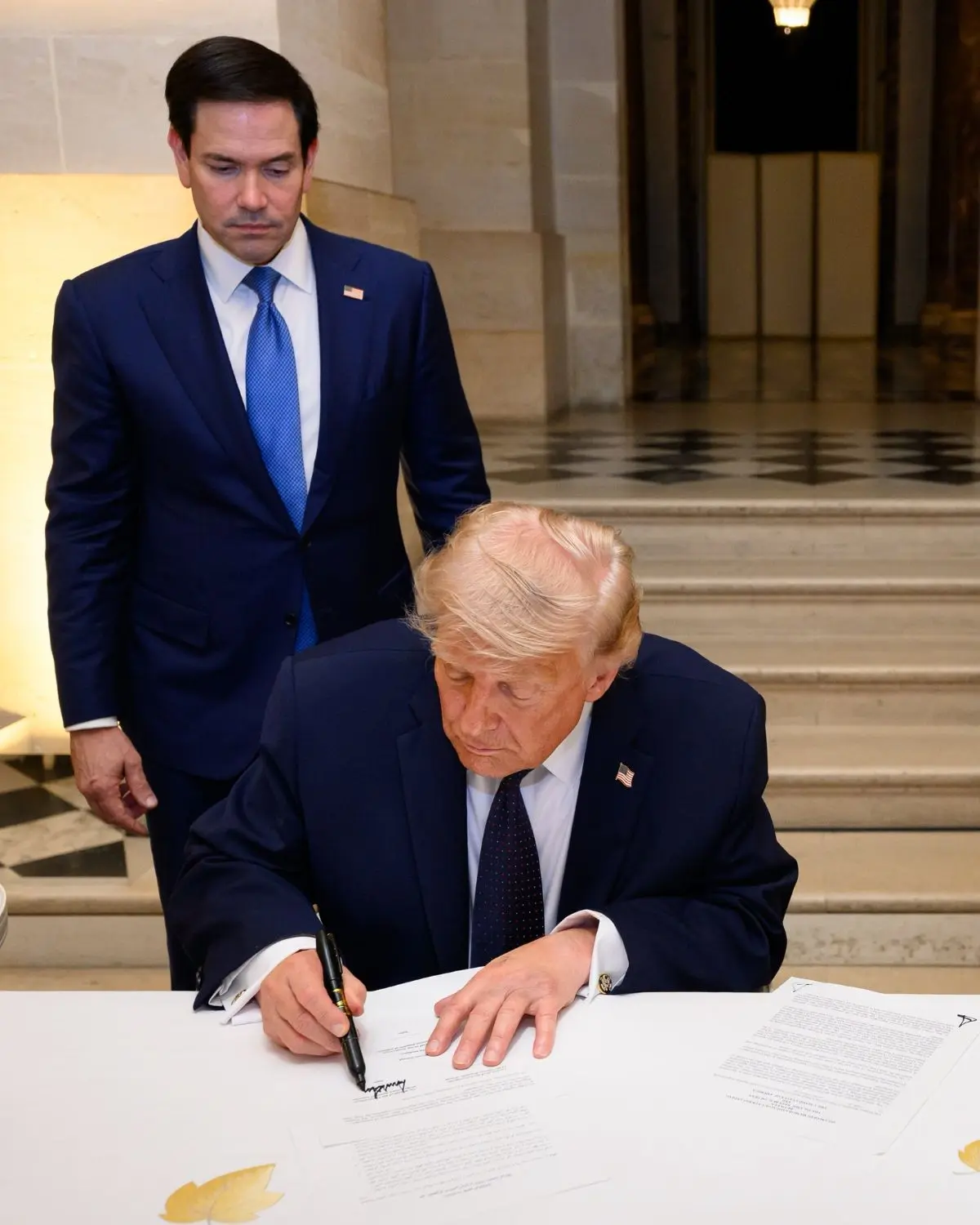
The United States and Iran have signed a 14-point memorandum of understanding to bring an immediate end to their recent military conflict and reopen the Strait of Hormuz to international shipping.President Donald Trump and Iranian President Masoud Pezeshkian signed the document on Wednesday. Mr Trump put his name to it during a dinner at the Palace of Versailles in France after the G7 summit, while Mr Pezeshkian signed in Tehran. The memorandum, dubbed as the Islamabad Memorandum after mediation by Pakistan, took effect immediately.
The agreement declares an immediate and permanent end to military operations on all fronts, including Lebanon. It sets a 60-day period for further talks on a final deal covering sanctions, Iran’s nuclear programme and other economic issues. A final agreement would need approval by the United Nations Security Council.
Under the terms, Iran will gradually reopen the Strait of Hormuz to commercial vessels, while the United States will lift its naval blockade of Iranian ports. Iran has committed not to produce or obtain nuclear weapons during this initial period and will engage in dialogue with Oman and other Gulf states on the future administration of the strait in line with international law. The United States will issue waivers allowing Iran to export oil.
The memorandum also provides for work towards a $300 billion reconstruction fund for Iran, to be developed with regional partners as part of later negotiations. Both sides have agreed to set up a mechanism to monitor how the terms are carried out. It includes the possible release of frozen Iranian assets, estimated at up to $24 billion, depending on compliance.
The deal does not include the immediate full lifting of all sanctions or detailed limits on Iran’s missile programme. Those issues are left for the 60-day talks, which can be extended if both sides agree.
After the signing, Mr Trump told reporters: “It’s signed.” He added: “I signed it in Versailles.” He later described the agreement as a step towards peace and said ships could now move through the strait. He claimed it would bring “Success, Lower Oil Prices, and Victory” for the United States.
Iranian President Masoud Pezeshkian welcomed the agreement as a “historic document”.
“This is a historic document and a message from a powerful Iran: peace will be achieved in the shadow of mutual respect,” he wrote on X. He added that the Islamic Republic remained committed to global peace while preserving its dignity and independence, as well as to progress and regional cooperation.
A senior Iranian official said the deal would allow the country to sell oil and petrochemical products again. Iran’s supreme leader authorised the signing despite holding a different view on some points.
French President Emmanuel Macron, who hosted the dinner at Versailles, welcomed the move. He described it as a step towards stability in the region.
Israel reacted with strong criticism. Prime Minister Benjamin Netanyahu said his country would not accept any deal that left Iran able to develop nuclear weapons. “With an agreement or without an agreement, Iran will not have nuclear weapons — not today and not tomorrow,” he declared. “As long as I am prime minister of Israel, it will not happen.” He vowed to keep security zones in Lebanon, Gaza and Syria and said Israel was not bound by the agreement, stressing that “Israel is not a party to this agreement” and would continue to act independently to defend its security.
The memorandum comes after a period of intense fighting that closed the strait and disrupted global oil supplies. Shipping traffic through the strait has already begun to increase. Both sides say they will now begin technical work to put the terms into effect. The agreement follows months of conflict that began earlier this year. It aims to restore the flow of oil through the narrow waterway that carries about one-fifth of the world’s oil supply.
Under the initial terms, Iran must allow commercial vessels to pass freely. The United States has agreed to end its naval restrictions on Iranian ports, enabling ships to enter and leave without blockade. Technical teams from both countries are expected to meet soon to work out details of oil exports and sanctions waivers.
The 60-day period gives time for deeper discussions on Iran’s nuclear activities, including limits on uranium enrichment and the removal or dilution of stockpiles. Regional partners, including Oman, will take part in talks about long-term management of the Strait of Hormuz. The memorandum stresses respect for international law and the rights of coastal states.
The signing marks a significant diplomatic step after weeks of high tensions. Officials on both sides described the document as a framework for peace rather than a complete solution. European reactions have been largely positive but cautious. Leaders have called for full implementation and continued dialogue to build lasting peace.
French President Emmanuel Macron, who hosted the signing at Versailles, said: “This agreement paves the way for lasting peace and allows the reopening of the Strait of Hormuz. It is an important step in the right direction.”
European Commission President Ursula von der Leyen welcomed the agreement and stressed: “The priority now is its swift and full implementation by all parties.”
UK Prime Minister Keir Starmer called for full implementation, saying attention must now turn to ensuring the Strait remains “fully and permanently open” while details of the nuclear agreement are finalised.
Both governments have urged calm as the agreement takes hold.
Speaking after the signing at Versailles, Trump told reporters: “If they behave, it’s going to be very good. We want peace. Let’s give it a chance.” He added that the focus now should be on implementation and lowering oil prices for the benefit of the world economy.
In Tehran, Iranian President Pezeshkian called for national unity and restraint, stating that the agreement should be implemented “with wisdom and patience” while Iran monitors compliance. A senior Iranian official emphasised that both sides must now “avoid any provocative actions” during the 60-day negotiation period.
Further negotiations will decide the full scope of sanctions relief and economic measures. Shipping companies are watching developments closely, with several vessels already preparing to resume routes through the strait in the coming days.
“We welcome the agreement but safety remains our top priority,” The New York Times quoted Vincent Clerc, CEO of Maersk, as saying. “We need clear evidence of sustained stability and de-mining progress before we can fully resume normal operations.”