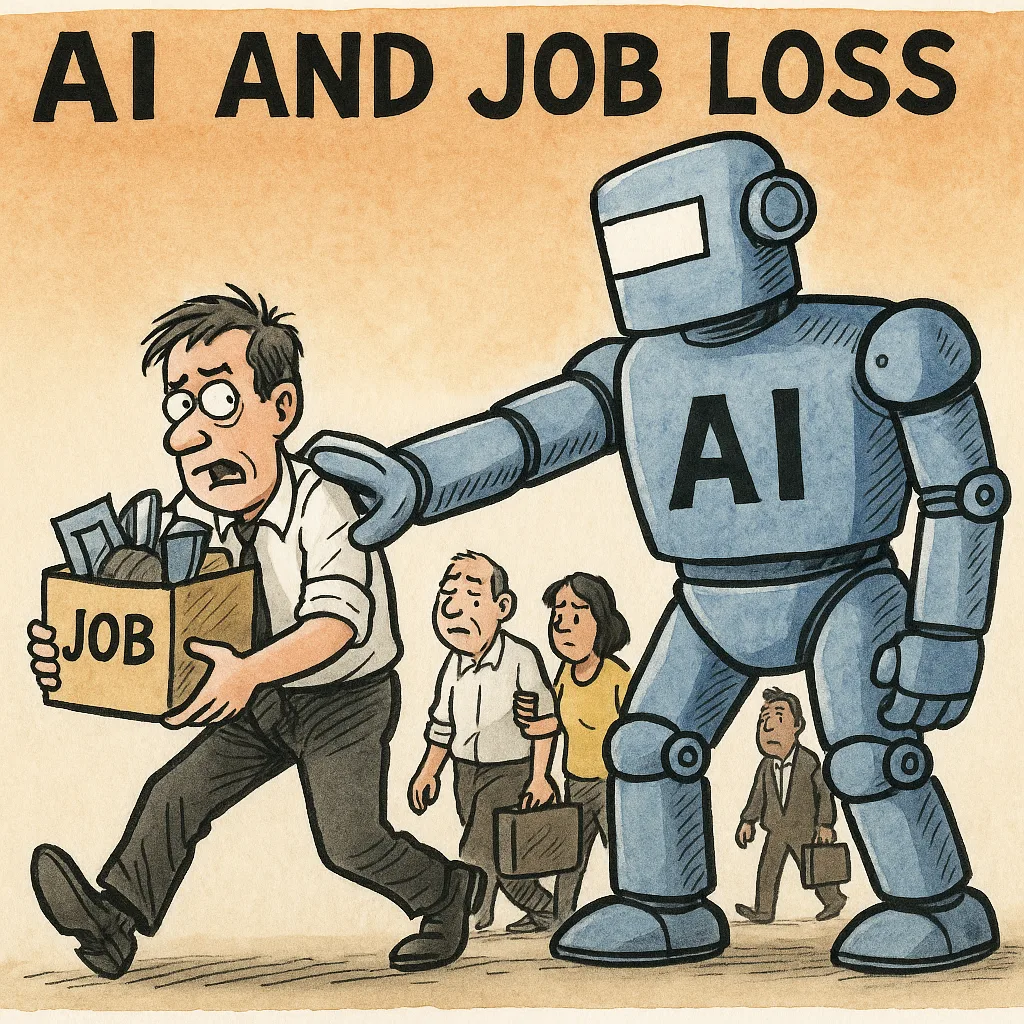
As Artificial Intelligence rapidly reshapes global industries, a sweeping wave of job cuts is disrupting lives and futures at a pace unseen since the dot‑com collapse and the 2008 financial meltdown. The very technology that promises efficiency and innovation is fast becoming a force of economic displacement, displacing hundreds of thousands of workers across continents—particularly in the IT sector—while offering little refuge to those already employed.
In India, once hailed as the global back office of technology services, Tata Consultancy Services (TCS), Infosys, Wipro and HCLTech—giants that powered the digital revolution—are laying off employees by the thousands. While executives publicly claim the cuts are part of “strategic workforce realignment,” internal memos and leaked HR documents reveal a more sobering reality: automation and AI adoption are directly replacing mid‑level coders, testers and support engineers at scale.
Ruthless Optimization
“It was brutal,” said a 36‑year‑old TCS employee who requested anonymity. “One morning, we were told our roles were redundant. No prior warning, no upskilling. Just a forced exit.” He was among nearly 3,000 employees let go over a span of six months—a figure corroborated by IT workers’ unions and internal sources.
In the United States, job cuts in the tech sector are nearing a three‑year high. According to Challenger, Gray & Christmas, tech companies have eliminated over 260,000 jobs since January 2023—with projections suggesting another 150,000 could be cut by mid‑2026. Companies including Google, Meta, Amazon, IBM, Microsoft and Salesforce have all cited “efficiency” as a rationale, a euphemism increasingly interpreted as cost cutting driven by AI.
“AI is no longer an experiment. It’s deployment‑ready and it’s replacing humans,” said Michael Ryan, labor economist at the Brookings Institution, in comments to The Wall Street Journal. “Any role that is pattern‑based, repeatable and reliant on large datasets is now under threat.”
The Surge of Generative AI
The acceleration came after OpenAI’s GPT‑4 model and its successors outperformed human benchmarks in a wide range of cognitive tasks. McKinsey estimates that generative AI could automate tasks accounting for 60–70 percent of time spent by knowledge workers—from writing code and producing content to handling customer service, compliance and legal research.
According to a 2024 World Economic Forum report, 83 million jobs may disappear globally by 2030, while 69 million new ones will be created, leaving a net loss of 14 million. The displacement, however, is immediate and unbalanced—while opportunities demand new skills, layoffs are targeting those with outdated ones.
Corporations Chase Profits, Not People
Despite repeated calls for responsible AI deployment, corporations are pushing for leaner, AI‑augmented teams with a laser‑sharp focus on quarterly profits.
“Investors are rewarding tech companies that reduce their workforce,” said financial analyst Priya Sharma, speaking to The Economic Times. “This has become the new metric of success: cut costs, show productivity gains through AI—never mind the human toll.”
Amazon reportedly saved nearly $2.5 billion in annual wages through automation between 2023 and 2025, replacing warehouse workers, call‑center agents and marketing teams with AI solutions. Meta and Microsoft have reported similar savings while diverting capital toward AI infrastructure.
A Tale of Two Futures
Yet for fresh graduates from top-tier universities, the outlook is not all grim. Institutes offering AI and machine‑learning programs have seen 2×–3× salary hikes in placement packages. “We’ve placed over 85 percent of our students in AI roles across Europe, the U.S. and Southeast Asia,” said Dr. Lakshmi Rao, director of IIIT‑Hyderabad’s AI program, in an interview with Mint.
Startups in healthcare, fintech and logistics are recruiting aggressively, especially for prompt engineers, data scientists and AI product managers. Venture capital funding for AI startups crossed $60 billion in 2024 alone, according to Crunchbase.
But this optimism masks a deeper structural divide. “Those who have the skills are flying. The rest are falling off a cliff,” said Bengaluru-based job‑transition consultant Arun Mahadevan, speaking with The Times of India. “This is creating a techno‑elitism where only the AI‑literate will thrive.”
Psychological Fallout
Beyond economic loss, the emotional and mental toll is mounting. According to a joint survey by Deloitte and NASSCOM, 72 percent of laid‑off tech workers reported high levels of anxiety and depression—many facing prolonged unemployment despite years of experience.
“I have worked for 17 years. Suddenly I’m being told my experience is a liability, not an asset,” said a 42‑year‑old ex‑Wipro developer in an email to The Economic Times. “Companies want 25‑year‑olds with AI degrees—not us.”
Suicides linked to IT job losses have surfaced in Hyderabad and Pune, triggering calls for government intervention and corporate accountability.
Governments Wake Up, Slowly
Facing mounting pressure, India’s IT Ministry told Hindustan Times it is “keeping close watch” on the TCS layoffs and engaging with the company for explanations. Critics, however, say the response is insufficient.
“The state has no long‑term roadmap for AI‑induced disruption,” said labor rights expert Dr. Kunal Sen in comments to The Hindu. “Where are the retraining programmes, wage support schemes and job‑matching systems?”
In the United States, the Trump administration has issued executive orders on AI innovation and security, but has yet to unveil a comprehensive retraining program for displaced workers. Meanwhile, European Union officials have pledged an “AI Adaptation Fund,” but distribution remains stalled amid bureaucratic obstacles.
Ethical Questions Mount
The mass layoffs have revived debates about the ethical deployment of automation and AI. “Companies are pursuing efficiency at the cost of human dignity,” said Timothée Legrand, UN special rapporteur on human rights and automation, during testimony to the UN Human Rights Council. “There’s no social contract here—just the cold calculus of profit.”
Some firms have begun responding. Salesforce CEO Marc Benioff, in remarks to The Guardian, pledged not to eliminate jobs for AI‑led restructuring until 2027. But such commitments remain exceptions, not the norm.
Future at a Crossroads
The world stands at a historic inflection point. The AI revolution may eventually lift productivity, transform healthcare, democratize education and create entirely new industries—but the short‑term dislocation is brutal, indiscriminate and largely unmitigated.
“We are witnessing the end of the industrial‑era job model,” said futurologist Elena Grunewald, in an op‑ed for Foreign Policy. “Work, as we know it, is being unbundled. Either societies adapt with empathy and innovation—or we face a prolonged era of techno‑driven inequality and unrest.”
For millions, the promise of progress now feels like a sentence. Whether they find their footing in this new world depends not only on their skills but on how society chooses to distribute the burdens and benefits of its brightest innovations.