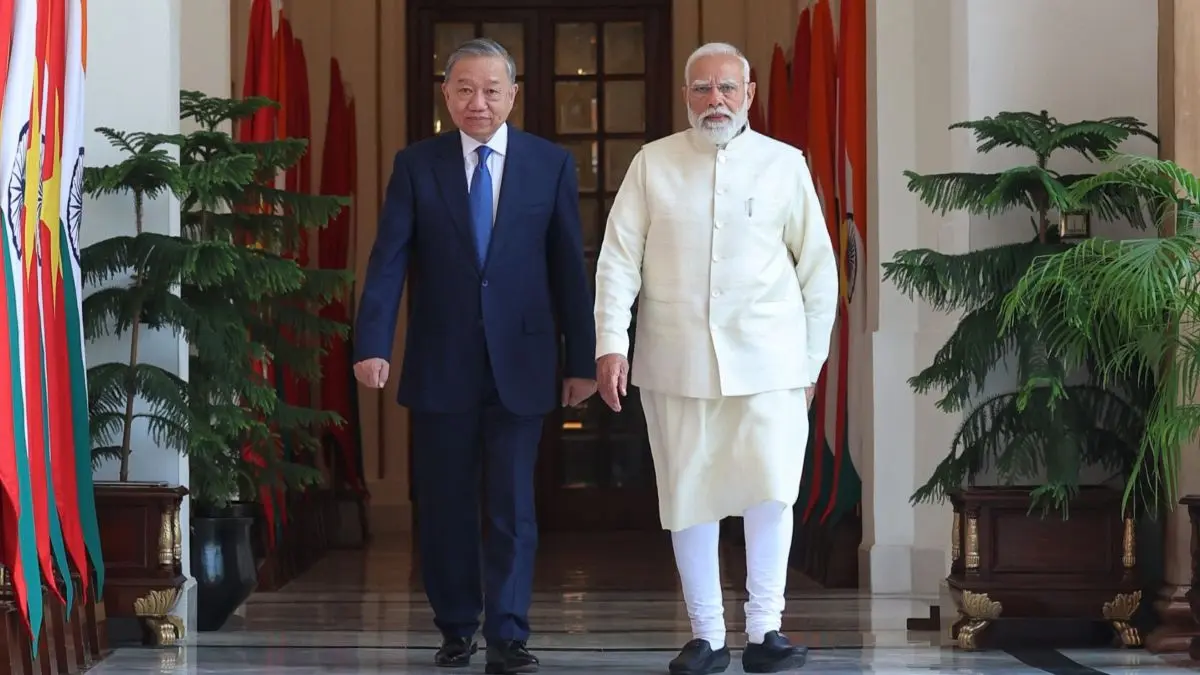
In the pantheon of diplomatic upgrades, “Enhanced Comprehensive Strategic Partnership” sounds like typical bureaucratic inflation. Yet the elevation of ties between India and Vietnam on May 6th carries more substance than the label suggests. As both countries mark the tenth anniversary of their original Comprehensive Strategic Partnership, the latest agreements signal a pragmatic convergence of economic ambition and geopolitical caution in an Indo-Pacific region increasingly defined by Chinese assertiveness and supply-chain fragility.
The headline numbers are eye-catching for investors: a target of $25bn in bilateral trade by 2030, roughly 50% above current levels, backed by 13 new agreements and a broader package of 18 outcomes. Critical minerals top the list. An MoU between India’s IREL and Vietnam’s rare-earths institute is more than symbolic. Vietnam holds some of the world’s largest reserves of these materials, vital for electric vehicles, wind turbines and defence electronics. For India, the pact offers a route to diversify away from China-dominated processing chains. For Vietnam, it promises technology transfer and downstream investment rather than raw export dependence.
Digital and financial connectivity add practical ballast. Linking India’s UPI with Vietnam’s NAPAS system and broader payment innovations will ease commerce for the growing number of Indian firms eyeing Vietnamese manufacturing bases. Pharmaceutical regulatory alignment and agricultural protocols (Indian grapes and pomegranates heading to Vietnam, Vietnamese durians the other way) deliver quick commercial wins. Tourism, cultural exchanges and sister-city ties between Mumbai and Ho Chi Minh City round out the people-to-people layer that often underpins longer-term trust.
Geostrategic calculus
The real significance lies in the strategic domain. Both nations share a deep wariness of Beijing’s maritime claims in the South China Sea, where Vietnam has repeatedly clashed with Chinese vessels. India, for its part, has watched Chinese influence expand in its neighbourhood and the Indian Ocean. The upgraded partnership strengthens a web of middle-power alignments—alongside the Quad, India’s Act East policy, and Vietnam’s own hedging diplomacy—that seeks to preserve a rules-based order without forcing smaller states into outright bloc confrontation.
Defence cooperation is advancing cautiously but meaningfully. Progress on submarine search-and-rescue, existing lines of credit, and reported discussions over BrahMos supersonic cruise missiles (potentially making Vietnam only the third Southeast Asian operator after the Philippines and Indonesia) matter. These are not alliance commitments but capability enhancers that raise the cost of adventurism for any aggressor. Vietnam gains credible maritime deterrence; India gains a foothold in defence exports and operational familiarity in a key sub-region.
Energy and technology add another dimension. Cooperation in renewables, possible oil and gas exploration, and emerging talks on artificial intelligence and cybersecurity position the duo as players in the “friendshoring” of strategic sectors. In a world where critical minerals, semiconductors and secure data flows increasingly define power, India and Vietnam are quietly building redundancy.
Future trajectory and realism
Optimists see the seeds of a broader Indo-Pacific supply-chain architecture. A more integrated India-Vietnam axis could attract Western and Japanese investment seeking alternatives to China-plus-one strategies. ASEAN-India maritime cooperation in 2026 provides an additional multilateral hook. Diplomats in Washington, Tokyo and Brussels will view this as a welcome diversification of strategic partnerships in Southeast Asia.
Yet sober analysis demands caveats. Trade targets are aspirational; implementation has historically lagged. Bureaucratic hurdles, differing regulatory cultures and infrastructure gaps could blunt momentum. Vietnam’s “bamboo diplomacy” means it will continue balancing relations with China—its largest trading partner—while deepening ties with India. New Delhi, likewise, must manage its own complex relationship with Beijing. Over-hyping the partnership risks provoking exactly the pushback both sides wish to avoid.
For investors, the opportunities are tangible in minerals processing, pharmaceuticals, fintech and defence-adjacent manufacturing, but patience and local partnerships will be essential. For policymakers and strategists, this is another data point in the slow reconfiguration of Asian order: not loud containment, but incremental, resilient hedging by capable middle powers.
The pact between New Delhi and Hanoi illustrate how shared vulnerabilities—maritime insecurity, supply-chain concentration and technological dependence—are forging pragmatic alliances. In the messy geopolitics of the 2020s, quiet convergence may prove more durable than grand declarations. The coming years will test whether rhetoric on “shared vision and strategic convergence” can be translated into the supply chains, capabilities and habits of cooperation that matter when pressure rises.