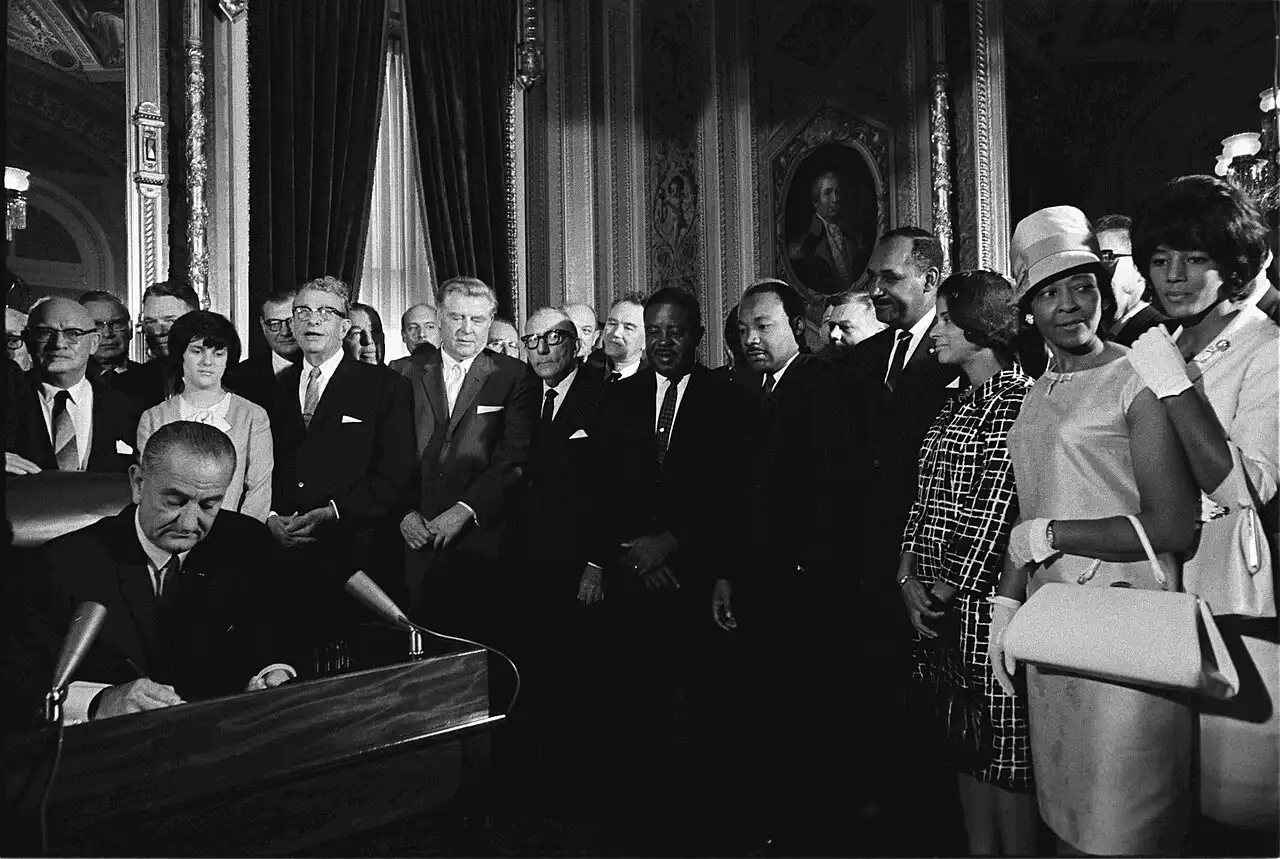
Few pieces of legislation have reshaped a democracy as profoundly as America’s Voting Rights Act. Signed into law by President Lyndon B. Johnson on August 6, 1965, at the height of the civil-rights struggle, the Act stands as one of the most effective federal interventions in the country’s history. It marked the moment when the world’s leading democracy finally began to make good on its promise of equal political participation for Black citizens, nearly a century after the abolition of slavery. Its story is one of dramatic progress, fierce resistance, and ongoing legal erosion.
The long shadow of exclusion
To understand the Act’s importance, one must grasp the scale of the problem it sought to solve. The 15th Amendment, ratified in 1870 after the Civil War, prohibited denying the vote on account of race. In the Reconstruction era that followed, Black men in the South briefly gained political power, electing congressmen and state legislators. But white Southern elites soon reclaimed dominance through violence, intimidation, and legal ingenuity.
By the early 20th century, most Southern states had erected formidable barriers: poll taxes (fees to register or vote), literacy tests (often administered subjectively by white officials), grandfather clauses (exempting those whose ancestors could vote before 1867, thus favouring whites), and restrictive residency or property rules. These were supplemented by the “white primary” (excluding Blacks from Democratic contests that effectively decided elections in one-party South) and outright terror by groups such as the Ku Klux Klan. In Mississippi, Black voter registration plummeted to below 7% in some periods; in Alabama, it hovered around 19% as late as the early 1960s. The result was near-total disenfranchisement despite constitutional guarantees.
These practices, collectively known as Jim Crow laws (after a racist caricature), endured because earlier federal efforts—court cases and narrower laws—proved inadequate. States simply devised new schemes faster than lawsuits could dismantle them.
The crucible of 1965
The catalyst came in Selma, Alabama, in March 1965. Peaceful marchers demanding voting rights were brutally attacked by state troopers on the Edmund Pettus Bridge in an event broadcast nationwide as “Bloody Sunday”. The outrage galvanised Congress and the White House. President Johnson, a master legislator from Texas, pushed through sweeping legislation. The Voting Rights Act banned discriminatory tests and devices outright. It authorised federal examiners to register voters directly in resistant areas. Most innovatively, it introduced Section 5 preclearance: jurisdictions with the worst histories of discrimination (identified by a coverage formula in Section 4 based on 1960s turnout and test usage) had to obtain federal approval before changing any voting rules. This shifted the burden from reactive litigation to proactive prevention.
The impact was swift. Within months, hundreds of thousands of new Black voters registered. By the late 1960s, Black registration in the South had roughly doubled. Black elected officials began appearing at local and state levels.
Evolution and expansion
Congress renewed and strengthened the Act several times. The 1975 amendments extended protections to language minorities (such as Hispanic, Asian-American, and Native American voters) and required bilingual ballots in certain areas. The 1982 renewal, passed over President Ronald Reagan’s initial reservations, clarified Section 2: it prohibited not only intentional discrimination but also practices that had a discriminatory effect, judged by the “totality of circumstances”. This allowed challenges to vote dilution—for instance, drawing electoral districts that “cracked” minority communities across multiple seats or “packed” them into few overwhelmingly safe ones, minimising their overall influence.
A landmark Supreme Court case, Thornburg v. Gingles (1986), established a three-part test for such dilution claims, focusing on minority population size and compactness, political cohesion, and the ability of the white majority to defeat minority-preferred candidates. For decades, this framework enabled courts to order remedial maps, often creating “opportunity districts” where minorities could elect their chosen representatives.
Judicial retrenchment
Success bred backlash. Critics, particularly on the political right, argued the Act had become race-conscious in ways that violated colour-blind principles and encouraged gerrymandering. In a series of rulings, the Supreme Court—especially under Chief Justice John Roberts—has pared back its reach.
The pivotal blow came in Shelby County v. Holder (2013). The Court struck down the coverage formula as outdated, effectively neutering preclearance. “Things have changed dramatically,” the majority declared, citing improved registration rates. Freed from federal oversight, several Southern states promptly passed stricter voter-ID laws, reduced early voting, or purged rolls—measures supporters called integrity safeguards and opponents viewed as targeted suppression. Studies showed subsequent widening of racial turnout gaps in previously covered areas.
Section 2 survived longer. In Allen v. Milligan (2023), the Court upheld its use to challenge Alabama’s congressional map, requiring a second Black-opportunity district. Yet even this provision has narrowed. In Brnovich v. Democratic National Committee (2021), the justices made vote-denial claims (challenging rules like ballot collection limits) harder to win. More recently, in Louisiana v. Callais (2026), the Court further restricted Section 2’s application to redistricting, emphasising limits on race-based map-drawing and casting doubt on remedies once seen as standard.
Enduring significance—and debate
The Act’s legacy is measurable. Black voter registration and turnout soared; Black representation in Congress and statehouses grew. Scholars link it to better public services in minority areas and broader policy shifts. For international observers, it highlights America’s federal tensions: a powerful national tool overriding state autonomy to enforce constitutional rights, versus arguments for local control and against “proportional representation” by race.
Critics contend it outlived its emergency justification, fostering division by treating race as central to districting. Defenders counter that racially polarised voting patterns persist, and without robust safeguards, subtle dilution or new barriers can achieve old ends. Mid-decade map fights in Southern states underscore the stakes.
Sixty years on, the Voting Rights Act remains a living battleground. Its history illustrates both the fragility of democratic gains and the persistent American struggle to reconcile majority rule with minority protections. For a republic founded on “We the People,” ensuring that phrase includes all remains unfinished work.