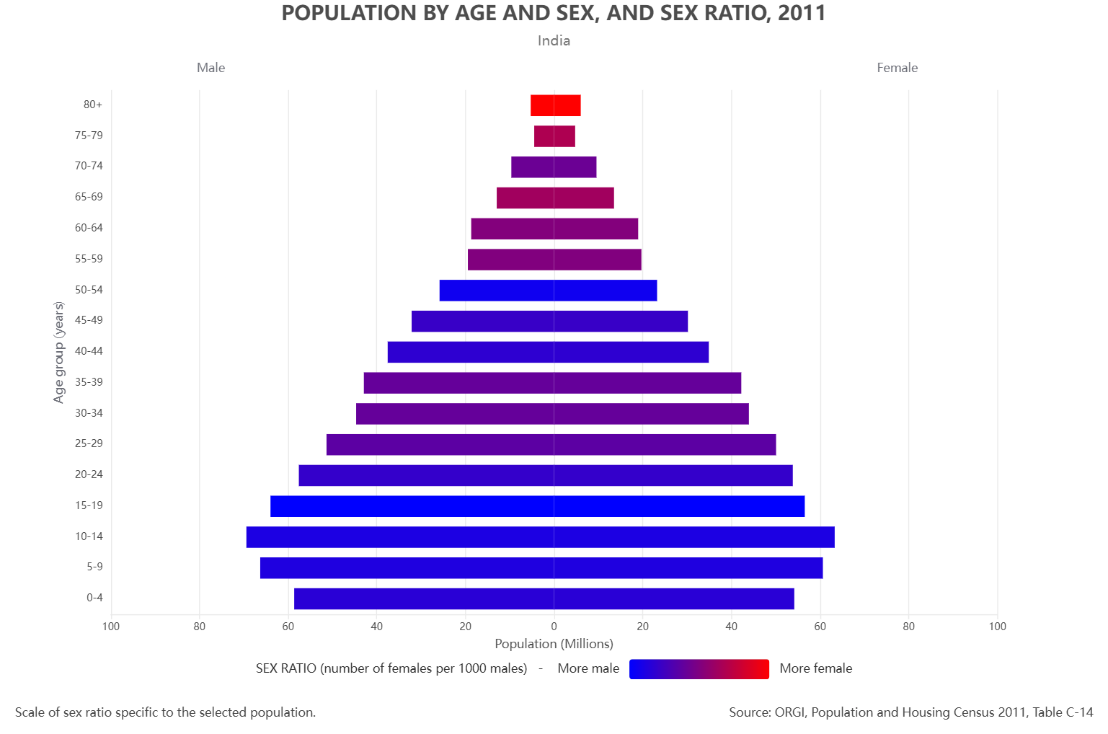

Where the world economies are struggling with declining birth rates, tight labour markets and an ageing population, India is standing at the cusp of an unprecedented opportunity—all thanks to its demography. With the world’s largest youth population with the median age of 28.4 years, India is not only strengthening its competitive advantage but also setting trends in consumer and discretionary spending. According to EY, India will have 1.04 billion working age persons by 2030, highest of any large economy.
India’s young population has long been described as its “demographic dividend,” but today, this advantage is more relevant than ever in shaping the country’s economic trajectory. With a significant share of its citizens under the age of 25, India stands at a unique intersection of youthful energy, rising aspirations, and expanding economic potential. For global investors, this represents not just a trend, but a powerful, long-term opportunity.
India is experiencing the most consequential demographic shift of the 21st century. With over 65 per cent of its population under the age of 35, the country possesses the largest youth cohort in the world — a cohort that, if empowered, can lift millions into prosperity, boost productivity, expand India’s economic influence, and accelerate the nation toward developed-country status. But this demographic dividend is not guaranteed. It is a strategic opportunity with an expiry date, and converting it into national wealth requires unprecedented coordination between government, industry, society, and — most importantly — youth themselves.
As major economies like Japan, South Korea, and much of Europe struggle with aging populations and shrinking workforces, India stands out in the global landscape. The question is no longer whether India’s youth population is large. The question is whether it is capable — skilled, employable, entrepreneurial, confident, and future-ready. In this decade of demographic change, the success or failure of India’s development story will depend on how well it matches the supply of youth with the demand for new-age jobs in a transforming global economy.
The Demographic Dividend: A Window, not a Warranty
India adds nearly 10–12 million people to its working-age population every year. Demographers estimate that India’s demographic dividend window — when the proportion of working-age population is highest — will remain open until 2040, after which the share of dependent population will begin to rise. This means India has about 15 years to convert its youth bulge into economic strength.
Economists warn that demographic dividends do not automatically yield growth. They translate into wealth only when accompanied by:
• large-scale job creation,
• skilling and re-skilling aligned with market demand,
• high-quality education,
• a culture of entrepreneurship, and
• policy reforms that stimulate both supply and demand.
Countries like South Korea and Singapore succeeded because they invested aggressively in human capital, vocational excellence, and productivity. Countries that failed to channel their youth bulge saw rising unemployment, social unrest, and capital outflow. India stands at this exact crossroads today.
The Future of Work Has Arrived — And India Cannot Miss It
Technological disruption is transforming the global labour market. AI, automation, big data, green energy transitions, EVs, drones, logistics platforms, and the gig economy are redefining what it means to “work”. The new economy demands skills, adaptability, problem-solving, creativity, and digital fluency, not merely degrees.
Today’s young Indian must be able to learn, unlearn, and relearn continuously. Jobs of the future will be hybrid, tech-enabled, entrepreneurial, and global in nature. A talented young person in Indore, Guwahati, or Patna can serve a client in New York, Singapore, or London — if equipped with the right skill set and digital access.
This is precisely why the Government of India has launched a broad skilling and employability architecture. The Pradhan Mantri Kaushal Vikas Yojana (PMKVY), Skill India Mission, and National Skill Development Corporation (NSDC) have cumulatively trained millions of youth. However, the real challenge ahead is quality, not quantity. Training must translate into decent, stable work. Curriculum must be industry-aligned. Apprenticeships must be expanded dramatically to match global standards. Skill certificates must reflect real workplace competence.
India’s new Employment-Linked Incentive (ELI) scheme, approved in 2025, signals a critical shift: from purely supply-side skilling to demand-linked job creation. Wage support for MSMEs and manufacturers can catalyse large-scale hiring, but its success depends on local skilling, placement networks, and outcome monitoring.
Entrepreneurship: The New Engine of Youth Wealth
While not every youth will secure a salaried job, many can — and must — become job creators. India’s entrepreneurship ecosystem has exploded in recent years. With over 1.5 lakh recognised startups, India is now the 3rd largest startup ecosystem in the world, attracting record domestic and global investment. But the next leap cannot be limited to Bengaluru, Delhi, Mumbai, and Hyderabad. Entrepreneurship must spread into tier-2 and tier-3 towns, and into agri-tech, climate tech, manufacturing, health-tech, and rural enterprises.
Initiatives like Startup India, Stand-Up India, MUDRA loan schemes, and the Fund of Funds for Startups have democratized access to capital. India’s digital public infrastructure — UPI, Aadhaar, DigiLocker, ONDC — has reduced friction for young entrepreneurs, allowing them to build and scale businesses with unprecedented ease. For the first time in history, a young Indian can start and operate a business with almost zero paperwork and zero physical presence.
The challenge now is to strengthen incubation networks, improve access to early-stage capital in smaller cities, boost women-led startups, and ensure youth entrepreneurial training becomes part of early education. A country of 1.4 billion cannot rely only on jobs; it needs job creators at scale.
Where India Must Push Harder
For India to transform youth potential into national wealth, five priority actions are essential:
- Build sector-wise talent pipelines.
Green energy, semiconductors, manufacturing, tourism & hospitality, healthcare, AI and robotics, logistics, and agri-value chains must each have a dedicated workforce mission with employer-driven curricula. - Make apprenticeships central to the education system.
India must shift towards a “learn by doing” model. Germany and Japan built their demographic dividends on strong apprenticeship ecosystems. - Localize entrepreneurship ecosystems.
Every district should have an incubation hub, seed funding support, and industry partnerships to channel youth creativity into viable ventures. - Expand rural non-farm opportunities.
Agri-processing, cold chains, rural BPOs, digital services, and local manufacturing clusters can absorb millions of rural youths into productive employment. - Focus on outcomes, not inputs.
Skilling programs must be evaluated by jobs created, earnings growth, and enterprise survival, not simply enrolment numbers.
The Youth Imperative: A National Call to Action
A demographic dividend becomes demographic wealth when youth take ownership of their future. India’s young population must see themselves not as beneficiaries of government programmes, but as builders of the Indian economy. Young Indians must invest in learning, embrace digital tools, pursue global opportunities, and innovate relentlessly. The world is hungry for talent — and India has the numbers, the diversity, and the energy to become the Talent Capital of the World.
But youth must ask themselves difficult questions:
Am I preparing for the future or repeating the past?
Am I waiting for opportunities or creating them?
Am I competing locally or globally?
The answers will decide not only individual destinies but the fate of the Indian economy.
Conclusion: The Demographic Decade Must Not Be Wasted
India stands on the edge of a demographic transformation that will define its next 100 years. If India succeeds in skilling, employing, and unleashing the entrepreneurial potential of its youth, the country can achieve what China achieved in the 1990s — but with digital speed and democratic scale.
The demographic dividend is not about having the world’s largest youth population. It is about turning that youth into productive, innovative, globally competitive human capital. India does not merely possess the world’s largest youth population — it holds the world’s largest reservoir of untapped human capital.
The real question is no longer whether India has a demographic dividend.
The real question is:
If we fail, we risk missing a once-in-history chance.
The window is open — but not forever.
The time to act is now.
And it is India’s youth who must lead the way.
(Dr. Bhavana Rai, author of this article, is an eminent Economist. Currently, she serves as Joint Director at the FHRAI Centre of Excellence for Research in Tourism and Hospitality (CERTH), She has previously been associated with reputed institutions such as ASSOCHAM, PHD Chamber of Commerce and Industry, and the Institute of Economic Growth)