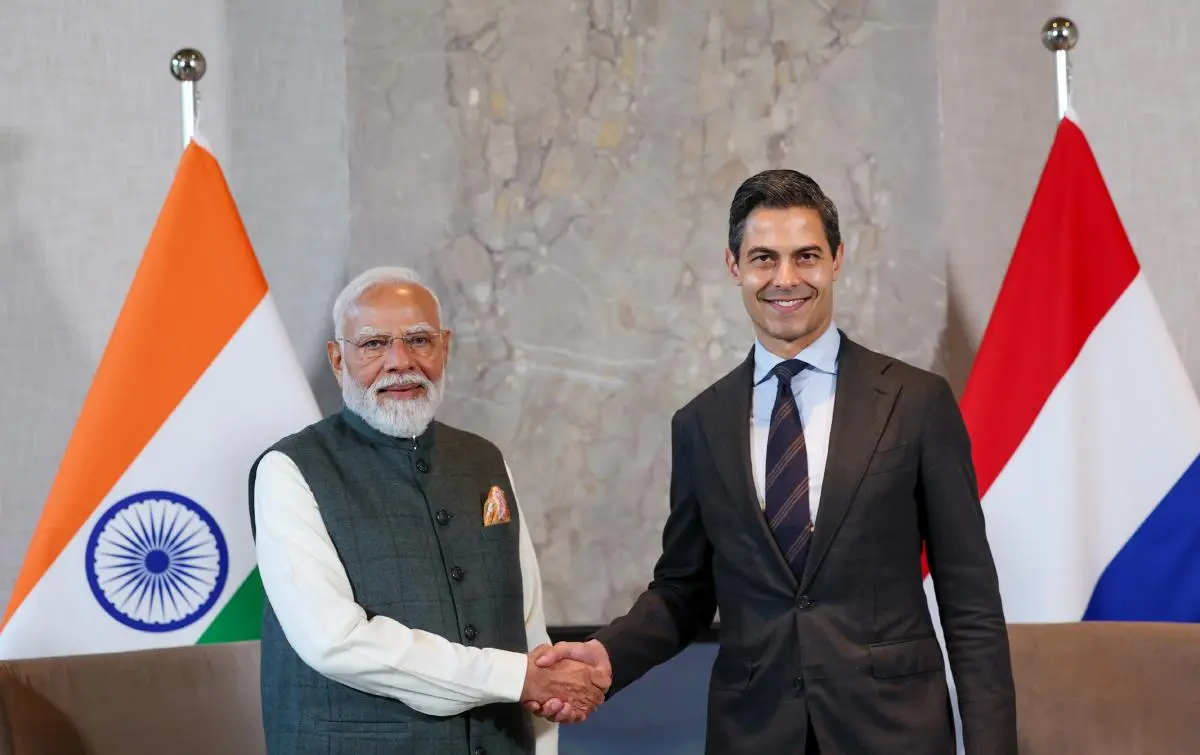
In a world increasingly defined by technological rivalry, supply-chain fragility and great-power competition, India and the Netherlands have chosen pragmatic alignment over lofty rhetoric. During Prime Minister Narendra Modi’s visit to The Hague on 16-17 May 2026, the two countries formally elevated their relationship to a strategic partnership, backed by a detailed 2026-2030 roadmap and 17 new agreements.
This is no ceremonial upgrade. It represents a calculated convergence between a compact, high-tech European gateway and one of the world’s fastest-growing major economies, both seeking resilience in an era of uncertainty.
The Strategic Logic
At its core, the partnership addresses shared vulnerabilities. The Netherlands possesses world-leading capabilities in semiconductors (via ASML), water management, logistics through Rotterdam, and advanced engineering. India brings demographic scale, a rapidly expanding market, manufacturing ambition, and growing strategic heft in the Indo-Pacific.
The centrepiece is technology and critical supply chains. Agreements include deeper semiconductor cooperation, notably an MoU linking Tata Electronics with ASML to support India’s first major 300mm chip fabrication facility in Dholera, Gujarat. A new framework on critical minerals aims to build diversified, resilient value chains — an implicit effort to reduce dependence on concentrated sources of supply. A dedicated green hydrogen roadmap further signals intent to collaborate on the energy transition.
Defence and security ties are also set to deepen, with discussions on a defence industrial roadmap, technology transfer, joint ventures and enhanced maritime cooperation. These steps reflect a broader European awakening to the need for reliable partners beyond traditional Atlantic frameworks, and India’s parallel quest for high-end technology without excessive political strings attached.
Wider Geopolitical Context
The timing is telling. Both nations expressed concern over disruptions in West Asia, particularly threats to freedom of navigation through the Strait of Hormuz. On Ukraine, they reiterated support for a just peace grounded in the UN Charter. In the Indo-Pacific, they endorsed a free and open region based on international law and respect for sovereignty — language that subtly acknowledges shared unease over coercive maritime strategies.
Dutch Prime Minister Rob Jetten condemned the April 2025 Pahalgam terrorist attack, while India welcomed continued Dutch support for its aspirations for permanent membership of a reformed UN Security Council. These convergences on global issues add political ballast to what is fundamentally a pragmatic economic and technological arrangement.
Economic Momentum
Bilateral trade already stands at around $28 billion, with the Netherlands one of India’s largest European investors. The recently concluded India-EU Free Trade Agreement provides additional tailwinds. A new migration and mobility pact should ease the flow of talent and skilled workers, while longstanding Dutch strengths in agriculture, water and sustainability offer practical avenues for collaboration that directly benefit Indian development priorities.
Limits and Realism
Seasoned analysts will note that strategic partnerships do not always translate into rapid transformation. Differences remain — from occasional Dutch scrutiny of governance issues in India to New Delhi’s continued multi-alignment in foreign policy. Implementation will matter more than declarations, particularly in sensitive areas such as defence co-production and critical minerals processing.
Yet the direction is clear. In an age when countries are hedging against over-reliance on any single power or region, India and the Netherlands are quietly building a middle-power bridge. Dutch expertise in precision technology and efficient systems meets India’s speed, scale and market potential. The partnership is less about grand strategy than about mutual insurance in a fragmenting world.
As Modi concluded his visit and departed for the next leg of his European tour, both sides spoke of “new momentum” and an “ambitious roadmap”. For once, the diplomatic language matches the underlying reality: two democracies with complementary strengths have decided that getting closer makes sense — not out of ideological alignment, but because it serves their long-term interests in security, prosperity and resilience. The real work of turning this framework into tangible outcomes now begins.