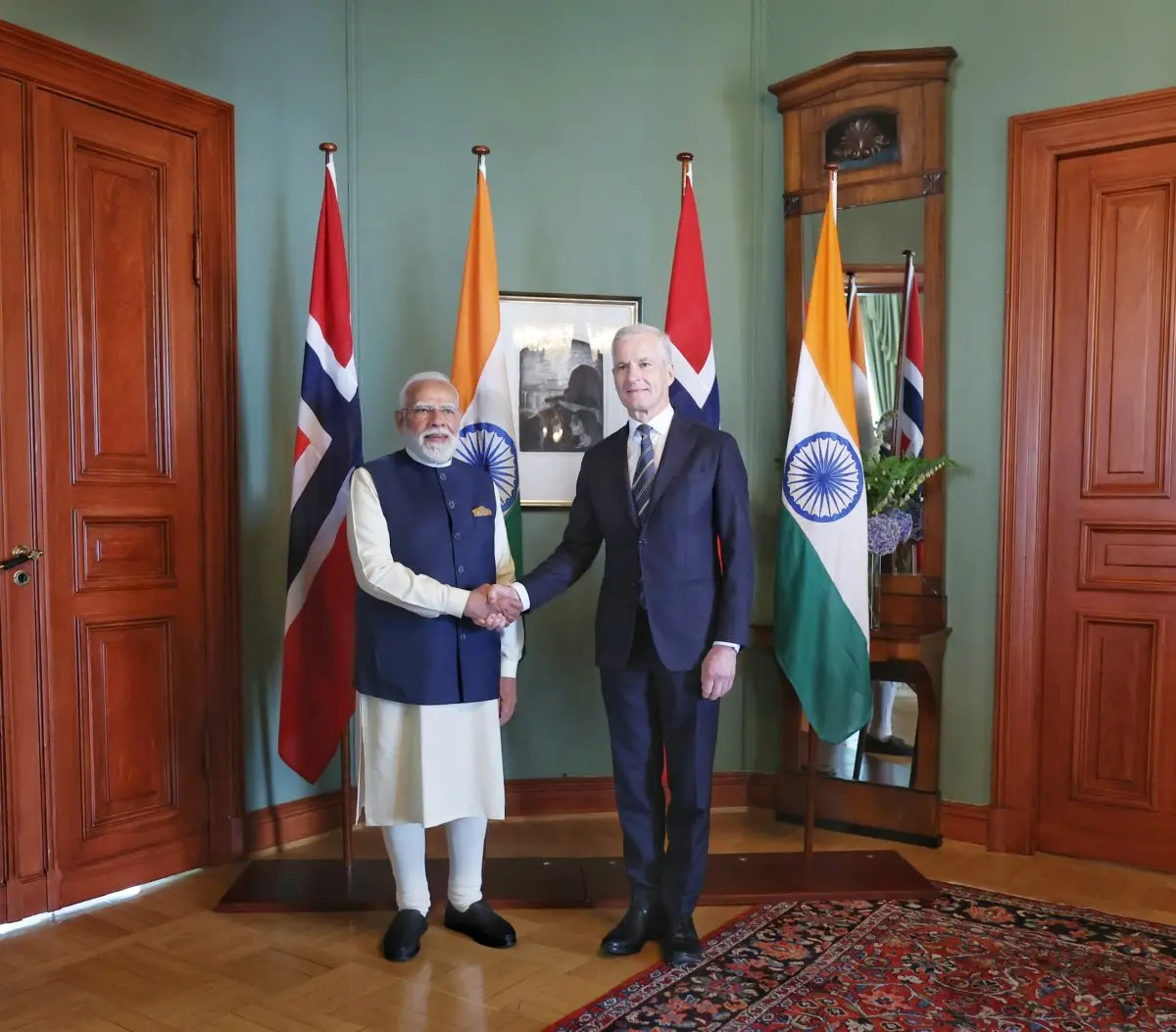
Prime Minister Narendra Modi’s visit to Norway has marked a significant upgrade in bilateral relations, with both countries formalising a Green Strategic Partnership focused on clean energy, climate resilience, the blue economy, and sustainable technologies. The move comes at a time of heightened global instability, offering a forward-looking example of pragmatic cooperation between a major emerging economy and a leading European nation with advanced green expertise.
During talks with Norwegian Prime Minister Jonas Gahr Støre on Monday, Modi emphasised that the partnership would combine India’s scale, speed, and talent with Norway’s technology and capital to develop solutions with global relevance. Both leaders stressed the importance of dialogue and diplomacy in resolving conflicts, explicitly referencing the situations in West Asia and Ukraine. “No issue can be resolved through military conflict,” Modi noted, underscoring a shared commitment to a rules-based international order.
The visit, the first by an Indian prime minister to Norway in over four decades, coincided with the 3rd India-Nordic Summit and delivered tangible outcomes. Around a dozen agreements were signed, covering areas such as renewable energy, green shipping, maritime cooperation, space research (including an MoU between ISRO and the Norwegian Space Agency), digital technologies, health innovation, and Arctic studies. Norway also formally joined India’s Indo-Pacific Oceans Initiative, opening avenues for enhanced maritime security and blue economy collaboration.
Economic Momentum and Investment Push
Modi used the platform of the India-Norway Business and Research Summit to invite Norwegian companies to expand their footprint in India. Highlighting recent reforms in taxation, labour laws, and ease of doing business, he pointed to opportunities in clean energy, shipbuilding, health, and nutrition sectors. Currently, around 10 per cent of Norway’s ships are built in India; the Prime Minister set an ambitious target of raising this to 25 per cent within five years.
Both sides aim to double bilateral trade by 2030 and fully leverage the India-EFTA Trade and Economic Partnership Agreement (TEPA), which targets $100 billion in investments into India and the creation of one million jobs over 15 years. Norwegian officials described the agreements as unique in their scope, reflecting strong mutual trust.
Modi also received Norway’s highest civilian honour during the visit, symbolising the warmth of the relationship. The two leaders strongly condemned terrorism in all forms, including cross-border terrorism, and reiterated support for dismantling terror infrastructure. Norway backed India’s call for reforms in global institutions, including its aspiration for permanent membership of a reformed UN Security Council.
Strategic Significance in a Fragmented World
From a wider perspective, the Green Strategic Partnership adds a specialised Nordic pillar to India’s deepening engagement with Europe. It complements recent agreements with the UAE on energy security and the Netherlands on critical minerals and semiconductors. In an era marked by disruptions in traditional energy routes — notably the Strait of Hormuz — and growing concerns over supply chain vulnerabilities, cooperation with Norway strengthens India’s access to clean technology, critical minerals expertise, and diversified energy options, including potential LNG and green hydrogen pathways.
Norwegian media and analysts have welcomed the development as a timely alignment of interests: Norway’s strengths in offshore technology, green transition, and Arctic research pair naturally with India’s vast market, manufacturing base, and digital public infrastructure capabilities. Triangular cooperation projects in the Global South were also agreed upon, using Indian digital solutions backed by Norwegian expertise.
For India, the visit reinforces its multi-alignment approach — maintaining engagement across regions while prioritising resilient supply chains, climate goals, and technological self-reliance. For Norway and the broader Nordic region, it opens doors to one of the world’s fastest-growing major economies as a partner in the green transition.
As Modi concluded this leg of his five-nation tour and headed to Italy, the message from Oslo was clear: amid global conflicts and economic uncertainty, India and like-minded partners are investing in long-term stability through sustainable growth and innovation. The Green Strategic Partnership may prove to be one of the quieter but more enduring outcomes of this diplomatic push. The coming years will test whether the ambition — from shipbuilding targets to joint Global South projects — translates into concrete results. For now, it stands as a pragmatic step in an increasingly fragmented world.