Prime Minister Narendra Modi’s visit to Sweden has elevated bilateral relations to a full Strategic Partnership, underpinned by an ambitious Joint Action Plan for 2026–2030. This upgrade reflects a maturing alignment between the world’s fastest-growing major economy and one of Europe’s most innovative nations, at a moment when technology leadership, secure supply chains, and sustainable growth have become central to geopolitical competition.
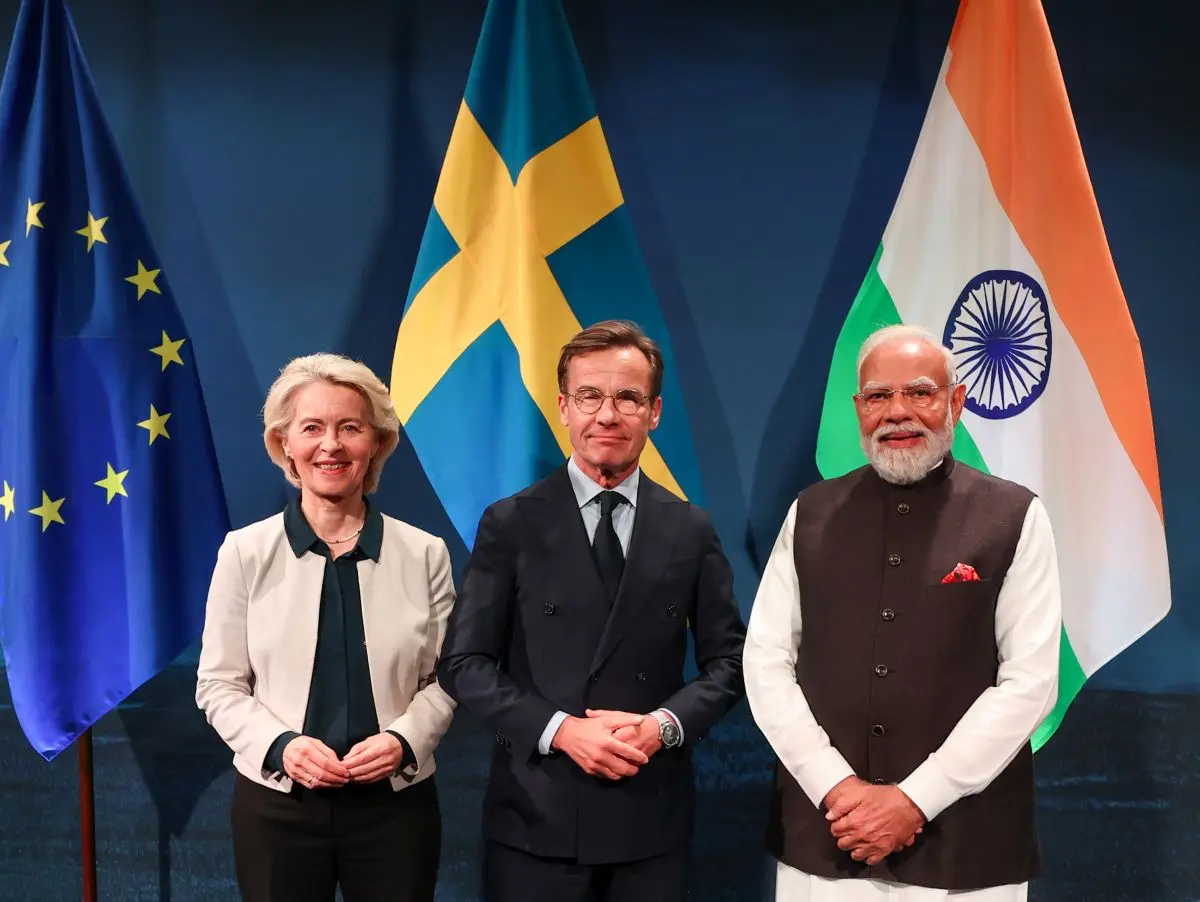
In talks with Swedish Prime Minister Ulf Kristersson in Gothenburg, the two leaders outlined four guiding pillars: strategic dialogue on security and stability; a next-generation economic partnership; cooperation on emerging technologies and trusted connectivity; and joint efforts on people, planet, health, and resilience. The partnership includes the launch of the India-Sweden Joint Innovation Partnership 2.0 and the India-Sweden Technology and Artificial Intelligence Corridor, targeting collaboration in artificial intelligence, 6G, quantum computing, smart grids, and renewable energy.
A particular emphasis was placed on critical minerals and resilient supply chains. Both sides agreed to advance mining and processing technologies for low-grade deposits and to explore co-development of refining capabilities, especially for rare earths. This move aligns with global efforts to reduce vulnerabilities in high-technology and green transition supply chains.
Ambitious Economic Targets and Business Engagement
The leaders set a clear goal of doubling bilateral trade and investment within five years, building on the current base of approximately $7.75 billion. Modi actively courted Swedish industry leaders at a high-level European Round Table for Industry event, also attended by European Commission President Ursula von der Leyen. He highlighted opportunities in clean energy, green hydrogen, semiconductors, advanced manufacturing, defence, and digital infrastructure, while stressing India’s ongoing reforms and “Design in India, Make in India, Export from India” vision.
Swedish and European business circles welcomed the outreach, viewing India as a crucial partner for scaling innovation and diversifying away from concentrated supply risks. Cooperation on healthcare innovation, AI for health, SME and startup platforms, and talent mobility further broadens the agenda. Cultural ties were also reinforced through the announcement of a Tagore-Sweden lecture series commemorating the centenary of Rabindranath Tagore’s visit to Sweden.
During the visit, Modi was conferred Sweden’s prestigious Royal Order of the Polar Star (Commander Grand Cross), one of the country’s highest civilian honours.
Wider Geopolitical Context
From a global perspective, the Strategic Partnership forms another important thread in India’s deepening engagement with Europe. It complements recent upgrades with the Netherlands (critical minerals and semiconductors) and Norway (green transition and maritime cooperation), creating a coherent Nordic-European pillar focused on technology sovereignty and economic resilience. Swedish analysts have noted that the partnership offers mutual benefits: Sweden gains access to India’s scale, market, and talent pool, while India benefits from Swedish strengths in innovation, sustainability, and industrial expertise.
Both sides strongly condemned terrorism, including cross-border terrorism, and reiterated support for dismantling terror infrastructure. Kristersson reaffirmed Sweden’s backing for India’s permanent membership in a reformed UN Security Council. The leaders also welcomed the recently concluded India-EU Free Trade Agreement as a transformative development that will further amplify these bilateral gains.
Strategic Significance
In an era defined by great-power rivalry, disrupted energy flows from West Asia, and the weaponisation of supply chains, this partnership is more than a bilateral upgrade. It represents India’s deliberate strategy of multi-alignment — building dense, issue-based networks with like-minded democracies that can deliver tangible outcomes in critical domains such as AI, quantum technologies, green transition, and secure minerals.
For Sweden, the deal strengthens its role as a bridge between India and broader European industrial and technological ecosystems. For India, it advances core objectives: technological self-reliance, supply chain diversification, and positioning itself as a preferred partner for high-value collaboration rather than simply a low-cost manufacturing base.
As Modi concluded this leg of his European tour and moved to the India-Nordic Summit in Oslo, the Sweden visit reinforced a clear message: in a fragmenting world, partnerships grounded in shared democratic values, innovation, and mutual strategic interest offer one of the most effective hedges against uncertainty. The real test, as always, will lie in implementation — turning roadmaps and corridors into concrete projects, investments, and resilient capabilities over the coming years.