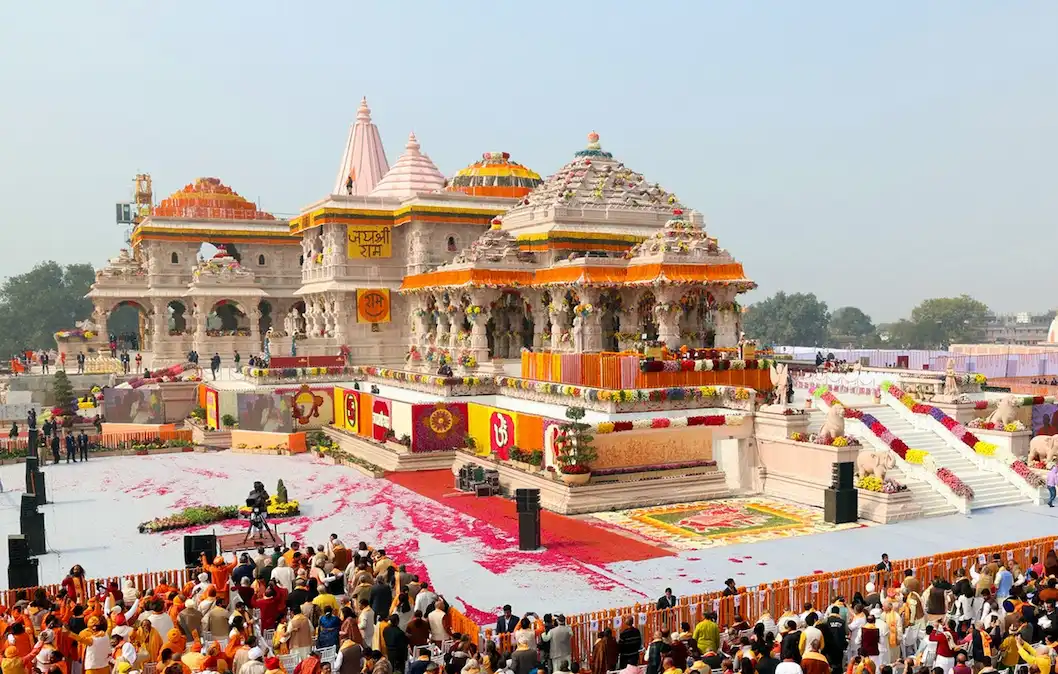
In the shadow of the majestic Ram Mandir in Ayodhya where millions of devotees have poured their faith and savings into hundi boxes as offerings to Lord Ram, a betrayal unfolded that has shaken the very foundations of one of India’s most revered religious institutions.
What began as whispers of missing cash and unaccounted valuables has erupted into a full-blown criminal investigation, exposing alleged systematic pilferage of crores in donations, the arrest of eight individuals—including close aides of top trust officials—and the dramatic resignation of the temple trust’s powerful general secretary, Champat Rai, who is also a senior functionary of the Vishva Hindu Parishad (VHP).
This is not just a story of greed; it is a crime against faith itself, where the pious contributions of ordinary Hindus—notes tucked into donation boxes after darshan—were allegedly siphoned off by those entrusted with their safekeeping. Uttar Pradesh Police and a state-appointed Special Investigation Team (SIT) have peeled back layers of procedural lapses, missing CCTV footage, and brazen theft, painting a picture of opportunity meeting unchecked ambition within the hallowed precincts.
The Spark: Allegations Ignite a Firestorm
The scandal surfaced publicly in early June 2026 when Samajwadi Party chief Akhilesh Yadav amplified claims of massive irregularities in the handling of Ram Mandir donations. He spoke of crores vanishing, missing records, and a conspiracy of silence. Trust officials, led by Champat Rai—a veteran of the Ram Janmabhoomi movement and VHP vice president—initially pushed back, insisting internal audits involving the State Bank of India were routine and nothing untoward had been found.
But the murmurs grew louder. Reports emerged of cash handlers skimming daily hauls, valuables like gold, silver, and ornaments disappearing from inventories, and a culture of lax oversight. On June 13, at the trust’s own request, the Uttar Pradesh government under Chief Minister Yogi Adityanath formed a three-member SIT headed by senior officials, including Divisional Commissioner Vijay Vishwas Pant. Their mandate: probe the collection, counting, storage, and banking of donations.
What the SIT uncovered was damning. Preliminary findings revealed blatant violations of standard operating procedures (SOPs). Temporary staff with inadequate background checks had access to sensitive areas. CCTV surveillance was patchy or missing at critical junctures. The chain of custody for cash—from temple boxes to counting rooms, trust offices, and bank deposits—had glaring gaps. Discrepancies in records of jewellery and precious items offered by devotees raised further red flags. Estimates of the missing amounts have varied, with some reports citing Rs 5-7.5 crore in cash alone, though recoveries so far are lower.
The Breakthrough: Cash Under Cow Dung
The probe turned concrete on June 14 when the Special Operations Group (SOG) and local police raided the home of Lavkush Mishra, a temporary donation-counter. Hidden beneath a pile of cow dung, investigators found Rs10 lakh in unaccounted cash—a stark symbol of the alleged deceit. This discovery validated the initial suspicions and accelerated the momentum.
Over the following days, SIT teams grilled temple employees, bank officials, and even senior trust figures. Champat Rai and trustee Dr. Anil Mishra were questioned for hours on the temple premises on June 19. Chief Minister Yogi Adityanath visited Ayodhya the same day, assuring devotees that truth would be separated from falsehood and urging restraint in politicising the issue. “Tampering with people’s faith cannot be tolerated,” he later asserted.
On June 23, the SIT submitted its preliminary report. Pressure mounted from the Vishva Hindu Parishad (VHP) and others for an FIR. Akhilesh Yadav taunted that the SIT was “a bow without arrows” without formal charges. On June 25, trust member Krishna Mohan filed the complaint, leading to the registration of the first FIR at Ayodhya police station.
The Accused and the Charges
The FIR named eight people, many with direct roles in cash handling and counting: Avinash Shukla, Anukalp Mishra, Lavkush Mishra, Manish Kumar Yadav, Karunesh Pandey, Ramashankar Mishra, Subhash Srivastava, and Ram Shankar Yadav alias Tinnu (notably, Champat Rai’s driver and close associate). They were charged under multiple sections of the Bharatiya Nyaya Sanhita (BNS) for theft by servant, criminal breach of trust, receiving stolen property, criminal conspiracy, and under the Prevention of Corruption Act.
All eight were arrested swiftly on June 25-26 and remanded to judicial custody. Raids on their residences yielded nearly Rs 80 lakh in cash , along with foreign currency and other valuables. Police described a pattern: employees allegedly skimming bundles of Rs 500 notes, hiding cash, and exploiting weak monitoring during counting sessions. One report highlighted around 70 incidents of daily thefts amounting to Rs 2.5 lakh.
Leadership Shake-Up: Resignations on ‘Moral Grounds’
The very next day, June 26, came the seismic news: Champat Rai and trustee Anil Mishra handed their resignations to trust president Mahant Nritya Gopal Das, reportedly citing moral responsibility. Rai, often called the “encyclopaedia of Ayodhya” for his deep involvement in the temple movement, stepped down amid the heat. The trust later confirmed the resignations, though it plans to deliberate on them formally in upcoming meetings. Some VHP voices initially denied or downplayed the resignations, emphasising Rai’s cooperation with the SIT and absence of his name in the FIR.
The resignations were widely seen as damage control exercise, especially after pressure from the top ranking RSS offcials and the ruling BJP leadership. Trust officials have assured devotees that major valuables like silver bricks and ornaments remain secure, while calling for a broader audit, but there is authentic proof available on their claims. The SIT’s probe has since been extended , with plans to scrutinise five years of accounts, land deals, and higher-level oversight. More questioning, including of additional trust members, is expected.
Political Ripples and Calls for Accountability
The case has ignited fierce political debate. Opposition leaders like Akhilesh Yadav and Arvind Kejriwal have accused the system of shielding “big fish” while nabbing small fry, demanding a CBI probe or full audit. Congress and others have called it a betrayal of Hindu sentiments. Within the Sangh Parivar, the RSS and VHP have expressed disappointment and pushed for transparency and reforms, including better professional management of the trust.
CM Yogi Adityanath has maintained a firm stance: zero tolerance, no politicization, and full accountability. “Whoever tampers with the faith of the people will have to face the consequences,” he warned. Nripendra Misra, chairman of the temple construction committee, has called for a complete overhaul of management structures.
The Human Cost and Lingering Questions
For millions of Lord Ram devotees who donated selflessly—some their life’s savings—the scandal is profoundly painful. Daily donations reportedly continue unabated, a testament to enduring faith, but trust has been eroded. The SIT is now tracing the full money trail, examining possible “commission” cultures, outsourced counting staff, and discrepancies in high-value offerings.
As the investigation deepens, with Champat Rai’s statement already recorded post-resignation, the story is far from over. Will more arrests follow? Will senior officials face scrutiny? What systemic reforms will protect the temple’s sanctity going forward? The Ram Temple, a symbol of national resurgence and devotion in India, now stands as a cautionary tale: even in the house of God, vigilance against human frailty is eternal.
In the crime annals of Uttar Pradesh, this case may be remembered not just for the arrests or resignations, but for the profound lesson it delivers—faith demands not only temples of stone, but fortresses of integrity. The SIT’s final report, expected soon, will determine how deep this rot ran and how the state restores the devotees’ shattered trust.