A federal judge has struck down President Donald Trump’s eye-watering $100,000 fee on new H-1B visa applications, dealing a sharp setback to one of the administration’s signature efforts to reshape skilled immigration.
In a ruling issued on Monday in Boston, US District Judge Leo Sorokin declared the charge unlawful, finding that it amounted to a tax imposed without the approval of Congress.
The decision, coming in a lawsuit brought by a coalition of 20 Democratic-led states, underscores the enduring tension in American governance between executive assertiveness on immigration and the constitutional allocation of powers.
“The Court finds that the Policy imposes a tax on H-1B petitions without the requisite delegation by Congress,” Judge Sorokin wrote. He added that “the substance and application of the $100,000 payment reveal that it is a tax, regardless of what the payment is called.”
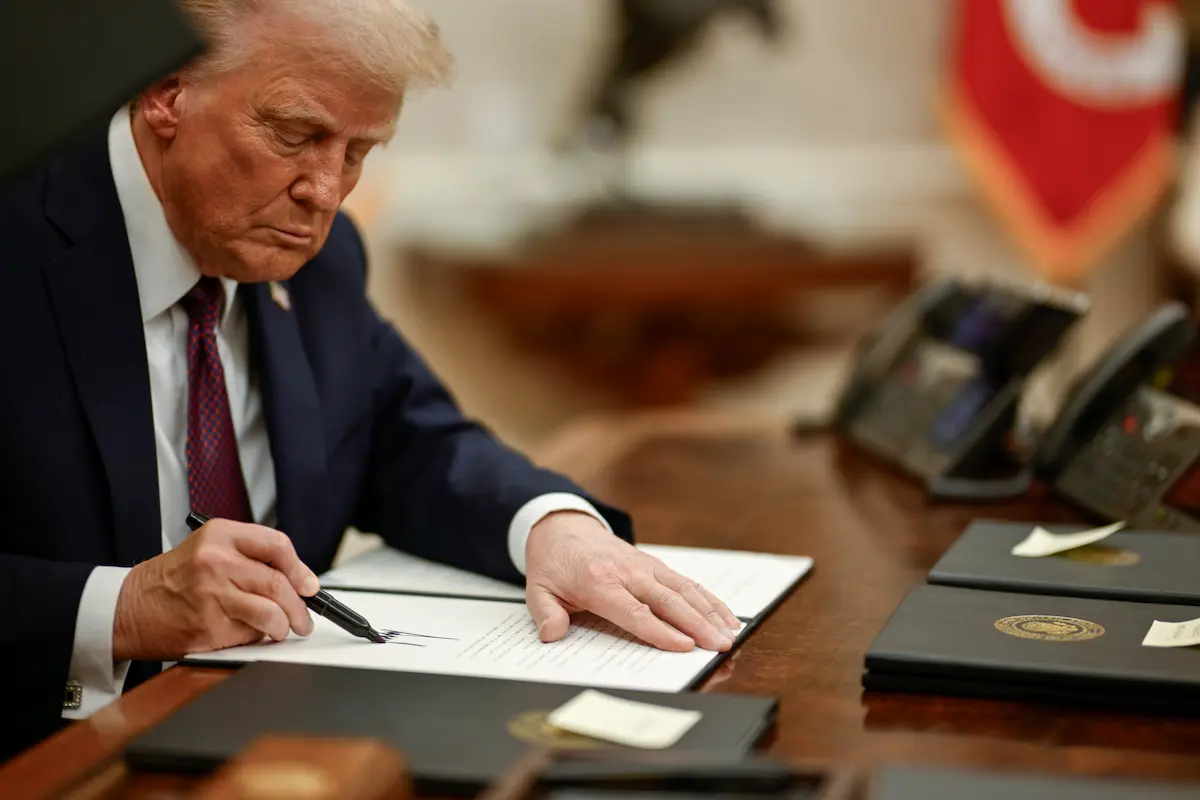
The fee originated in a presidential proclamation signed by Mr Trump in September 2025. Invoking his authority under the Immigration and Nationality Act to restrict entry deemed “detrimental to the interests of the United States,” the President sought to make hiring foreign workers in specialty occupations far more expensive.
Administration officials framed the measure as a tool to discourage outsourcing, protect American wages, and nudge firms towards domestic talent. The levy applied primarily to new petitions filed with US Citizenship and Immigration Services for workers outside the country, with the funds collected by the agency rather than the IRS.
Critics, including the plaintiff states led by California, argued that the move exceeded executive authority, usurped Congress’s power over taxes and immigration policy, and ignored the programme’s economic value to key sectors.
Judge Sorokin agreed, pressing during hearings on the limits of presidential power under provisions such as Section 1182(f). He questioned whether such broad authority could, in theory, extend to far more extreme measures, highlighting the absence of clear congressional delegation for revenue-raising of this scale.
Silicon Valley’s relief, and its limits
The H-1B programme, which allows American companies to hire university-educated foreigners for roles requiring specialised skills, has long been a lightning rod. It is a vital pipeline for technology firms, universities, hospitals, and other employers struggling to fill gaps in fields such as software engineering, data science, and medicine.
Indian professionals constitute one of the largest groups of beneficiaries. The programme has helped power the rise of Indian-born executives at firms like Google, Microsoft, and IBM.
For businesses, the fee threatened chaos. At a stroke, it could have added tens or hundreds of millions in costs for large sponsors, while smaller firms and startups might have been priced out entirely.
Some analysts predicted accelerated offshoring, higher project costs, and slower innovation as companies shifted more work abroad or curtailed expansion.
In fiscal year 2026, even before full implementation effects, over 200,000 applicants reportedly paid the fee for expedited processing amid uncertainty, according to Department of Homeland Security officials.
The ruling provides immediate relief. It restores a measure of predictability to talent acquisition for firms already contending with tight labour markets and intense global competition for skills. Yet it does not resolve deeper frictions.
The H-1B system remains imperfect—critics on the right point to genuine abuses, wage suppression in certain niches, and incentives for outsourcing firms to displace American workers. Supporters highlight its role in sustaining American technological primacy.
Political reverberations
The decision is politically awkward for the Trump administration. It arrives as the President has sought to project strength on border security and economic nationalism. While Mr Trump’s broader immigration agenda—focused heavily on illegal crossings—retains strong backing among his base, interventions in legal skilled migration have drawn more mixed reactions, even within business-friendly Republican circles.
Tech executives, a constituency the administration has courted, will welcome the ruling, but organised labour and “America First” hardliners may see it as judicial overreach shielding corporate preferences for cheaper foreign talent.
For the states involved, the victory reinforces their strategy of using litigation to contest federal immigration policy when it threatens local economies. Many rely heavily on foreign-born doctors, engineers, and researchers. Massachusetts itself, home to the court, boasts a dense cluster of universities and biotech firms that draw international talent.
Legally, the case highlights perennial questions about the scope of presidential power under immigration statutes. Successive administrations, Republican and Democratic alike, have tested the boundaries.
Judge Sorokin’s emphasis on the fee’s revenue-raising character and its detachment from mere administrative cost recovery may complicate future executive experiments. An appeal seems likely, potentially climbing towards higher courts and injecting further uncertainty.
Broader implications
In the longer term, the episode illuminates America’s ambivalent relationship with high-skilled immigration. The H-1B programme is neither a pure boon nor an unmitigated harm. It supplies scarce talent while exposing vulnerabilities in education, training, and wage policy at home. Capping or pricing it aggressively risks ceding ground to competitors such as Canada, Britain, or Australia in the global hunt for brains. Leaving it unreformed invites continued criticism over fairness to domestic workers.
Monday’s ruling does not kill reform. It merely insists that major changes to the cost and shape of legal immigration channels require Congress’s explicit buy-in. In a polarised Washington, that is a high bar.
For now, companies can breathe easier, foreign talent retains a pathway, and the executive’s tax-by-another-name has been rebuffed. But the underlying debate—how America balances openness to global talent with protections for its own citizens—will rage on.