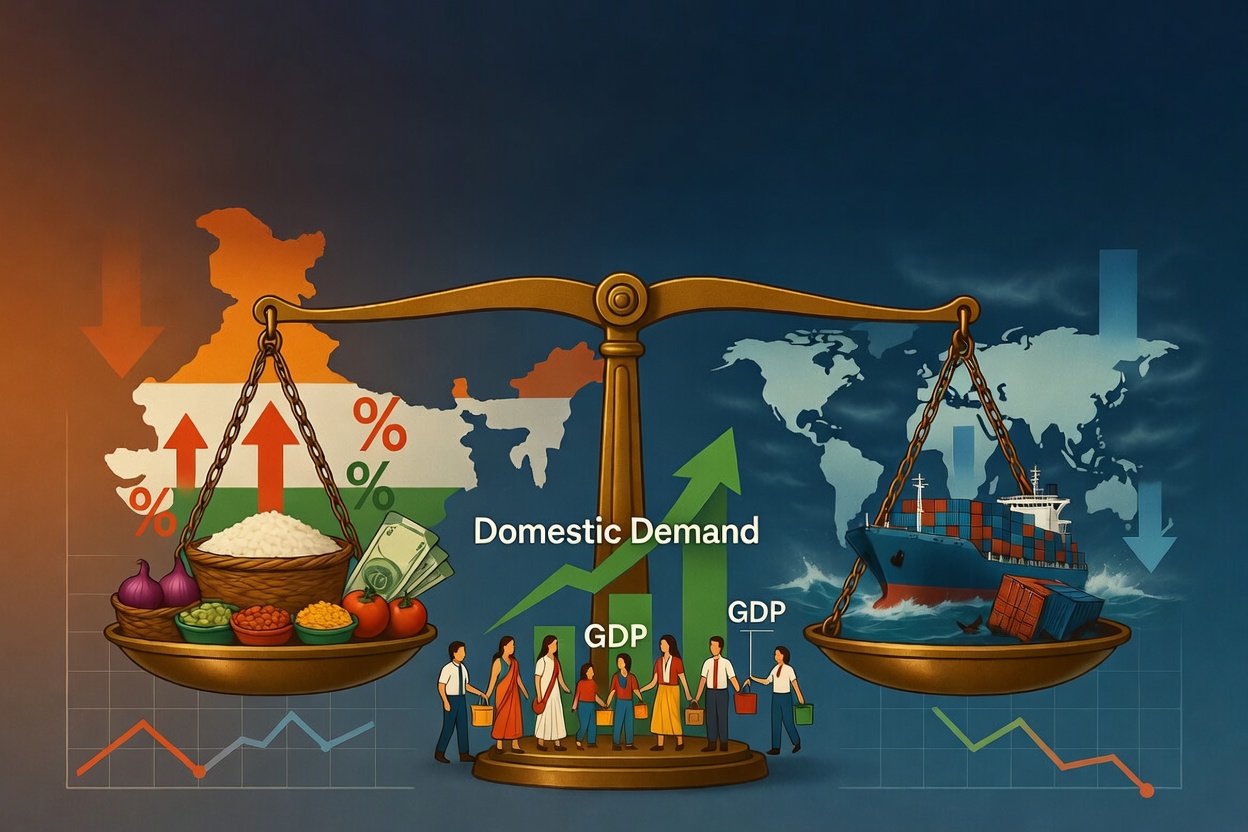

India’s economic story in recent years has stood out as a rare bright spot in an otherwise fragile global landscape. While advanced economies grapple with stagnation and slowing trade, India continues to post robust growth numbers. Yet beneath this resilience lies a complex and emerging paradox—persistently high food inflation coexisting with weakening export demand. Together, these forces raise a critical question: Is India entering a phase where domestic demand must shoulder the burden of growth amid structural inflationary pressures and a soft external sector?
The Changing Nature of Inflation in India
Inflation in India has increasingly taken on a dual character—with food inflation remaining stubbornly high even as core inflation (excluding food and fuel) shows signs of moderation. This divergence is significant because it exposes the structural vulnerabilities of the Indian economy.
Food inflation, unlike core inflation, is deeply influenced by supply-side dynamics. Erratic weather patterns, uneven monsoons, supply chain inefficiencies, and rising input costs have made food prices volatile and persistent. Despite easing global commodity prices, domestic food inflation has not softened proportionately, indicating that the issue is no longer cyclical but structural.
For policymakers, this presents a dilemma. The Reserve Bank of India primarily uses monetary tools such as interest rate adjustments to control inflation. However, these tools are more effective in curbing demand-driven inflation rather than supply shocks. When inflation is driven by food shortages or agricultural disruptions, raising interest rates may have limited impact, while simultaneously risking a slowdown in economic growth.
Monsoon Dependency and Supply Constraints
India’s continued dependence on the monsoon adds another layer of uncertainty. Agriculture still employs a significant portion of the population and plays a critical role in food price stability. Any deviation in rainfall patterns—whether due to climate change or seasonal variability—can trigger supply disruptions and push prices upward.
Moreover, structural inefficiencies such as inadequate storage, fragmented supply chains, and limited cold chain infrastructure exacerbate price volatility. The result is a recurring cycle where food inflation spikes even when overall economic conditions remain stable.
This structural nature of food inflation raises a deeper concern: Is India transitioning into a regime of persistently elevated food prices? If so, the implications for consumption, savings, and overall economic stability could be profound.
Impact on Domestic Demand
High food inflation disproportionately affects lower- and middle-income households, as a larger share of their income is spent on essential consumption. As food prices rise, discretionary spending declines, weakening demand for non-essential goods and services.
This is particularly significant because domestic consumption has been a key driver of India’s growth. If rising food inflation erodes purchasing power, the sustainability of this consumption-led growth model comes into question.
At the same time, urban demand has shown relative resilience, supported by higher income growth and a shift towards services consumption. This divergence between rural and urban demand points to the emergence of a two-speed economy, where inflation impacts different segments unevenly.
The External Sector: Weakening Export Momentum
While domestic challenges are intensifying, India’s external sector is also facing headwinds. Sluggish growth in major global markets such as the European Union and China has dampened demand for Indian exports.
Merchandise exports, in particular, have been affected by declining global demand, supply chain adjustments, and geopolitical uncertainties. Sectors such as textiles, engineering goods, and chemicals have experienced slower growth, reflecting broader global trends.
In contrast, services exports—especially in IT and business process outsourcing—have remained relatively resilient. However, even this sector is not immune to global economic conditions. Slower growth in advanced economies has led to reduced technology spending, raising concerns about the future trajectory of India’s IT exports.
Can Domestic Demand Offset Export Weakness?
The central question that emerges is whether domestic demand can compensate for a weakening external sector. On the surface, India’s large and growing consumer base appears to provide a strong cushion. However, this assumption becomes less certain when viewed in the context of rising food inflation.
If inflation continues to erode household purchasing power, domestic demand may not be strong enough to fully offset the decline in exports. This creates a potential growth constraint, where both internal and external drivers of the economy face simultaneous pressure.
Furthermore, India’s integration into global supply chains means that export performance has broader implications for investment, employment, and industrial growth. A sustained slowdown in exports could dampen private investment and limit job creation, further affecting domestic demand.
Policy Challenges and Trade-offs
The intersection of high food inflation and weak exports presents a complex policy challenge. The Reserve Bank of India must balance the need to control inflation with the imperative of supporting growth. Tightening monetary policy to curb inflation could further weaken demand and investment, while a more accommodative stance risks allowing inflation to persist.
At the same time, fiscal policy must address supply-side constraints. Investments in agricultural infrastructure, logistics, and storage can help reduce food price volatility. Similarly, targeted interventions to support rural incomes can mitigate the impact of inflation on consumption.
On the external front, diversifying export markets and enhancing competitiveness will be crucial. Reducing dependence on traditional markets and moving up the value chain in both goods and services exports can strengthen resilience against global slowdowns.
A Structural Shift in India’s Growth Model?
The current dynamics suggest that India may be at a turning point in its economic trajectory. The traditional growth model—driven by a combination of domestic consumption and export growth—is facing new constraints.
Persistent food inflation challenges the sustainability of consumption-led growth, while global economic uncertainty limits export opportunities. This raises the possibility that India may need to recalibrate its growth strategy, placing greater emphasis on investment, productivity, and structural reforms.
Conclusion: Navigating the New Economic Reality
India’s economic resilience remains undeniable, but it is increasingly being tested by a combination of internal and external pressures. The coexistence of high food inflation and weak export demand highlights the complexity of the current economic environment.
The path forward will require a nuanced and coordinated policy approach—one that addresses structural supply constraints, supports domestic demand, and strengthens external competitiveness. More importantly, it will require a recognition that short-term policy tools may not be sufficient to tackle long-term structural challenges.
As India navigates this evolving landscape, the key question is not just whether it can sustain growth, but whether it can do so in a way that is balanced, inclusive, and resilient. The answer to this question will shape the next phase of India’s economic journey in an increasingly uncertain world.