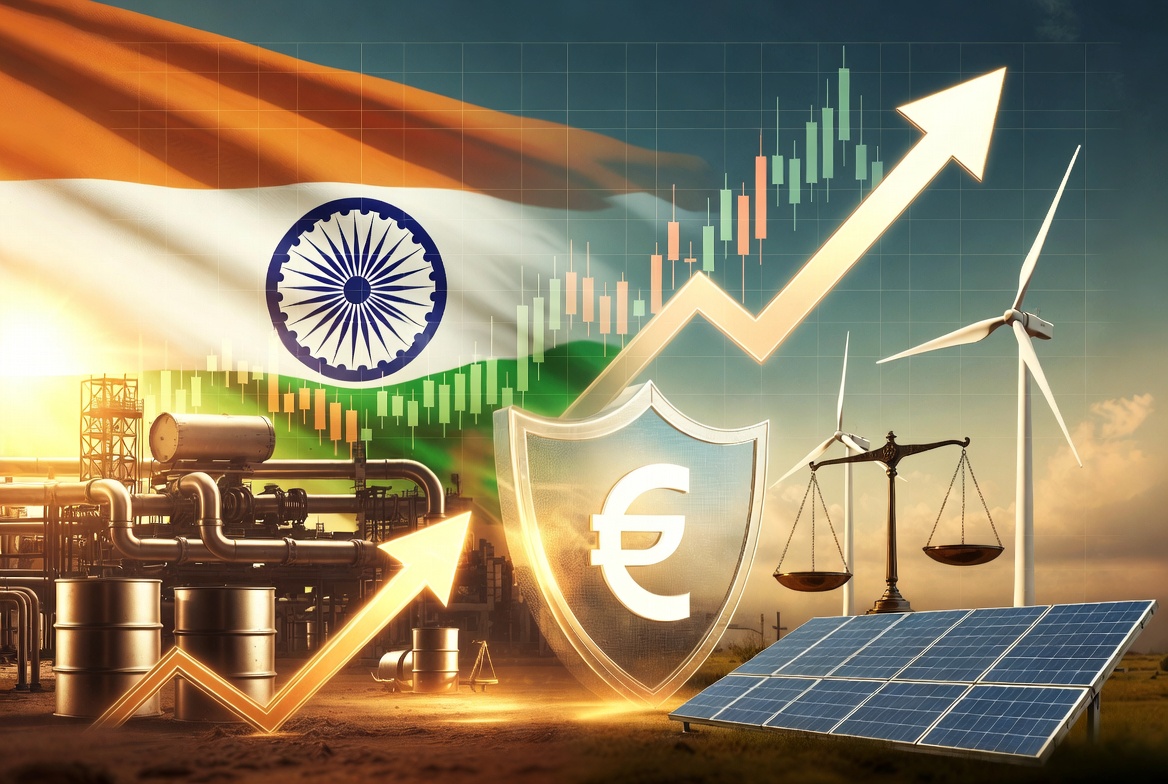

In an era defined by overlapping global crises—volatile oil prices, energy insecurity, and economic uncertainty—India stands at a critical juncture. As one of the world’s fastest-growing major economies and the third-largest energy consumer, the country faces a unique challenge: sustaining growth while shielding its population from external shocks. Yet, the response of the Indian government in recent years reflects a calibrated mix of pragmatism, innovation, and long-term vision—one that is increasingly policy-driven and reform-oriented.
A Perfect Storm: Oil, Energy, and Economic Pressures
The global energy landscape has been anything but stable. Supply disruptions triggered by geopolitical tensions, particularly the Russia-Ukraine conflict, have caused crude oil prices to fluctuate sharply. For India—importing nearly 85% of its crude oil—this volatility directly impacts inflation, fiscal stability, and current account balances.
Simultaneously, the lingering effects of the pandemic, tightening global financial conditions, and slowing international trade have compounded economic stress. Energy demand within India continues to surge, driven by rapid urbanization, industrial expansion, and rising living standards. The convergence of these pressures has made policy responses both urgent and complex.
Strategic Response: A Multi-Pronged Approach by the Indian Government
Diversification of Oil Imports and Energy Diplomacy: India has demonstrated remarkable agility in reshaping its energy procurement strategy by diversifying suppliers and leveraging discounted crude oil imports. Strategic engagement with new partners has strengthened energy diplomacy and reduced overdependence on traditional suppliers, ensuring both affordability and energy security.
Inflation Management and Monetary Coordination: The Reserve Bank of India has played a pivotal role in managing inflationary pressures through calibrated repo rate adjustments and liquidity control. Complementing this, the government has implemented excise duty cuts on fuel, food security schemes, and targeted subsidies to protect vulnerable populations without derailing economic growth.
Accelerated Push for Renewable Energy and Green Transition: India’s renewable energy transition has gained unprecedented momentum through flagship initiatives such as the National Solar Mission and the National Green Hydrogen Mission. The latter aims to position India as a global hub for green hydrogen production and export.
Additionally, schemes like the PM Surya Ghar Muft Bijli Yojana are democratizing solar energy by promoting rooftop installations for households, reducing electricity costs while advancing clean energy goals.
With a target of achieving 500 GW of non-fossil fuel capacity by 2030, India is rapidly transitioning from a fossil fuel-dependent economy to a renewable energy leader.
Strengthening Energy Security and Self-Reliance: India has expanded its strategic petroleum reserves and is investing in domestic exploration. Policy reforms such as the Hydrocarbon Exploration and Licensing Policy aim to boost domestic production.
Simultaneously, initiatives like ethanol blending under the Ethanol Blending Programme—targeting 20% blending—are reducing crude import dependence while supporting the agricultural economy.
Structural Economic Reforms and Industrial Growth: The government’s structural reforms continue to underpin economic resilience. Production-linked incentive schemes like the Production Linked Incentive Scheme are boosting domestic manufacturing, particularly in sectors like electronics, semiconductors, and renewable energy equipment.
Further, the PM Gati Shakti National Master Plan is transforming infrastructure development through integrated planning, reducing logistics costs and enhancing economic efficiency—critical during global economic uncertainty.
Energy Efficiency and Demand-Side Management: Recognizing that energy security is not only about supply, the government has expanded programs like the UJALA Scheme and strengthened electric mobility through the FAME India Scheme. These initiatives reduce energy demand, cut emissions, and promote sustainable consumption patterns.
Measuring Success: How Effective Has the Response Been?
India’s handling of the crisis can be assessed across three key dimensions:
Macroeconomic Stability: Despite global turbulence, India remains one of the fastest-growing major economies. Inflation, while periodically elevated, has been managed within a tolerable range compared to global peers.
Energy Transition Momentum: India has emerged as a global leader in renewable energy expansion, particularly in solar energy deployment and green hydrogen ambitions.
Resilience and Adaptability: The government’s ability to recalibrate policies—whether in sourcing crude oil, managing inflation, or accelerating reforms—highlights a high degree of institutional agility.
However, challenges persist. High import dependence, grid integration of renewables, financing constraints, and balancing sustainability with rapid growth remain critical concerns.
The Road Ahead: From Crisis Management to Opportunity
What distinguishes India’s approach is not merely crisis containment but the strategic conversion of challenges into opportunities. Current crises are being leveraged to accelerate structural transformation—towards cleaner energy, technological self-reliance, and resilient supply chains.
The focus is now on emerging sectors such as green hydrogen, battery storage, electric mobility, and digital energy systems. If sustained with policy consistency and innovation, these initiatives could redefine India’s global positioning in both energy and economic domains.
Conclusion
India’s response to the oil, energy, and economic crises reflects a blend of short-term pragmatism and long-term strategic foresight. The integration of recent policies and reforms demonstrates a proactive governance approach aimed not just at crisis mitigation but at future readiness.
While challenges remain, India’s trajectory offers a compelling narrative—one of resilience, reform, and reinvention. In a world grappling with uncertainty, India is not merely adapting; it is actively shaping a sustainable and secure energy future.
