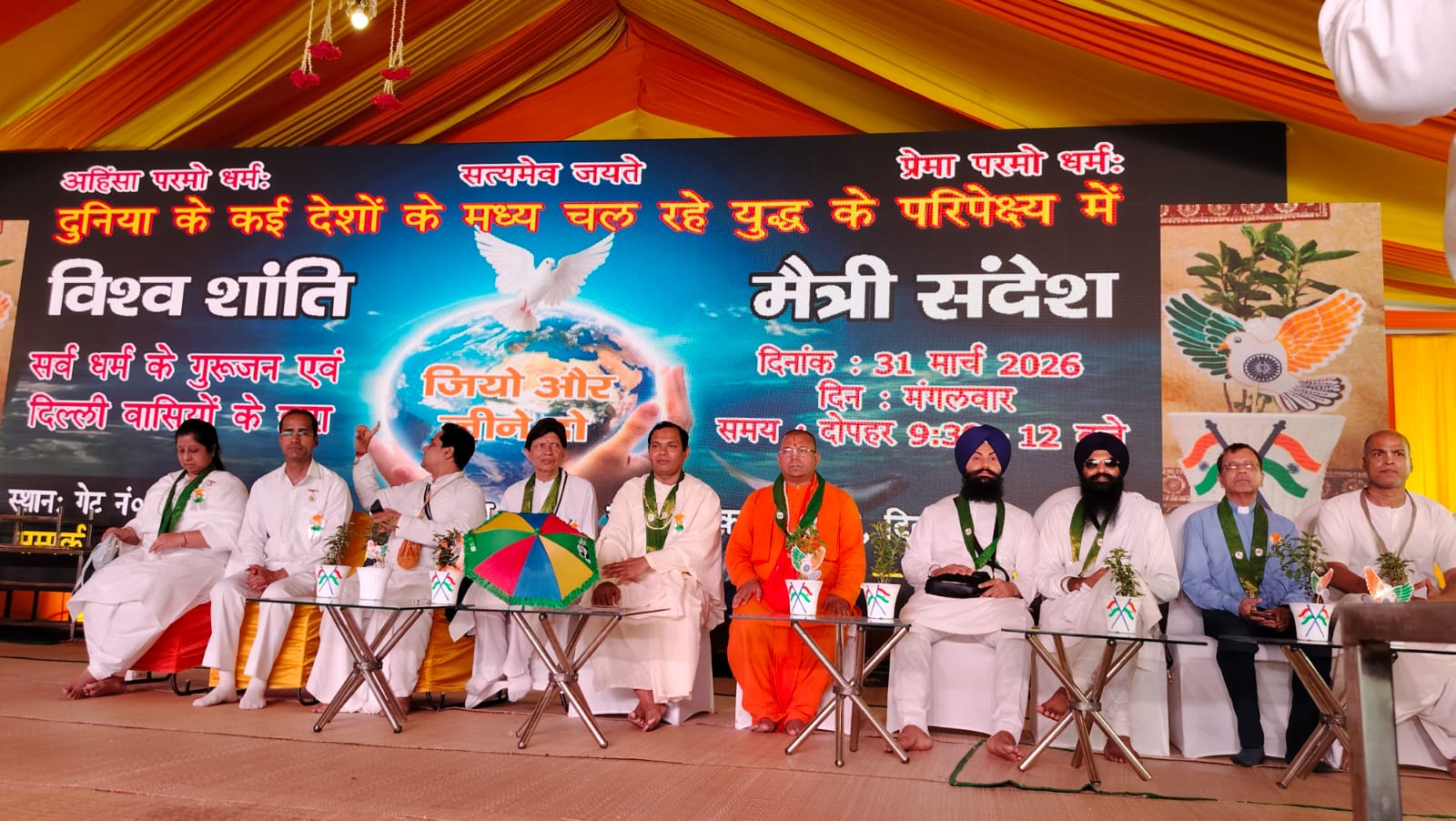
As conflict rages in West Asia following the joint US-Israeli military strikes on Iran that began on 28 February, prominent religious leaders from all major faiths in India came together at Red Fort grounds to participate in an Interfaith Prayer Assembly on Tuesday. The event sought to promote world peace, non-violence and nature conservation at a time of escalating global tensions.
The joint US-Israeli operation launched nearly 900 airstrikes in its initial phase, targeting Iranian military sites, air defences, missile installations, nuclear facilities and key infrastructure. Iranian retaliation has included waves of missile and drone attacks on Israel and US-linked targets across the region, while disruptions in the Strait of Hormuz have severely affected oil and gas flows.
Against this backdrop of mounting unrest, representatives from diverse religions and communities came together to deliver a collective message of harmony. The programme was organised by Sant Prithu Das and Shriman Vibhu Keshav Das (President), ISKCON Chhipiwara.
Responsibility for successfully conducting the event rested with Vakesh Jain, President of Prachin Shri Agrawal Digambar Jain Panchayat, Chandni Chowk, Delhi, and Punit Jain, Manager of Digambar Jain Temple, Chandni Chowk.
Religious leaders who participated included Mufti Mukarram Ahmad Shahi Imam of Fatehpuri Masjid; Tashi Khetup, Head of the World Buddhist Centre, East of Kailash; Sanjay Penjor Mala Thangpa; Father Anthony and Father Joseph Norbert of St Mary’s Catholic Church; Father Norbert Richard Dey (Pastor) of Central Baptist Church, Chandni Chowk; Karmel M. Tripathi, Head of the Lotus Temple, East of Kailash; Father Richard of St Stephen’s Church; Nandalal Ji, head of Kabir Panth; Sister Kavita of Brahmakumaris; and Granthi Agrenj Singh.
During the assembly, the leaders delivered messages of peace, observed a moment of silence, and released white doves as a symbol of peace. All participating religious figures were honoured.
The organiser, Sant Prithu Das, said that every living being on earth has an equal right to live. Humans should follow the principle of “live and let live” while maintaining the balance of nature. However, in today’s time, some people are engaged in destroying the natural and human order, which is creating an environment of imbalance and unrest.
Sant Vakesh Jain emphasised the role of people with divine nature, stating that such individuals always promote development, creation, love and harmony, whereas those with negative tendencies become the cause of destruction. Therefore, it is essential for society to move forward in the direction of peace, coexistence and harmony.
Representatives of all religions offered prayers to their respective deities for world peace and appealed to political leadership and all sections of society to maintain peace. They stated that in the present time, the world needs to unite to protect itself from unrest, violence and environmental crises.
The speakers highlighted the fundamental principles of human life, urging balance with nature, mutual cooperation and love. They stressed that adopting the principle of “Ahimsa Paramo Dharma” (non-violence is the highest religion) and ending all forms of violence is the need of the hour to establish an atmosphere of peace and harmony.
They noted that great men of all religions have taught the path of love, peace, contentment and joy. “Love is the supreme religion,” and through this, balance and unity can be established in society.
The programme also conveyed that just as people of different temperaments live together in one family, humanity as a whole should be treated as one family, living with a spirit of brotherhood and cooperation. Unity in diversity forms the foundation of world peace.
At the conclusion, all those present took a collective pledge to make continuous efforts for world peace, non-violence and nature conservation.
The ongoing war in West Asia has sent shockwaves across the globe. Disruptions to the Strait of Hormuz — a critical chokepoint for roughly one-fifth of the world’s oil and significant liquefied natural gas shipments — have triggered sharp rises in energy prices, with Brent crude climbing well above $100 per barrel in the weeks following the outbreak. This energy shock has fuelled inflationary pressures, raised production costs for industries worldwide, and forced some nations to ration fuel or subsidise energy for vulnerable populations.
Beyond economics, the conflict has heightened risks to global food security through higher fertiliser and transport costs, disrupted international shipping and aviation routes, and contributed to uncertainty in financial markets. Humanitarian concerns have grown, with reports of civilian casualties, damage to infrastructure, and broader regional instability affecting millions. In response, voices from diverse faiths, as seen in Delhi, continue to underscore the urgent need for dialogue, restraint and a return to shared human values of peace and coexistence.