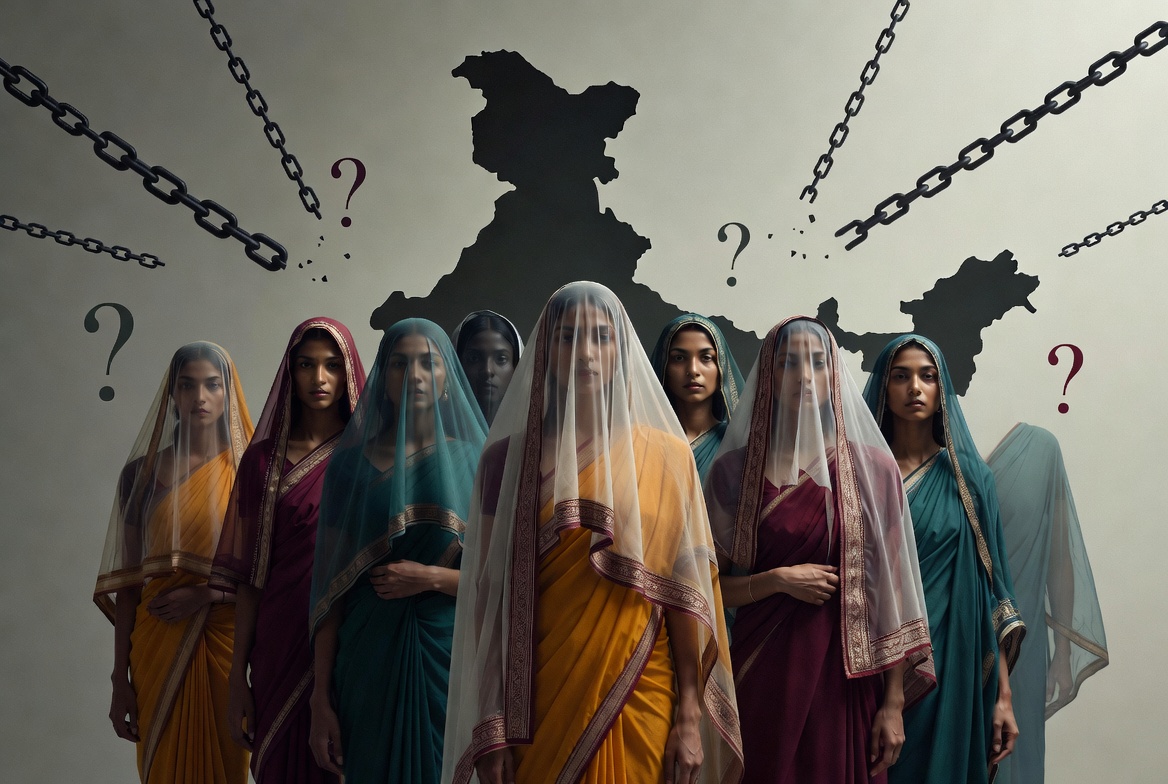
In offices, universities and political corridors across India, an unspoken belief continues to influence how people perceive and judge women: the idea that women from certain regions or communities have distinct romantic or relational tendencies. These assumptions, rarely discussed openly but widely shared in private conversations, form a powerful layer of gender stereotyping that is particularly intense in India.
Far from being mere casual chatter, these stereotypes reveal deeper social processes — how societies handle diversity, manage gender roles, and fill gaps created by limited interaction.
A Country of Differences — and Assumptions
India celebrates its diversity in language, food and culture. Yet this same diversity often fuels categorical thinking about people, especially women. Regional identities frequently come with unspoken labels: some groups are seen as more emotionally expressive, others as traditionally reserved, and some as more romantically inclined.
Social psychology research shows these are classic gender stereotypes — widely held generalisations about the attributes and behaviour of men and women. Such beliefs persist even as India modernises rapidly, as documented in studies published in journals like SAGE Open between 2018 and 2023.
The Indian Paradox
India presents a striking contradiction. The Constitution and public rhetoric strongly support gender equality, yet traditional attitudes remain firmly rooted. A 2022 Pew Research Center study found that while most Indians support gender equality in principle, nearly 80% believed men should have priority for jobs when opportunities are scarce.
This gap between ideals and practice creates space for informal narratives about “what kind of women come from which region or community”.
The Information Gap
A major driver of these stereotypes is the limited interaction between men and women during formative years. Many parts of India still feature segregated schooling, family-controlled social circles, and strong discouragement of open romantic interaction. This information deficit is often filled by anecdotes, media portrayals and peer stories.
As behavioural economists and psychologists like Daniel Kahneman and Amos Tversky have shown through the availability heuristic, people tend to generalise from vivid but limited examples rather than representative evidence. In India, a few memorable cases can quickly harden into perceived regional patterns.
Cultural Archetypes Without Evidence
Over time, certain regional identities have acquired romanticised archetypes — the emotionally expressive, the traditionally passionate, or the modern yet rooted. These images are reinforced by literature, cinema and generational storytelling. However, academic literature is clear: there is no robust empirical evidence that women from specific Indian regions are inherently more romantically inclined or relationally different than others. These remain products of collective cultural imagination.
Real-World Consequences
These stereotypes move beyond private talk and affect tangible outcomes.
In the workplace, women often face a competence-likeability double bind. Research by Heilman (2012) and Eagly & Karau’s Role Congruity Theory (2002) explains how this creates disadvantages in leadership roles. A 2019 British Council report on women in arts and culture leadership in India revealed women clustered in junior positions while being underrepresented at senior levels due to perception bias.
Occupational segregation remains strong, with men dominating high-paying technical and leadership roles and women concentrated in support and care-oriented functions, according to ILO and World Bank data (2019–2023).Stereotypes also distort everyday interactions: friendly behaviour may be misread as personal interest, and assertiveness viewed as aggression. Many women report concealing marriage or maternity plans to avoid bias, reflecting what researchers call anticipatory compliance.
Even education is affected. Studies from 2021–2024 show young women are often steered away from STEM fields due to societal expectations rather than aptitude — a trend consistent with UNESCO’s global findings.
Global Patterns, Indian Intensity
Stereotypes about women exist worldwide, but their intensity varies. Western societies moderate them through greater social mixing and dating norms. In parts of East Asia and the Middle East, restricted interaction similarly amplifies assumptions. What distinguishes India is the combination of vast internal diversity, rapid modernisation alongside tradition, strong family reputation systems, and persistent patriarchal structures — as noted in research from the Indian Journal of Gender Studies.
Why They Persist
Psychological mechanisms help explain their staying power: the availability heuristic, the Stereotype Content Model (Fiske et al., 2002), and Sexual Economics Theory (Baumeister & Vohs, 2004). Together they show how limited interaction plus cultural narratives create amplified perceptions that become self-reinforcing.
The Cost — and the Way Forward
These distortions carry real costs: misjudged intentions, talent underutilisation, slower progress toward equality, and a distorted view of human behaviour.
India’s challenge is not unique, but it is urgent. Moving forward requires shifting from assumption to observation, and from inherited narratives to evidence-based understanding. Only then can perceptions align more closely with reality and allow individuals and institutions to move beyond outdated constructs.