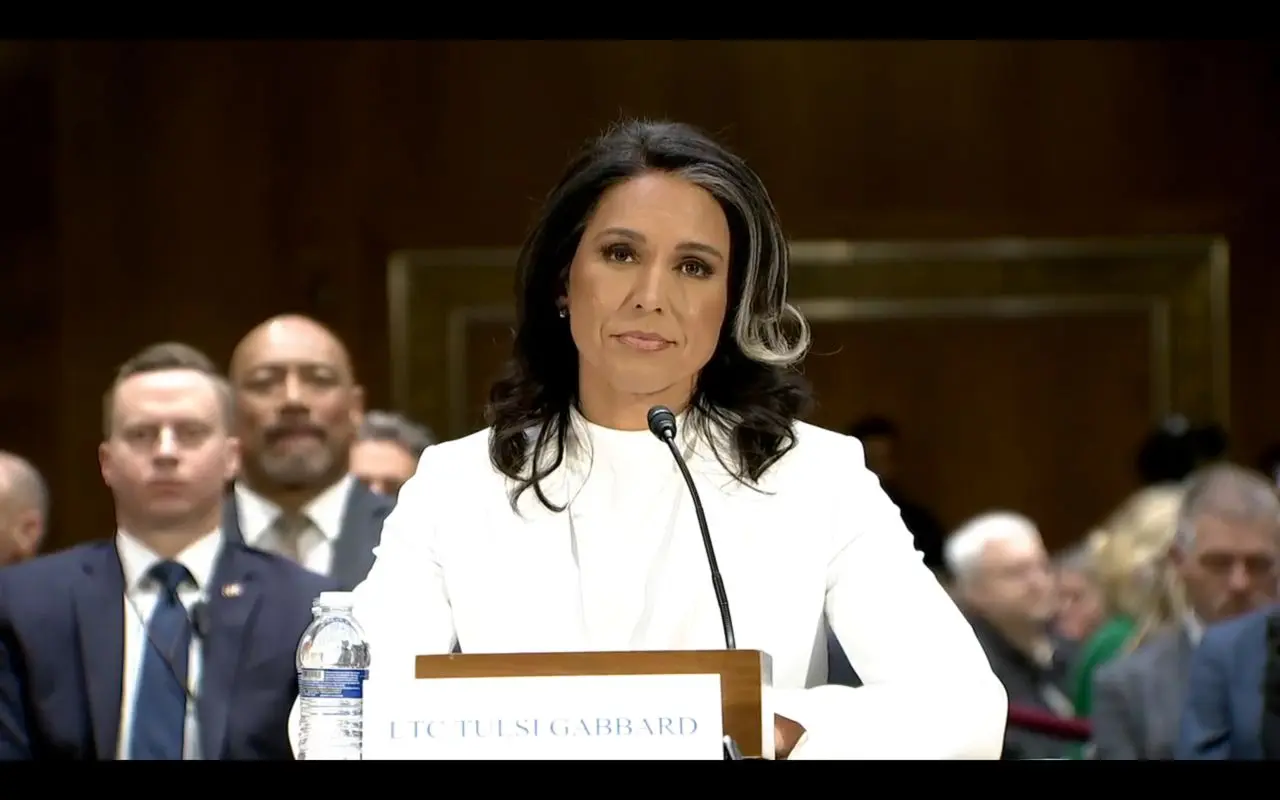
Tulsi Gabbard, President Donald Trump’s director of national intelligence, has resigned, citing the need to care for her husband, who has been diagnosed with an extremely rare form of bone cancer. The departure, effective June 30th, marks the latest turbulence in an administration already marked by high-profile exits. Though framed as a personal decision, it caps months of quiet friction over America’s military engagement with Iran and questions about the independence of its intelligence apparatus.
Ms Gabbard informed the president during an Oval Office meeting on May 22nd. In her resignation letter, posted on X, she wrote: “Unfortunately, I must submit my resignation… My husband, Abraham, has recently been diagnosed with an extremely rare form of bone cancer.” Abraham Williams, a cinematographer and her partner of more than a decade, has been a steady presence through her military deployments and political odyssey. Friends describe the couple as unusually close; her decision to step away reflects the gravity of the diagnosis rather than mere political calculation.
An unconventional choice
Ms Gabbard was always a surprising pick for the role. A combat veteran with two tours in the Middle East, former Democratic congresswoman from Hawaii, and one-time presidential candidate, she lacked traditional intelligence credentials when tapped to oversee America’s 18 spy agencies in early 2025. The Office of the Director of National Intelligence was created after the September 11th attacks to foster coordination; she arrived promising to depoliticise it.
Her journey to the post was circuitous. She rose in Democratic ranks as a critic of endless foreign wars, endorsed Bernie Sanders in 2016, then Joe Biden in 2020. Disillusioned with what she called her party’s “elitist cabal of warmongers and woke ideologues,” she left the Democrats, became an independent, and eventually aligned with Mr Trump—another vocal sceptic of nation-building adventures. Her Hindu faith (she was sworn into Congress with a hand on the Bhagavad Gita) and American Samoan roots added to her outsider appeal.
In office, she moved swiftly. She oversaw staff reductions, budget savings, the elimination of certain diversity initiatives, and a push to declassify documents. She launched task forces to reform the intelligence community and supported Mr Trump’s efforts to revisit the 2020 election. Critics, particularly Democrats, accused her of politicising the very office she sought to cleanse, including a much-noted appearance at election-related activities in Georgia. A whistleblower complaint alleged she withheld intelligence for political reasons.
Iran and the limits of loyalty
The real strain emerged over Iran. Ms Gabbard’s long-standing opposition to foreign entanglements clashed with the administration’s decision to join Israel in striking Iranian targets starting in late February 2026. Joe Kent, her close ally and director of the National Counterterrorism Centre, resigned in March, stating he could not support a war against a country that “posed no imminent threat.” His exit was the first major public defection over the conflict.
Ms Gabbard’s own testimony proved awkward. In written remarks to Congress, she noted that Iran had made no effort to rebuild its nuclear programme after earlier American strikes had “obliterated” it—language that sat uneasily with Mr Trump’s insistence on an imminent danger. During hearings, she dodged direct endorsement of the strikes, repeatedly stressing that threat assessments were ultimately the president’s call, not the intelligence community’s. Lawmakers pressed her on the Strait of Hormuz and potential fallout; her measured, non-committal replies drew notice.
Reports suggest mounting presidential impatience. Mr Trump had privately sounded out advisers about replacing her. Her reluctance to fully echo the White House line, even as she attempted to demonstrate loyalty elsewhere, left her position precarious. Some observers noted she appeared sidelined in key discussions once the conflict escalated.
Her departure is the fourth Cabinet-level exit in Mr Trump’s second term. Kristi Noem left the Department of Homeland Security amid criticism of immigration enforcement and disaster response. Pam Bondi stepped down as attorney-general over frustrations with the Justice Department’s handling of sensitive files. Labour Secretary Lori Chavez-DeRemer resigned after misconduct probes. Such churn is not unknown in this administration, but the pattern hints at the difficulty of balancing fierce personal loyalty with governing realities.
A Hindu veteran in Washington
Born in American Samoa, raised in Hawaii with a spell in the Philippines, Ms Gabbard entered politics young. Elected to Hawaii’s state house at 21, she deployed to Iraq with the National Guard, interrupting her career. She became the first Hindu and first American Samoan in Congress. Her early support for progressive causes gave way to sharp critiques of her party’s foreign policy.
That anti-interventionist streak defined her—and ultimately complicated her service under a president who, despite campaign promises to avoid unnecessary wars, found himself drawn into another Middle Eastern conflict. Supporters praise her integrity and willingness to speak uncomfortable truths. Detractors saw naivety or inconsistency once in power.
Her resignation letter pledged a smooth transition. Mr Trump is said to have thanked her for her service; Aaron Lukas will serve as acting director in the interim. No permanent successor has been named.
In the end, family necessity has provided an honourable exit from a role that tested the limits of Ms Gabbard’s principles. America’s intelligence community continues its work amid great-power competition, but the episode underscores the enduring tension between ideological consistency and the messy demands of high office. For a politician who built her brand on opposing forever wars, the Iran chapter proved a bridge too far—personal circumstances allowing a graceful departure where policy differences might otherwise have forced a sharper break.