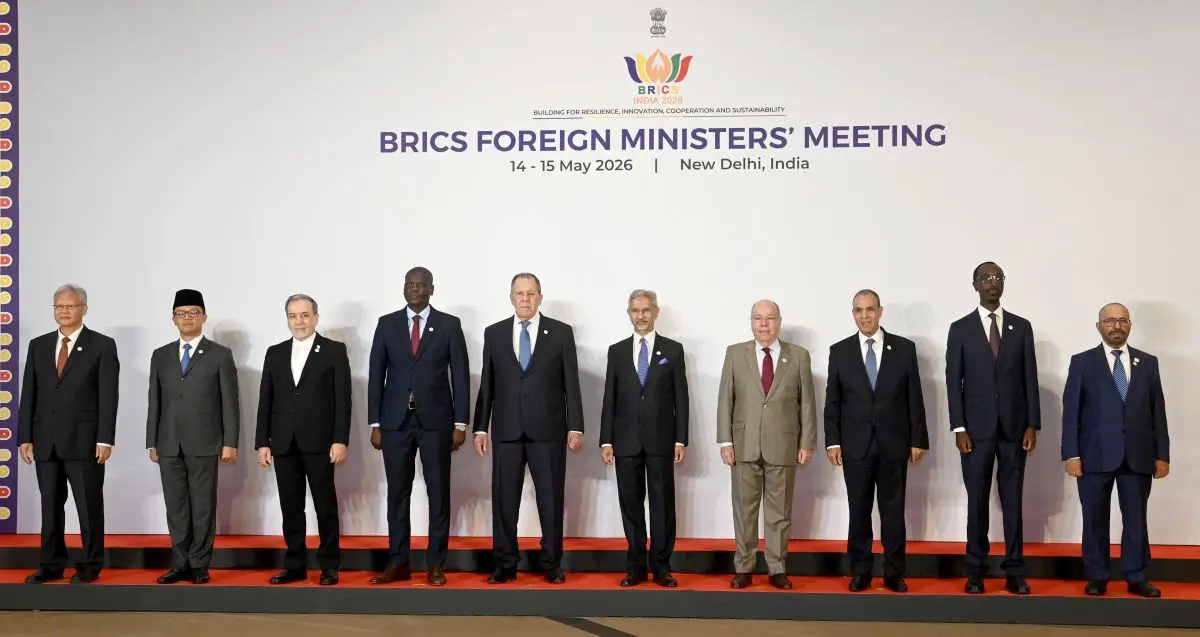
As foreign ministers from an expanded BRICS gathered in India’s capital this week, the gathering carried the weight of a world in flux. External Affairs Minister S. Jaishankar, chairing the sessions, did not mince words. “Peace cannot be piecemeal”, he declared, framing the bloc’s discussions against the backdrop of escalating tensions in West Asia, disrupted energy flows through the Strait of Hormuz, Houthi-related threats in the Red Sea, and the enduring humanitarian catastrophe in Gaza.
The timing was no coincidence. Since late February 2026, direct military exchanges involving U.S. and Israeli strikes on Iranian targets, followed by Iranian retaliation—including actions affecting maritime traffic—have turned critical waterways into zones of high risk. Reports indicate significant disruptions: vessels seized or attacked, energy infrastructure strained, and oil prices spiking amid fears of prolonged closure or interference in the Strait of Hormuz, through which roughly one-fifth of global oil and LNG transits.
Jaishankar’s address blended principled diplomacy with pragmatic alarm. Without naming specific actors, he stressed respect for sovereignty and territorial integrity as the bedrock of international relations. Dialogue and diplomacy, he argued, remain the only sustainable path—echoing a longstanding Indian preference for multilateral solutions over unilateral force or sanctions. India, he said, stands ready to support de-escalation and stability initiatives.
Energy Fragility and Global Ripple Effects
The concerns are not abstract. For import-dependent economies like India—one of the world’s largest oil buyers—any sustained disruption in the Hormuz or Red Sea routes translates into higher costs, inflationary pressures, and supply chain headaches. New Delhi has already undertaken operations to secure its tankers. Yet the message from Jaishankar extended beyond national interest: safe, unimpeded maritime flows are “vital for global economic well-being”. Disruptions here do not merely affect Gulf exporters and Asian importers; they ripple into European energy security, global inflation, and the stability of emerging markets.
Geopolitically, the crisis tests BRICS’ coherence. The bloc now includes original members Brazil, Russia, India, China, and South Africa, alongside newer entrants Egypt, Ethiopia, Iran, the UAE, and Indonesia (with Saudi Arabia’s status nuanced). This diversity—encompassing major energy producers, consumers, and actors with differing ties to Western powers—makes consensus challenging. Iranian Foreign Minister Abbas Araghchi’s presence alongside Russia’s Sergey Lavrov and others underscores the bloc’s role as a forum where Global South perspectives, often skeptical of Western-led interventions, can be aired.
Jaishankar highlighted the “grave humanitarian implications” in Gaza, reiterated support for a two-state solution to the Palestinian issue, and noted challenges in Lebanon, Syria, Sudan, Yemen, and Libya. “Stability cannot be selective”, he said. This stance aligns with India’s traditional balancing act: maintaining strong defense and energy ties with Israel while upholding longstanding support for Palestinian statehood and engaging Arab partners.
Pushback Against Unilateralism
A recurring theme was criticism of “unilateral coercive measures and sanctions inconsistent with international law and the UN Charter”. Such tools, Jaishankar noted, disproportionately harm developing countries and cannot replace diplomacy. This resonates deeply within BRICS, where members like Russia and Iran face extensive Western sanctions regimes. Analysis from various outlets frames these measures as remnants of unipolarity in a increasingly multipolar world—tools that accelerate de-dollarization efforts, alternative payment systems, and South-South trade, even as they impose short-term pain.
For India, which has navigated secondary sanctions risks while expanding ties with Russia (notably in oil) and maintaining energy imports, the position is pragmatic. It underscores a broader BRICS narrative: the current international architecture often fails the Global South, whether on sanctions, climate finance, or representation in institutions like the UN Security Council.
Jaishankar renewed the call for UNSC reform in both permanent and non-permanent categories, warning that delays come at a “high cost”. With BRICS representing nearly half the world’s population, over 40% of global GDP at purchasing power parity (PPP), and a significant share of trade, the bloc positions itself as a voice for reformed multilateralism—though internal divergences (e.g., India-China border issues or varying Gulf alignments) limit its immediate transformative power.
Broader Horizons: Terrorism, Tech, and Climate
Beyond West Asia, the minister flagged cross-border terrorism as requiring “zero tolerance”, a pointed reference consistent with India’s concerns over groups operating from safe havens. He also touched on technological shifts—opportunities laced with risks around trust, transparency, and the digital divide—and climate action paired with “climate justice”, credible financing, and support for vulnerable nations.
Implications: A Stabilizing Force or Ambitious Talk?
As India hosts this foreign ministers’ conclave ahead of its full BRICS summit later in 2026, the gathering signals the bloc’s maturation into a platform for emerging powers to coordinate amid great-power competition. Yet realism tempers optimism. BRICS lacks the military cohesion of alliances like NATO or the unified economic leverage of the G7. Its influence lies more in agenda-setting, economic resilience (trade within the group, alternative financing), and diplomatic cover for members navigating crises.
Jaishankar’s emphasis on practical cooperation—navigating upheavals, safeguarding sea lanes, and upholding international law—reflects New Delhi’s self-image as a responsible stakeholder: a democracy with civilizational depth, economic heft, and a preference for strategic autonomy. In a region where selective peace deals have repeatedly faltered, the insistence that “peace cannot be piecemeal” offers a sober reminder. Whether BRICS can translate shared concerns into tangible outcomes—de-risked supply chains, humanitarian corridors, or pressure for ceasefires—will test its relevance.
For now, in the halls of Bharat Mandapam, the message from Delhi is clear: in an era of fragmented conflicts and contested norms, selective stability is an illusion. The world’s emerging powers are watching—and positioning themselves to shape what comes next.