“He is ready to rumble,” declared Karoline Leavitt, the White House press secretary, on the red carpet outside the Washington Hilton on April 25th. “This speech tonight will be classic Donald J. Trump. It will be funny. It will be entertaining. There will be some shots fired tonight.” The remark, offered in a cheerful preview to a Fox News correspondent, was meant as light-hearted anticipation of presidential zingers aimed at the assembled press. By the end of the evening, it had taken on a rather different cast.
The White House Correspondents’ Association dinner is one of Washington’s more durable rituals: an annual black-tie gathering at which journalists and politicians exchange barbed pleasantries, raise money for scholarships and pretend, for a few hours, that mutual loathing can be set aside for the sake of wit. Mr Trump, who skipped the event throughout his first term, had chosen this year to attend for the first time as sitting president. The ballroom filled with the usual uneasy coalition of cabinet members, network anchors, Silicon Valley executives and the odd film star. Salads were cleared. The president sat on the dais beside the first lady and Weijia Jiang of CBS News, the association’s president.
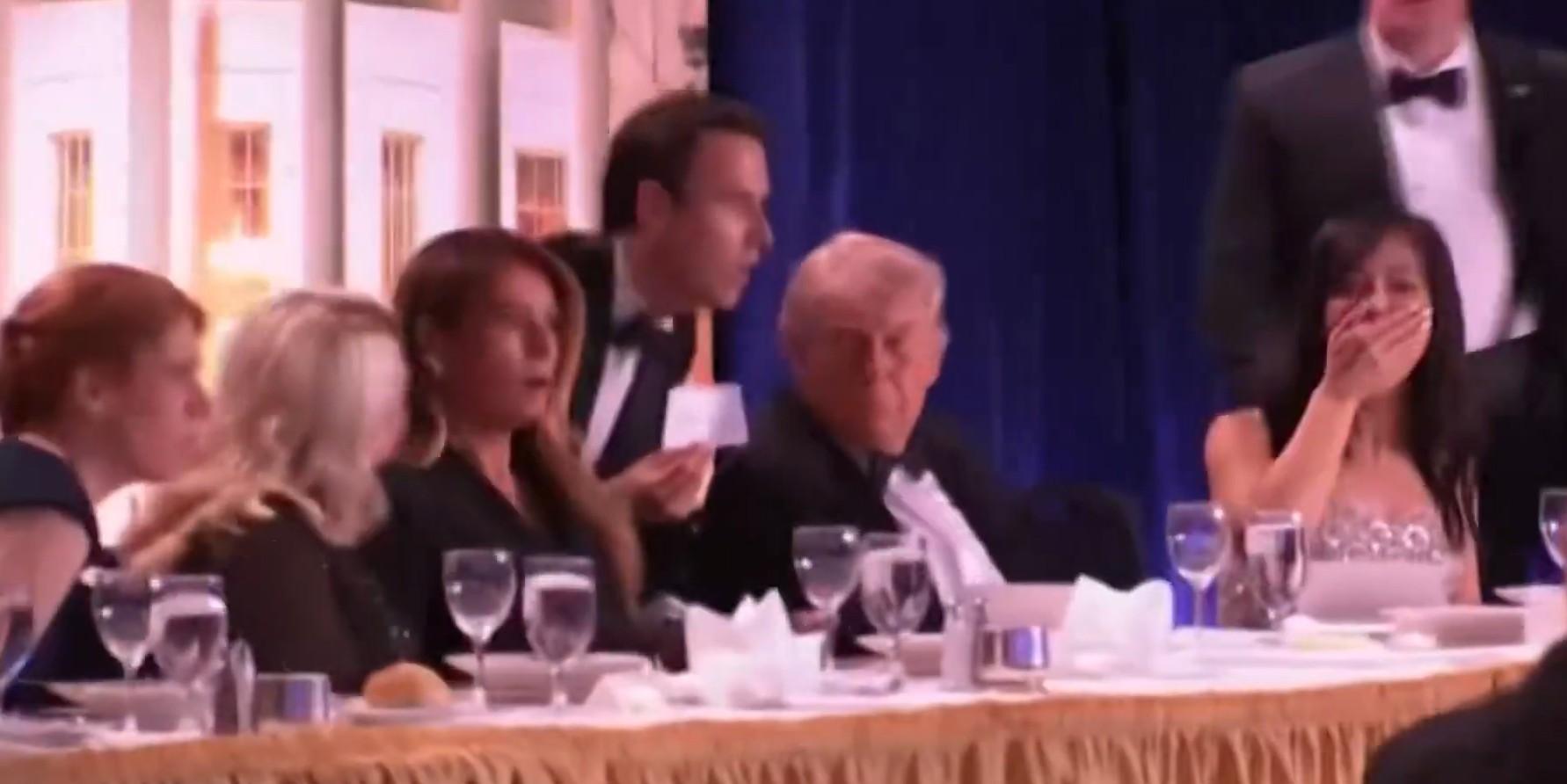
Shortly after 8:40pm, the evening fractured. In the lobby outside the main security checkpoint, a man later identified as Cole Tomas Allen, a 31-year-old from Torrance, California, who had been staying at the hotel, rushed the magnetometers. He was armed with a shotgun, a handgun and several knives. Security footage shows him sprinting forward. Secret Service agents moved in. At least one shot was fired by the assailant; agents returned fire. One agent was struck in the torso but protected by his vest. Inside the ballroom the reports were audible. Shouts of “Get down!” rippled across the tables. Guests dived beneath linen. Reporters who had come to chronicle satire found themselves chronicling something closer to panic.
The evacuation was brisk and well-drilled. Mr Trump and the first lady were ushered from the stage. Ms Leavitt, visibly pregnant, left alongside senior officials including the vice-president. The ballroom emptied within minutes. The dinner—intended as the season’s centrepiece of practised irreverence—was abandoned. The Hilton, which in 1981 had seen John Hinckley Jr wound Ronald Reagan outside its doors, had once again supplied an unwelcome footnote to presidential history.
Mr Trump returned to the White House and spoke briefly from the briefing room. He called the gunman a “sick person” and a lone actor, praised the Secret Service and observed, with his customary flourish, a momentary unity born of fear. Mr Allen was taken into custody and hospitalised for evaluation. He faces charges including assault on a federal officer and the use of a firearm in a crime of violence. Investigators believe he acted alone; his motives remain obscure. Public records suggest an unremarkable background: a tutor and amateur video-game developer with no evident history of political extremism.
By Sunday morning the coincidence had acquired its own momentum. Ms Leavitt’s earlier words, captured on video, circulated rapidly on social media. What had been intended as showmanship—“there will be some shots fired tonight”—now sounded eerily prophetic. Reactions ranged from grim humour to darker speculation, though claims of foreknowledge found little credible support. The episode arrives at a delicate point in Mr Trump’s second term. His administration has moved with characteristic energy on executive priorities while renewing old battles with institutions he once labelled the “enemy of the people”. The press corps, for its part, continues its uneasy dance between professional detachment and institutional friction.
This was the third time in three years that Mr Trump has been exposed to the sound of gunfire in a public setting. Each occasion has underscored both the proficiency of his protection detail and the persistent undercurrent of political violence in America. The dinner itself embodies a fragile truce: a night when power and its chroniclers acknowledge, however sardonically, their interdependence. On this occasion the truce proved brief.
No one died. The institutions held. The suspect is in custody. Yet the images—of a president hurried from the dais, of black-tie guests cowering under tables, of an evening of scripted mockery interrupted by the unscripted crack of real weapons—will endure. They serve as a reminder that in today’s Washington even the most ritualised display of political theatre can be overtaken by something rawer. The dinner will doubtless be rescheduled. Speeches will eventually be delivered. But the echo of those actual shots may prove more lasting than any rhetorical salvo Mr Trump had prepared.