After seven years of suspension caused by unstable Himalayan geology, concrete began pouring once more this week at Bhutan’s long-delayed Punatsangchhu-I hydropower project, a symbolic and practical milestone in one of the region’s most ambitious bilateral infrastructure endeavours.
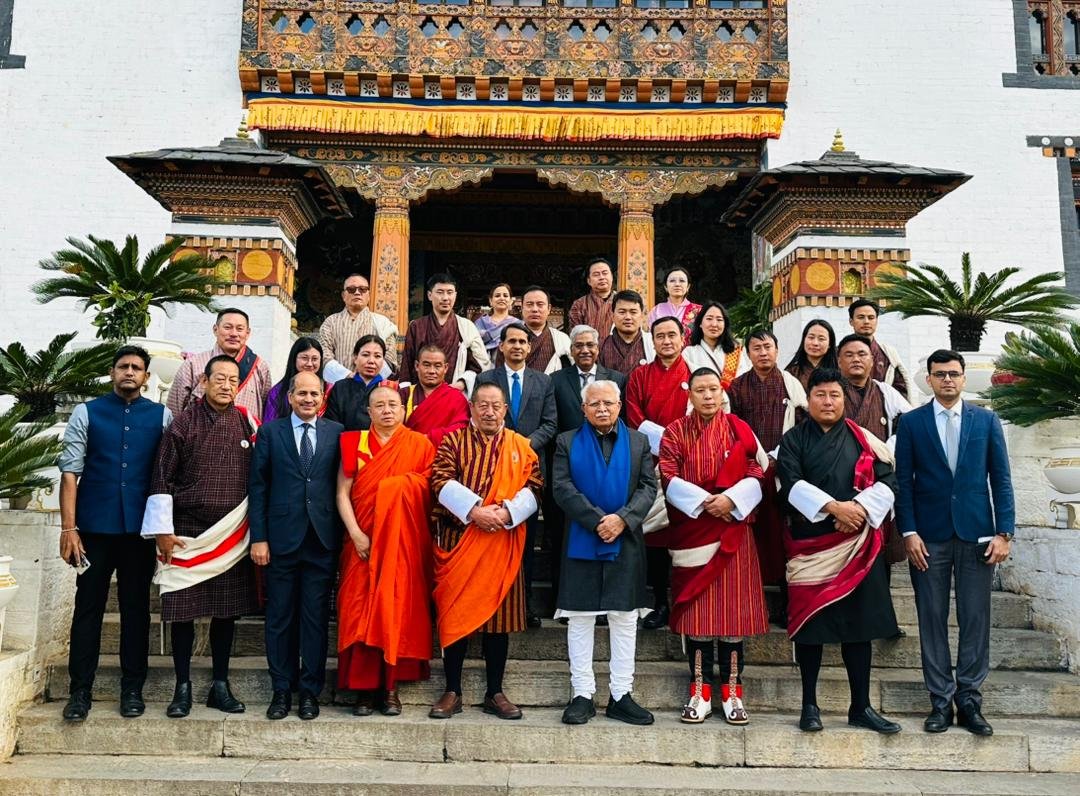
India’s Union Minister for Power , Manohar Lal, joined Bhutan’s Energy and Natural Resources Minister, Gem Tshering, at the remote site in Wangdue Phodrang district for the ceremonial first pour that restarted main dam construction on Friday. The 1,200-megawatt run-of-the-river scheme on the Punatsangchhu River had been largely frozen since 2019 after severe slope destabilisation threatened the right bank of the proposed dam.
The project, Bhutan’s largest single hydropower venture and a flagship of decades-long India-Bhutan energy cooperation, had already consumed years and far more money than originally planned. Work began in 2008 with an initial target commissioning date of 2015 and an approved cost of about Rs 9,376 crore (at 2013 prices). By early 2026, financial progress stood at roughly 94 per cent and physical completion at nearly 88 per cent, yet the critical dam component remained stalled. A revised cost estimate is still under review, with total expenditure already exceeding expectations because of repeated geological surprises, design changes and the need for extensive stabilisation measures.
Geological challenges in the young and fragile Himalayas have plagued the project from the outset. Experts had warned of weak rock formations, shear zones and clay gouge on the right bank even before full construction advanced. In 2013 the slope began to move, leading to a halt in dam works by 2019 after further destabilisation. Similar difficulties have affected other Himalayan projects, underscoring the technical risks of building large infrastructure in seismically active terrain prone to landslides and unpredictable rock behaviour.
The restart follows intensive technical deliberations between the two governments. In July 2025 they agreed on a way forward to stabilise the slope and resume dam construction. Officials now speak of completion within five years, though past experience suggests caution. Once operational, Punatsangchhu-I is expected to generate around 5,670 million units of electricity annually and boost Bhutan’s total installed hydropower capacity by about 30 per cent, to nearly 4,700 MW. Surplus power will be exported to India at a mutually agreed tariff, continuing a long-standing arrangement that has become a vital revenue stream for the Himalayan kingdom.
For Bhutan, hydropower remains the backbone of the economy. It accounts for a substantial share of GDP and roughly 63 per cent of total exports, with the bulk of that electricity flowing south to India. Revenue from power sales funds social programmes, infrastructure and debt servicing in a country that pursues “Gross National Happiness” alongside conventional development goals. Successful completion of Punatsangchhu-I, alongside the recently commissioned Punatsangchhu-II (1,020 MW), would mark a significant step towards harnessing more of Bhutan’s estimated 23,000 MW hydropower potential while reducing seasonal dependence on Indian imports during dry months.
For India, the project carries both practical and strategic weight. Bhutanese hydropower supplies clean, renewable electricity that helps balance the Indian grid, supports decarbonisation targets and diversifies energy sources away from coal. New Delhi has financed the scheme with a 40 per cent grant and 60 per cent loan, reflecting a broader pattern of development partnership. India has backed several major projects in Bhutan over the decades — from the early Chukha and Tala plants to Mangdechhu and the now-operational Punatsangchhu-II, which was jointly inaugurated by Prime Minister Narendra Modi and Bhutan’s King Jigme Khesar Namgyel Wangchuck in November 2025 and has already begun exporting power.
The relationship extends beyond economics. Bhutan sits at a sensitive geopolitical crossroads, sharing borders with India and China. Stable, mutually beneficial ties with Thimphu have long formed a pillar of India’s neighbourhood policy. Hydropower cooperation reinforces trust, creates jobs (many filled by Bhutanese workers) and binds the two countries through shared infrastructure and technical collaboration. During his visit, Minister Lal also called on the King and reviewed operations at Punatsangchhu-II, which is already generating revenue, including from exports to India.
Yet the Punatsangchhu experience has not been without criticism. Delays and cost overruns have drawn scrutiny in both countries, with questions raised about initial site assessments and project management. Some voices in Bhutan have voiced concerns over environmental risks, displacement (though limited in run-of-the-river schemes) and the country’s heavy reliance on a single sector vulnerable to climate change and glacial lake outburst floods. Indian and Bhutanese authorities insist lessons have been learned, with greater emphasis now on robust geological studies and disaster-resilient design for future projects.
During his four-day trip, which also included a visit to the historic Wangdue Phodrang Dzong, Minister Lal described the restart as a reflection of the “strong and enduring” India-Bhutan partnership. Bhutanese officials echoed the sentiment, viewing the concrete-pouring ceremony as proof of joint commitment to overcome technical hurdles through sustained dialogue and expertise.
In the broader context of South Asian energy diplomacy, the resumption matters. As India pursues ambitious renewable targets and Bhutan seeks to diversify its economy while maximising its natural resources, projects like Punatsangchhu-I illustrate both the promise and the pitfalls of Himalayan hydropower. Success here could accelerate other stalled or planned initiatives and strengthen cross-border power trade in the region.
For now, the focus returns to the dam site, where engineers must carefully stabilise the slope while pouring concrete in challenging terrain. If the revived schedule holds, electricity from Punatsangchhu-I could begin flowing within five years — delivering clean power to Indian homes and industries, steady revenue to Bhutan’s coffers, and fresh evidence that even formidable geological obstacles need not derail a longstanding strategic friendship.