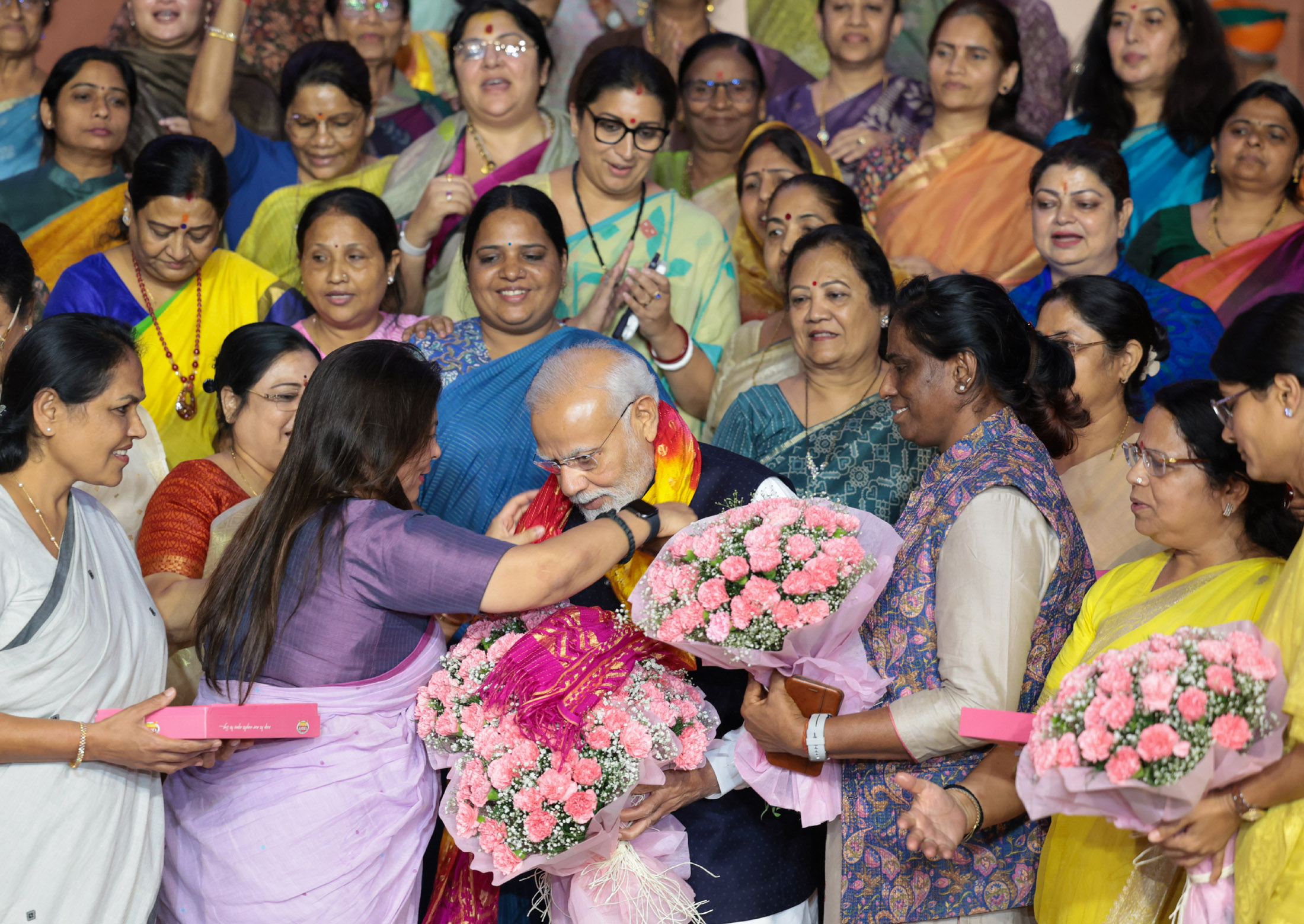
In the world’s largest democracy, where women make up half the electorate but have long been sidelined in the halls of power, a quiet constitutional revolution is under way. Next week, from April 16th to 18th, India’s parliament will hold a special three-day sitting to amend the Nari Shakti Vandan Adhiniyam—the Women’s Reservation Act passed in 2023—and delink the promised 33% quota for women from the next census and delimitation exercise. The move, cleared by the Union Cabinet earlier this month, aims to bring the reservation into force for the 2029 general election rather than waiting until the 2030s.
The principle itself commands near-universal support. Neither the government of Narendra Modi nor the opposition parties dispute the need to reserve one-third of seats in the Lok Sabha and state assemblies for women. Differences remain over timing, the use of 2011 census data for a fresh delimitation, and the planned expansion of the lower house from 543 to around 816 seats. Yet on the core idea of delinking the quota from the census-delimitation tangle, a rare consensus has emerged. After decades of false starts, India is poised to enact what could be the largest single act of affirmative action in modern democratic history.
The journey to this point has been long and tortuous. The demand for women’s reservation dates back to the 1990s. The first serious attempt came in 1996 under the United Front government; six more bills followed, all of which lapsed. In 2010 the Congress-led UPA government managed to pass the measure in the Rajya Sabha, only for it to collapse in the Lok Sabha amid raucous protests from the Samajwadi Party and Rashtriya Janata Dal, which demanded “reservation within reservation” for women from backward classes and minorities. The bill gathered dust until September 2023, when Mr Modi’s government steered the 106th Constitutional Amendment through both houses almost unanimously. Even then, implementation was tied to the first census after 2026 and the subsequent delimitation—an exercise that might not have concluded until 2033 or later.
By fast-tracking the law now, the government hopes to ensure that the 18th Lok Sabha, elected in 2029, will be the first in which at least 181 of 816 seats (and a corresponding proportion in state assemblies) are occupied by women. Seats will rotate every two election cycles, and existing reservations for Scheduled Castes and Tribes will be preserved within the women’s quota. The expansion in total seats is intended to accommodate the new quota without displacing male incumbents en masse, though it has already stirred regional anxieties: southern states fear a dilution of their relative weight if delimitation is based on 2011 population figures rather than fresher data that would better reflect current demographic realities.
The implications for Indian democracy are profound. At the most basic level, the change addresses a glaring deficit. Women currently hold just under 15% of Lok Sabha seats—far below the global average of 27.5% and light-years from the parity achieved in a handful of countries.
India’s record in local government offers a tantalising preview of what may come. Since the 73rd and 74th constitutional amendments of 1992-93 reserved one-third of seats in panchayats and municipalities for women, more than 1.4m female representatives have been elected. Studies have shown that women-led councils spend more on drinking water, sanitation, education and health—issues that matter disproportionately to female voters. Crime against women tends to fall, and girls’ school enrolment rises. The “critical mass” theory, long discussed by political scientists, suggests that once women reach roughly 30% of a legislature they cease to be tokens and begin to shift priorities. India’s local experience lends empirical weight to the claim.
Yet scaling up from village councils to the national parliament is no small feat. The new law will reshape the political ecosystem in three distinct ways. First, in polity. The simultaneous expansion of the lower house and state assemblies will redraw the electoral map more dramatically than any delimitation since 1976. Northern states with faster population growth stand to gain more seats; southern states, which have done better at family planning, may lose relative influence. Critics worry that rushing the exercise on 2011 data could exacerbate federal tensions precisely when India’s southern leaders are already vocal about fiscal devolution. The rotation of reserved seats every decade will also force parties to cultivate fresh female talent rather than relying on a handful of dynastic women.
Second, in society. For millions of Indian women, particularly in rural and small-town India, the law signals that politics is no longer an exclusively male preserve. It may encourage more girls to stay in school, more women to enter the workforce, and more families to value daughters as potential leaders rather than brides. The symbolic power should not be underestimated in a country where female labour-force participation remains stubbornly low and patriarchal norms still constrain ambition. At the same time, sceptics warn of “proxy” candidates—wives or daughters fielded in place of powerful men who continue to pull strings from behind the scenes. The absence of sub-quotas for OBC, Dalit or minority women, a sticking point since 2010, means the initial beneficiaries may skew towards more educated, upper-caste or urban women. Over time, parties will have to broaden their search for candidates or risk internal revolts.
Third, in democracy itself. Quotas are blunt instruments, and India has long debated whether they undermine merit or entrench identity politics. Yet the alternative—waiting for organic change—has produced glacial progress. Globally, the evidence is clear: quotas work, especially reserved seats. According to the International Institute for Democracy and Electoral Assistance, 138 countries now use some form of gender quota, whether voluntary party targets, legislated candidate quotas or reserved seats. Chambers with quotas elect, on average, 30.9% women; those without manage just 23.3%.
Only a minority of nations, however, have opted for constitutionally mandated reserved seats—the model India is now embracing. Rwanda leads the world with 64% women in its lower house, thanks to a post-genocide constitution that reserves 30% of seats for women (the rest are open but often won by female candidates). Tanzania, Uganda and Burundi have similar systems. In Latin America, Bolivia and Nicaragua have achieved parity through a mixture of quotas and political will. Europe, by contrast, relies more on voluntary or candidate quotas; Germany, France and Spain have seen steady rises without fixed seat reservations. Subnational legislatures rarely feature such provisions; India’s decision to extend the quota to all state assemblies makes it almost unique in scale.
The broader global picture remains sobering. As of January 2026 women hold just 27.5% of parliamentary seats worldwide, a gain of only 0.3 percentage points in the past year. Only seven countries have reached 50% or more in their lower or single houses. In 101 countries a woman has never led the government.
Against this backdrop, India’s leap is audacious. If successful, it will add hundreds of female voices to the national conversation in a single electoral cycle—more than the total number of women parliamentarians in most European legislatures combined.
Success is not guaranteed. Parties will need to invest in training and mentoring. The Election Commission must devise watertight rules for seat rotation and delimitation to prevent gerrymandering. And the political class must resist the temptation to treat the quota as a photo opportunity rather than a genuine transfer of power. The opposition’s demand for wider consultation before the special session reflects genuine concerns about process, not opposition to the principle. An all-party meeting on April 15th may yet smooth the path.
For a country that prides itself on being the mother of democracy, the move is both overdue and timely. India’s women have waited 78 years since independence for a proportionate say in the world’s largest experiment in self-rule. By delinking the quota from the census labyrinth, parliament is signalling that representation cannot wait for perfect data. The real test will come after 2029, when the reserved seats are occupied and the question shifts from “how many women?” to “what difference do they make?” If the panchayat precedent is any guide, the answer could be transformative—not just for Indian women, but for the quality of governance in the planet’s most populous nation.