From Red Veils to Emmer Cake: The Ancient Rite Winning Modern Hearts
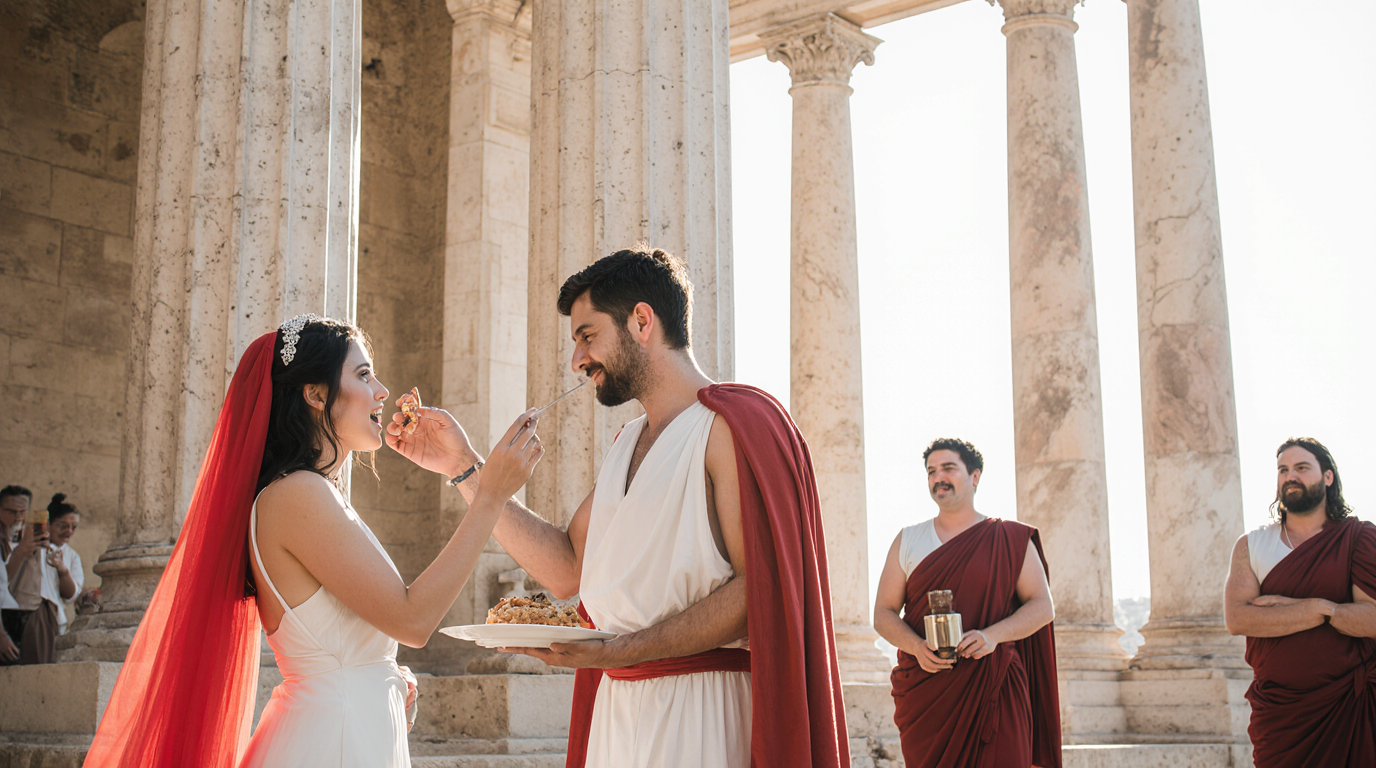
On a warm October afternoon in the Roman Forum, Valeria Rossi stands beneath the ruins of the Temple of Vesta wearing a flame-red veil that has not been seen at an Italian wedding for two millennia. She and her partner, Matteo, are about to be married by confarreatio – the ancient Roman rite sealed by the sharing of a simple emmer-wheat cake offered to the old gods Jupiter and Juno.
Once reserved for patrician families and high priests, confarreatio is quietly becoming the ceremony of choice for thousands of young Italians who want their wedding to feel unmistakably, unapologetically Roman.“
It’s not about rejecting anything,” Valeria says, laughing as she adjusts the flammeum over her dark hair. “It’s about choosing something that already belongs to us. The veil, the cake, the words – they’re older than any church in this city.”
The ritual is exacting in its beauty. Ten witnesses must be present. The bride’s hair is parted six times with a spear once used in battle. A spelt-flour cake (panis farreus) is broken and shared while the couple pronounce vows in archaic Latin that most guests only half-understand. Yet every detail is documented in breathless detail on Instagram and TikTok, where the hashtag #confarreatio has quietly crossed two million posts.“
People see the red veil against the marble and they lose their minds,” says celebrant Luca Marini, one of a handful of officiants trained in the revived rite. “Suddenly everyone wants the photos that look like they stepped out of a fresco.”
What began as a niche interest among classicists and history buffs has spread to urban professionals, artists, and even couples who have never opened a Latin textbook. The ancient words feel fresh precisely because they predate every modern institution.
In Milan, Naples, and Turin, wedding planners now offer “confarreatio packages” complete with toga-clad musicians playing lyres and double-flute aulos. In the countryside outside Florence, a former vineyard has been converted into an open-air temple where couples exchange vows at sunset beneath a canopy of laurel trees.
The ritual has also crossed the ocean. Italian communities in New York, Toronto, Melbourne, and Buenos Aires are booking celebrants and importing the distinctive red veils. For many second- and third-generation families, confarreatio has become a way to touch something older than the Catholicism their grandparents carried across the Atlantic.
“We grew up with pasta and saints,” says Sofia Moretti, an architect in Brooklyn who celebrated her confarreatio last spring on the steps of the Metropolitan Museum. “This felt like meeting the ancestors we never knew we had.”
Archaeologists and historians have helped standardise the modern version, drawing on texts by Pliny, Festus, and Servius. Yet the ceremony remains deliberately flexible: same-sex couples, interfaith couples, and couples who simply love the aesthetics are all welcome. The only requirement is the cake, the veil, and the ten witnesses – descendants of ancient rules bent gently to fit contemporary lives.
A Rite Born in Rome’s Deepest Past
Long before white dresses and church bells reached Italy, the city’s oldest families sealed their marriages with fire and grain.
Confarreatio – the word itself means “made one through spelt” – was not for ordinary Romans. From at least the eighth century BCE it was reserved for the patrician bloodlines who claimed descent from the founders of the city. Only a couple joined by confarreatio could produce children eligible for Rome’s highest priesthoods: the Flamen Dialis who served Jupiter, the Rex Sacrorum who carried the memory of the banished kings, and the three major flamines of the ancient state religion.
At the heart of the ceremony stood a simple cake of far, the emmer wheat that once fed the legions. Baked without yeast or salt, offered first to Jupiter Farreus, it was broken over the couple’s joined hands while the Pontifex Maximus and Flamen Dialis looked on. The bride’s hair was parted into six locks with the iron tip of a spear – a reminder that marriage, like war, was once a matter of conquest and alliance. Then came the flame-coloured veil, the flammeum, bright as the sacred fire of Vesta.
Ten witnesses were required, one for each of the original curiae that made up archaic Rome. Their presence turned a private promise into a public covenant with the gods and the city itself.
For centuries the bond was considered unbreakable. Roman historians record only one divorce ever achieved from a confarreatio marriage – and it required a special ceremony of “diffarreatio” so rare that most priests had never seen it performed.
By the time of Augustus, the old patrician houses had dwindled, the priesthoods had lost their power, and simpler forms of marriage had taken over daily life. The last known confarreatio may have taken place as late as 23 CE. After that, the flame-coloured veil and the spelt cake vanished from Roman weddings for almost two thousand years.
Until, on a quiet morning in the Forum, a young woman named Valeria Rossi asked for the veil to be brought out again.
On the Capitoline Hill last month, thirty couples gathered at dawn to renew their vows in a mass confarreatio organised by the city of Rome. As the first light touched the Temple of Jupiter, the scent of spelt bread drifted across the square and strangers stopped to watch, phones raised, suddenly part of something that felt both brand-new and impossibly old.
In an era of swipe-right romance and destination weddings, the return of the Roman wedding is perhaps the ultimate act of slow love: a deliberate, theatrical, deeply felt choice to root the most modern of promises in the oldest soil Italy possesses.
As Valeria and Matteo stepped down from the ancient stones last October, still tasting emmer wheat on their lips, she turned to the small crowd and smiled.“We didn’t invent anything today,” she said. “We just remembered.”