G20 Johannesburg 2025: Leaders Sign 122-Point Declaration While Gaza, Ukraine, Sudan and Congo Burn – The Summit That Chose Trade Deals Over Human Lives
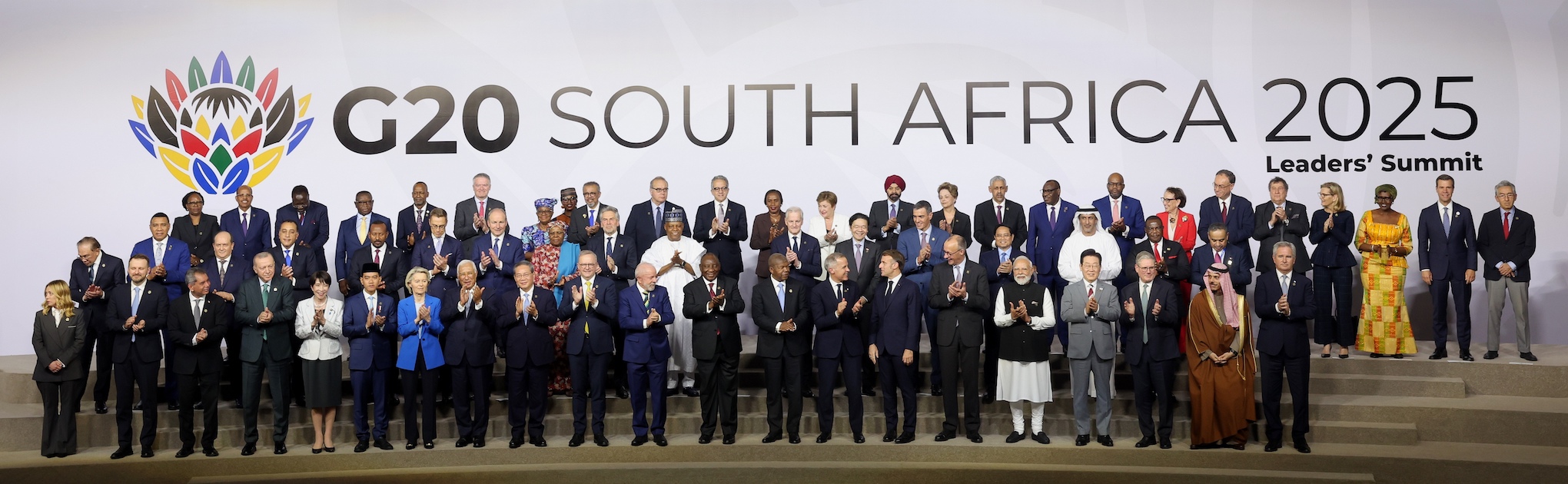
They flew in on private jets, smiled for the cameras, shook hands beneath a backdrop blaring “Solidarity, Equality, Sustainability,” and then signed 122 points of pure, polished hypocrisy.
The G20 Summit in Johannesburg is over. The champagne is gone, the microphones packed, and the people of Gaza, Ukraine, Sudan, the Democratic Republic of Congo, Yemen, Syria, Myanmar, Haiti, and a dozen other killing fields are exactly where they were before the circus arrived—only now with the added insult of knowing that the very governments arming, funding, or tolerating their slaughter just spent two days pretending to care.
This was not ignorance. This was choreography.
The Johannesburg Declaration—rammed through on Day One to avoid the embarrassment of failure—mentions “peace” nine times in 122 paragraphs. Ukraine gets one sentence. Gaza and the Occupied Palestinian Territory get one. Sudan gets one. The Democratic Republic of Congo—six million dead since 1996, 7.3 million still displaced in 2025—gets one.
Four sentences for four wars that, in the last five years alone, have killed more people than COVID-19 did in its first year. Four sentences from the nineteen economies that control 85 % of global GDP, 75 % of world trade, and—most crucially—over 60 % of global arms exports.
Let that sink in.
The same hands that signed “just and lasting peace” in Johannesburg also signed the export licences for the bombs now falling on hospitals in Khartoum, the cluster munitions maiming children in Donetsk, the drones turning wedding parties into funerals in Gaza and Yemen.
Global arms sales reached US$2.24 trillion in 2024. The five permanent members of the UN Security Council—four of them at the G20 high table—remain the top five exporters. The United States alone accounted for 43 % of major weapons exports between 2020 and 2024. Russia, China, France, Germany fill out the podium.
These are not bystanders. These are the dealers, and Johannesburg was their annual board meeting.
While Cyril Ramaphosa spoke of “shared goals outweighing differences,” the United States—under a president who boycotted the summit over a racist conspiracy theory about “white genocide” in South Africa—refused to send even a senior delegation. Trump’s absence was not a protest against war; it was a tantrum because the host dared take Israel to the International Court of Justice over Gaza. That is the level of moral seriousness the world’s most powerful nation brought to a gathering supposedly dedicated to human solidarity.
China sent its Premier, not its President. Russia sent its Foreign Minister, not Putin. One-third of invited leaders simply never showed. Emmanuel Macron called it a threat to the G20’s “future relevance.” He was too polite. It is already irrelevant to the mother burying her child in Khan Younis, the father carrying his starving daughter across the Sudanese desert, the Ukrainian conscript freezing in a trench outside Pokrovsk.
Yet the delegates found time to sign MoUs on critical minerals, green hydrogen, and AI governance. They congratulated themselves for “early adoption” of a declaration promising debt restructuring for the Global South—while the same Global North banks and governments remain the creditors who wrote those predatory loans in the first place. They pledged climate finance while the Democratic Republic of Congo, holder of 60 % of the world’s cobalt and the lungs of Africa, burns and bleeds so electric-car batteries can be produced cheaply in Europe and North America.
This is not diplomacy. This is laundering.
The bitterest irony: the G20 knows exactly how wars are linked to the economic issues it loves to discuss. The Declaration itself admits that “geopolitical tensions, conflicts and wars” undermine growth, food security, and energy transitions. Translation: the killing is bad for business—not bad for morality, not bad for humanity, but bad for GDP forecasts. That is the depth of their concern.
We are told the G20 is “not a security forum.” Fine. Then why does it exist at all when the world is on fire? If the club of the planet’s richest and most armed nations can muster only four sentences of condolence for four active genocidal wars, it has forfeited any claim on our respect or our taxes.
The truth is brutal and simple: none of them want these wars to end quickly because none have finished extracting what they came for.
Russia needs enough Ukrainian land to declare victory. The United States needs the war to keep draining Russia and justifying its $175 billion (and counting) aid package—most of which flows straight back to American defence contractors. Israel needs Gaza levelled and the West Bank annexed before any ceasefire is forced upon it. Saudi Arabia and the UAE need Yemen broken so no southern separatist state ever controls the Bab el-Mandeb strait. Turkey needs the Syrian Kurds crushed. France needs the Sahel unstable enough to keep access to Niger’s uranium and Mali’s gold. China needs African conflicts quiet enough to extract cobalt and lithium but chaotic enough to keep Western firms out.
Every leader in Johannesburg understands this chessboard. Every single one. And not one is willing to sacrifice a pawn—let alone a bishop—for the people dying beneath the falling pieces.The polite fiction is exhausted. After Johannesburg, no serious observer can still pretend the G20, as currently constituted, has either the will or the capacity to confront the wars its own members help prolong.
The hard questions that should have echoed through the Sandton Convention Centre were never asked inside its halls. They must now be asked outside—by journalists, parliaments, civil society, and citizens who refuse to look away.
How many more billions will flow to arms manufacturers before a single dollar enforces a ceasefire? Who funds the political campaigns of leaders who speak of “peace” while authorising fresh weapons shipments? When will governments admit that “strategic interest” has become the polite public euphemism for profiting from someone else’s blood?
Until those questions are answered—publicly, under oath—the 2025 Johannesburg Summit will remain exactly what it was: a meticulously staged exercise in collective evasion. Leaders posed beneath banners of solidarity, equality and sustainability while the wars in Gaza, Ukraine, Sudan and the Democratic Republic of Congo claimed thousands of lives every month.
Four active conflicts. Four sentences. Zero binding commitments.
History teaches that wars sustained by great-power rivalry and arms exports do not end in five-star conference venues. They end when domestic political cost finally outweighs perceived strategic gain, when sustained public outrage makes complicity untenable, and when independent reporting and parliamentary scrutiny expose the financial and human ledger leaders prefer hidden.
Johannesburg 2025 was not the moment the G20 chose to confront that ledger. It may, however, be remembered as the moment the rest of the world decided it could no longer wait for them to do so.
The burden of proof now lies with those who still claim that four sentences for four wars, and billions untouched for the arms trade, represents the limit of what is politically possible.
The rest of us are under no obligation to accept that verdict.