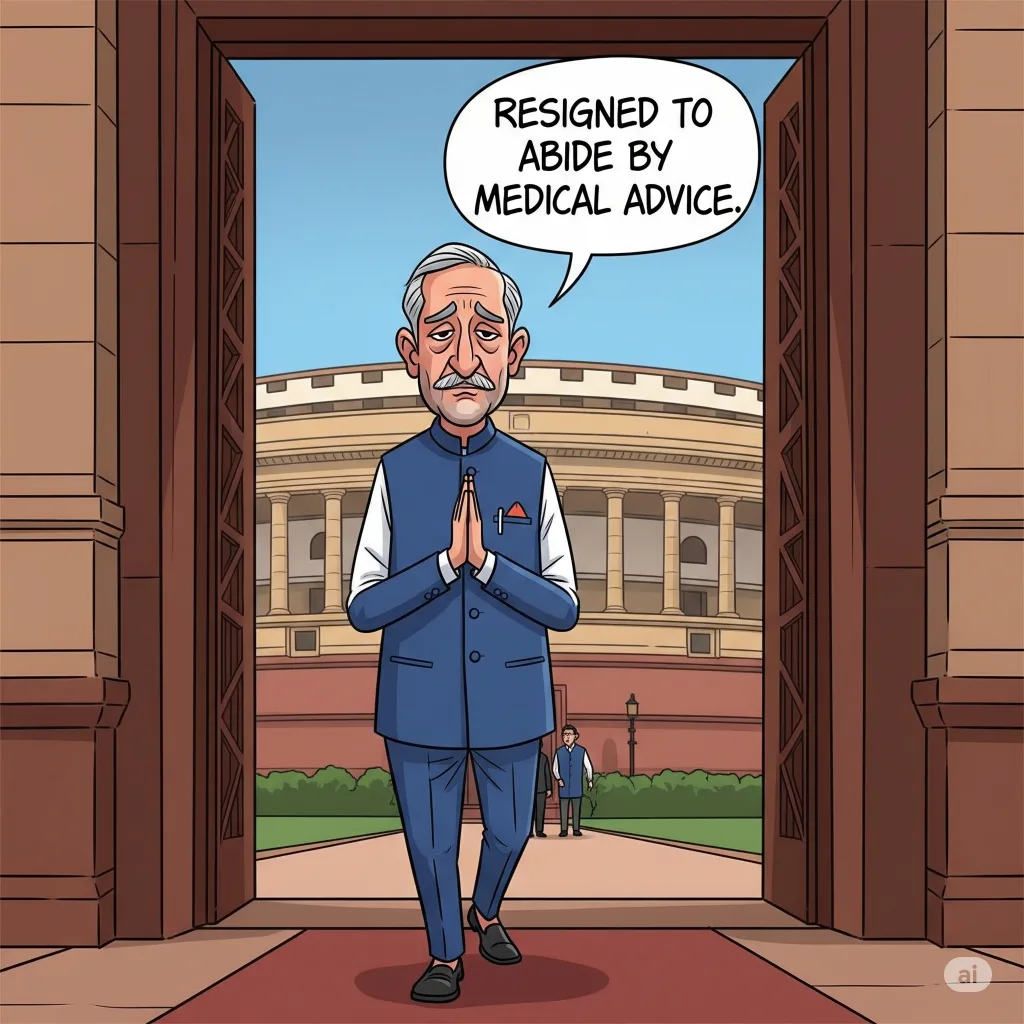
Vice President Jagdeep Dhankhar’s sudden resignation on July 21, officially attributed to health concerns, has triggered widespread speculation and concern over the state of institutional autonomy in India. The abrupt nature of his exit, coupled with the government’s muted response, has raised deeper questions about the evolving role of constitutional offices under Prime Minister Narendra Modi’s administration.
While the resignation letter cited “health reasons,” political observers and opposition leaders believe Dhankhar was asked to step down by senior members of the ruling Bharatiya Janata Party (BJP). The lack of a customary farewell speech, combined with the prime minister’s brief acknowledgment on social media, has only intensified speculation that Dhankhar’s resignation was not entirely voluntary.
The immediate backdrop to Dhankhar’s resignation was his decision to accept an opposition-backed notice seeking the impeachment of Justice Yashwant Varma, a sitting Supreme Court judge reportedly under scrutiny after a large sum of unaccounted cash was found at his residence. By entertaining the motion, Dhankhar appeared to challenge the government’s preferred strategy of managing the controversy internally.
Political sources familiar with the matter said Dhankhar’s action created friction with senior BJP leaders and parliamentary officials. According to reports, the government warned the vice president that a no-confidence motion could be initiated against him in the Rajya Sabha if he did not step down. Within 24 hours, Dhankhar submitted his resignation.
The government has not officially responded to these claims. However, opposition leaders have been vocal. Congress leader Jairam Ramesh said Dhankhar’s decision to entertain the impeachment notice “speaks highly of him” and “poorly of those who had got him elected.” Rajasthan’s Ashok Gehlot went further, alleging Dhankhar resigned under pressure and that the BJP and Rashtriya Swayamsevak Sangh “know the truth.”
Observers say Dhankhar’s relationship with key BJP figures had been deteriorating for months. Reports indicate he clashed with a top BJP leader on procedural matters and had made veiled public criticisms about the government’s handling of judicial appointments and parliamentary debate.
While Dhankhar had once been a staunch defender of the government—particularly during his tenure as West Bengal governor—his posture as vice president had shifted toward an emphasis on constitutional process and parliamentary decorum. His statements in recent months on the independence of the judiciary and the responsibilities of constitutional offices reportedly irked members of the ruling party.
There had been “growing discomfort” with Dhankhar’s interventions during Rajya Sabha sessions, at time not aligned with the government’s floor strategy, a source close to Dhankhar said on condition of anonyity
Unlike past vice presidents, Dhankhar was not allowed to deliver a formal farewell address to the Rajya Sabha, a customary practice for outgoing presiding officers. There was also no extended public tribute or official send-off from the prime minister or the party that had nominated him to the office in 2022.
Political observers noted the break from tradition as a sign of disapproval. “This is not just about a resignation,” constitutional expert Dinesh Mathur was quoted as saying by a section of Indian media. “This is a symbolic downgrading of the office itself. It sends a message to future holders of constitutional posts: don’t step out of line.”
The resignation raises serious concerns about the separation of powers and the independence of constitutional offices in India under Modi rule. Dhankhar’s exit is not the first time an institutional figure has faced pressure, but it is one of the most high-profile examples.
Critics argue that such moves weaken the constitutional framework by subordinating autonomous offices to party interests. “The vice president is supposed to be above politics once elected,” political analyst Neha Kapoor was quoted as saying in a section of media. “If that space is closed, parliamentary democracy suffers.”
The episode may also have a chilling effect on other constitutional authorities who may hesitate to act independently out of fear of political retribution.
Internationally, India has projected itself as the world’s largest democracy and a defender of rule-based governance. The removal—perceived or real—of a constitutional figure who sought to operate within his defined role may invite scrutiny from rights groups and democratic observers abroad.
The government has initiated move for electing Dhankhar’s successor. Speculation is already underway about whether the next vice president will be someone with a more pliant or loyalist profile.
For now, Dhankhar remains silent, issuing no public statement beyond his resignation letter. But the circumstances of his exit will likely fuel debate in the coming weeks about the nature of power, autonomy, and constitutional respect in the world’s most populous democracy.
As India enters a critical phase of governance—with economic challenges, geopolitical tensions, and domestic polarization—how it treats its democratic institutions may ultimately determine its global standing and internal cohesion.