India and New Zealand signed a comprehensive free trade agreement in New Delhi on Monday, delivering duty-free access for 100 per cent of Indian exports to New Zealand while granting New Zealand exporters preferential treatment covering 95 per cent of their current shipments to India. The deal, concluded in a record nine months after negotiations opened in March 2025, marks one of India’s fastest trade pacts and New Zealand’s highest-quality agreement to date, according to its trade minister.
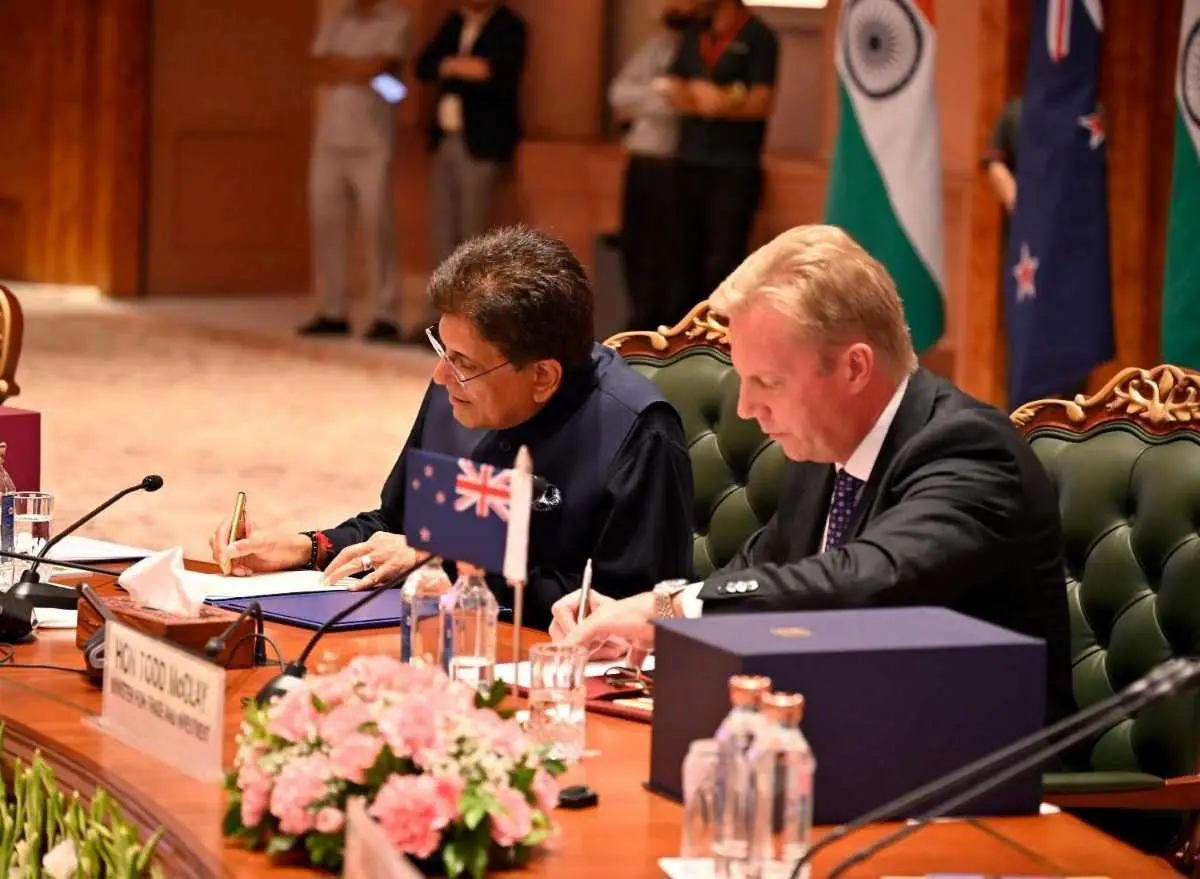
The signing ceremony, attended by Indian commerce and industry minister Piyush Goyal and New Zealand trade and investment minister Todd McClay, alongside business delegations from both countries, caps more than 16 years of intermittent talks. It reflects deepening strategic and economic ties between the world’s fifth-largest and a high-income Pacific economy, underpinned by a 300,000-strong Indian diaspora in New Zealand that accounts for nearly 5 per cent of its population.
Bilateral merchandise trade has already surged 49 per cent year-on-year to $1.3bn in 2024-25, with Indian exports to New Zealand climbing 32 per cent to $711m. Services exports from India added another $634m in 2024. New Zealand’s two-way trade with India stood at NZ$3.95bn annually, with forestry, horticulture, wool, coal and travel services among its leading exports.
Tariff liberalisation: a tale of two markets
Under the agreement, New Zealand will eliminate tariffs on all Indian goods from entry into force, providing Indian manufacturers, particularly in labour-intensive sectors such as textiles, apparel, leather, footwear, gems and jewellery, engineering and processed foods, immediate zero-duty access. New Delhi, for its part, has offered market access on 70 per cent of tariff lines, with exclusions protecting sensitive agricultural and dairy products that together account for 95 per cent of New Zealand’s current bilateral trade value.
New Zealand exporters will nevertheless secure significant gains. Tariffs will be removed immediately on 57 per cent of current exports by value, rising to 82 per cent over time, with sharp reductions on a further 13 per cent. Forestry products — a major export — will enjoy duty-free entry on more than 95 per cent of shipments from day one, with the remainder phased out over seven years. Sheep meat, wool and coal will also enter tariff-free immediately. Fish and seafood tariffs will be eliminated over seven years.
Horticulture wins include new tariff-rate quotas for kiwifruit and apples that exceed recent trade volumes; New Zealand becomes the first country to secure preferential apple access in any Indian FTA and the first kiwifruit exporter to gain duty-free quota access plus a 50 per cent tariff cut outside it. Mānuka honey receives a 75 per cent tariff cut over five years — the first preferential honey access India has granted. Wine tariffs, which can reach 150 per cent, will fall by 66-83 per cent over 10 years. Limited dairy access includes phased elimination on bulk infant formula and other preparations over seven years, plus a fast-track mechanism for duty-free supply of New Zealand ingredients to Indian manufacturers for re-export. India has committed to consult on further dairy concessions if offered to comparable partners and to review the deal one year after entry into force.
Indian officials described the outcome as a “huge win” for labour-intensive sectors while safeguarding core agricultural interests. New Zealand’s McClay called it a “level playing field” with India’s existing FTA partners and the “highest quality” agreement Wellington has concluded.
Services, mobility and the $20bn investment pledge
Beyond goods, the pact breaks new ground in services and people-to-people links. New Zealand has opened 118 services sectors with most-favoured-nation treatment across 139, including engineering, environmental services, tertiary education and audio-visual. For the first time, it has facilitated trade in traditional medicine, explicitly covering India’s AYUSH systems (Ayurveda, yoga, Unani, Siddha, Sowa-Rigpa and homeopathy) alongside Māori rongoā practices.
A dedicated annex on student mobility and post-study work visas is a first for New Zealand. Indian students will be permitted to work up to 20 hours per week during studies, with post-study work rights of up to three years for bachelor’s (STEM), three years for master’s and four years for doctorates. A new temporary employment entry (TEE) visa pathway offers up to 5,000 places (New Zealand specifies 1,667 annually, capped at 5,000 total) for skilled occupations and “iconic” Indian professions including yoga instructors, Ayurvedic practitioners, chefs and music teachers, alongside IT, engineering, healthcare, education and construction. A working holiday scheme will admit 1,000 young Indians annually.
New Zealand has committed to promote $20bn of private-sector investment into India over 15 years, supported by a new “New Zealand Investment Desk” in India. The agreement includes a rebalancing clause to address any shortfall. Cooperation extends to renewable energy, digital services, infrastructure, research, innovation and an organic products mutual recognition arrangement expected to boost Indian exports such as basmati rice, flax seeds and black tea.
Institutional safeguards and cultural ties
The FTA incorporates robust chapters on sanitary and phytosanitary measures and technical barriers to trade, promising faster approvals, electronic certification and simplified procedures. Customs facilitation targets 48-hour clearance for standard shipments and 24 hours for perishables and express cargo. Rules of origin are product-specific and balanced to prevent circumvention, with self-declaration options for approved exporters.
On intellectual property, New Zealand has agreed to review its laws to provide EU-level protection for Indian geographical indications within 18 months (or six months from entry into force per some NZ statements), with public consultation. A dedicated chapter on culture, trade, traditional knowledge and economic co-operation promotes Māori-Indian exchanges, tourism, sports and audio-visual collaboration. New Zealand’s Treaty of Waitangi exception is preserved, as in all its recent FTAs. There is no investor-state dispute settlement.
Strategic context and economic stakes
For India, the deal is the latest in a string of nine FTAs signed with 38 developed economies in recent years, part of its strategy to position itself as a global manufacturing and services hub under the “Viksit Bharat 2047” vision. It opens a gateway to Oceania and Pacific Island markets and strengthens supply-chain integration in sectors where New Zealand excels.
For New Zealand, the pact diversifies exports away from heavy reliance on China and Australia, tapping India’s projected rise to the world’s third-largest economy with a middle class exceeding 1bn by 2047. Prime Minister Christopher Luxon described it as delivering “more jobs, higher incomes and a sharp rise in exports” and fulfilling an election promise in his government’s first term. McClay emphasised that it supports a rules-based international order and Māori economic aspirations.
Analysts expect the agreement to boost bilateral trade significantly over time, though gains will materialise gradually as tariffs phase out and investment commitments are realised. New Zealand’s dairy industry, a sensitive sector, secured only modest access, prompting some domestic debate, but overall business reaction has been positive, with exporters welcoming the level playing field.
The pact now enters parliamentary scrutiny in both countries. In New Zealand, the full text and national interest analysis will be tabled immediately, triggering a treaty examination process ahead of ratification. India will follow its domestic procedures. Entry into force is expected within months once ratified.
A forward-looking partnership
The India-New Zealand FTA is more than a tariff-cutting exercise. It weaves together market access, services liberalisation, skilled mobility, investment promotion and cultural co-operation into a comprehensive strategic framework. For New Delhi, it reinforces its credentials as an open, rules-based trading partner. For Wellington, it cements access to one of the world’s fastest-growing consumer markets and diversifies its economic relationships in an uncertain global environment.
As Goyal and McClay stood together in New Delhi, both sides described the agreement as a “historic milestone” and the beginning of a new chapter. With $20bn in promised investment, enhanced student and professional mobility, and reciprocal recognition of traditional knowledge systems from the Himalayas to the Pacific, the pact signals a maturing relationship built on trust, complementary strengths and shared ambition for inclusive growth.