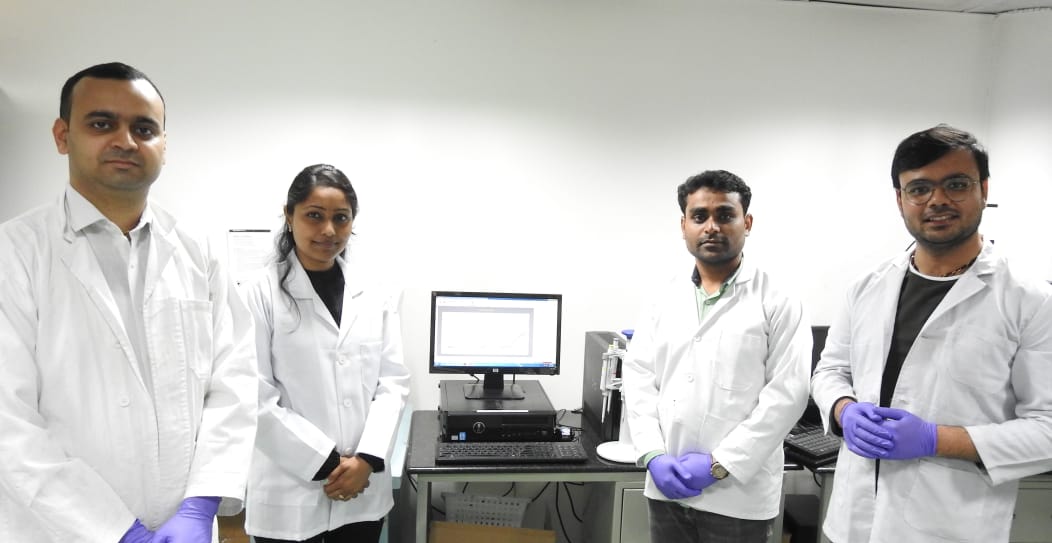
Researchers at the Indian Institute of Technology-Delhi (IIT) have developed a Covid-19 test kit which can be deployed to meet the huge demand for a PCR-based diagnostic assay at an affordable price in times of coronavirus pandemic in the country.
The Indian Council for Medical Research (ICMR) has given its approval to the Covid-19 detection assay developed by a team of researchers at the IIT Delhi’s Kusuma School of Biological Sciences (KSBS), the premier technical institute said in a statement on Thursday..
The assay, which can be deployed for “a real-time” PCR-based diagnostic, has been validated at the ICMR “with a sensitivity and specificity of 100%”, the IIT-Delhi added.
This is the first probe-free assay for the COVID-19 approved by the ICMR.
“It will be useful for specific and affordable high throughput testing,” the institute said.
This assay can be “easily” scaled up as it does not require fluorescent probes.
The researchers’ team, which developed the kit, comprised three PhD scholars Prashant Pradhan, Ashutosh Pandey, Praveen Tripathi.
This comes at a time when the Narendra Modi government is facing embarrassment after rapid test kits for novel coronavirus, recently imported from China, was found to be faulty when deployed for testing in Rajasthan and Haryana.
The ICMR, which had procured a total of 3 lakh testing kits from the neighbouring country, had to put on halt its use for further field validation of the kits.
“The (researchers) team is targeting large scale deployment of the probe-free COVID-19 detection assay at affordable prices with suitable industrial partners as soon as possible,” the IIT-Delhi said.
How the test kit was developed?
Using comparative sequence analyses, the IIT-Delhi team identified unique regions (short stretches of RNA sequences) in the COVID-19/SARS COV-2 genome.
“These regions are not present in other human corona viruses providing an opportunity to specifically detect COVID-19,” the researchers’ team said, adding “This method uses primers targeting unique regions of COVID-19 that were designed and tested using real time PCR.”
These primers specifically bind to regions conserved in over 400 fully sequenced COVID-19 genomes.
“This highly sensitive assay was developed by extensive optimization using synthetic DNA constructs followed by in vitro generated RNA fragments,” the team added.