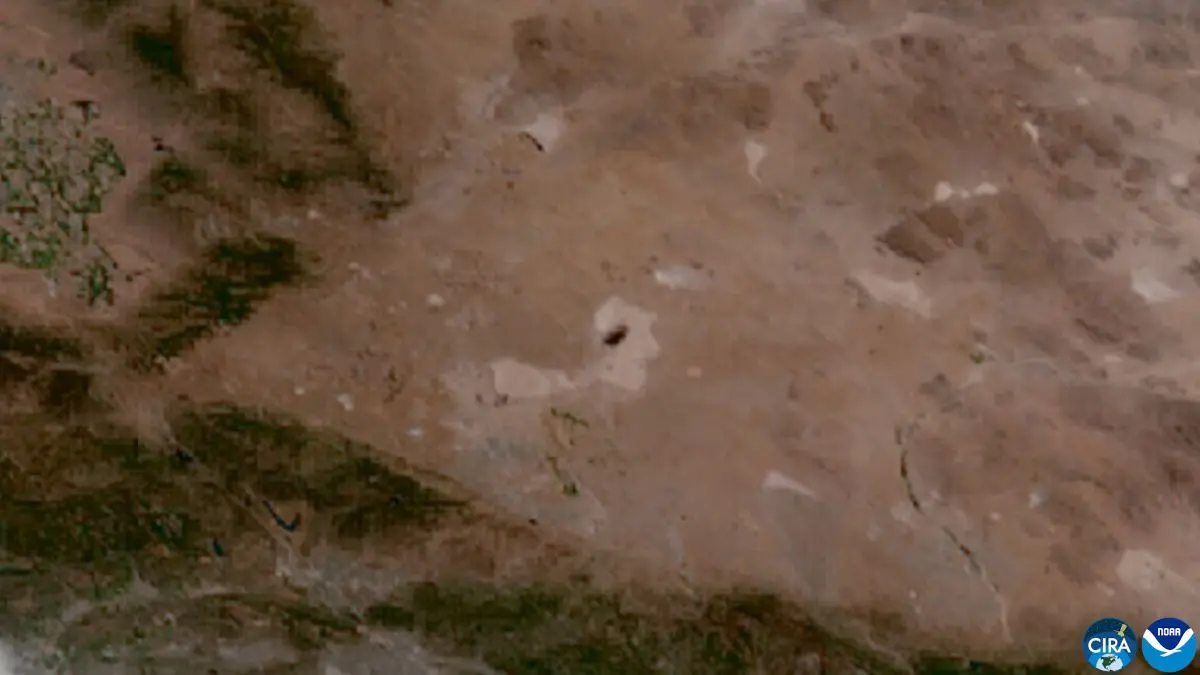
Early data from the investigation into Monday’s catastrophic loss of a B-52 Stratofortress at Edwards Air Force Base suggests the aircraft plunged towards the desert floor at nearly a mile a minute after a sharp, low-altitude turn shortly after takeoff, killing all eight people on board in what officials have called an unsurvivable impact.
The Boeing B-52H, tail number 60-0061, was conducting a routine test mission as part of the long-running programme to upgrade the bomber fleet with new Active Electronically Scanned Array (AESA) radar systems. The aircraft had barely cleared the runway when it veered sharply and came down around 11:20 a.m. local time, leaving a large burn scar and virtually no intact wreckage amid intense post-crash flames.
Col. James Hayes, deputy commander of the 412th Test Wing, described the loss as a “horrible tragedy” that claimed “eight great Americans” — a mix of uniformed military personnel, government civilians and contractors, including two employees from Boeing. Families have begun identifying some of the victims publicly, among them Lt. Col. Miles Middleton. Next-of-kin notifications continue.
Aviation safety specialists monitoring preliminary tracking information have pointed to the extremely limited altitude and airspeed as consistent with a sudden controllability problem. Whether this stemmed from an engine issue, flight control malfunction, or something connected to the test equipment itself is still unknown. The Air Force has emphasised that the full investigation — involving both a safety board and a separate accident investigation board — could take up to six months before public conclusions are released.
Edwards Air Force Base, the epicentre of American military flight testing for decades, temporarily stood down flight operations and restricted access as recovery work continued. The incident marks a serious blow to the B-52 community at a time when the ageing but indispensable fleet is undergoing one of its most significant modernisation efforts in years. The Stratofortress remains a cornerstone of US strategic airpower, expected to fly into the 2050s alongside newer platforms.
For those who work at Edwards, the vast high-desert base carries an inherent element of risk. Yet the suddenness of this loss, on what was described as a standard test sortie, has left colleagues and the wider aviation world shaken. Senior Air Force leaders have offered condolences while stressing support for grieving families.
As investigators piece together telemetry, maintenance records and witness accounts, attention is also turning quietly to the human stories behind the eight professionals who were helping prepare the B-52 for its next chapter. This remains a fast-moving story, with more details expected in the days and weeks ahead.