In the sweltering heat of a Tehran summer, hundreds of thousands of black-clad mourners gathered this week at the Grand Mosalla, beating their chests in rhythmic sorrow before a glass case holding the flag-draped coffin of Ayatollah Ali Khamenei. The spectacle, unfolding over several days from July 3rd to 9th, is one of the largest state funerals Iran has ever staged. Yet its grandeur belies a more complex reality: this is not merely a farewell to a leader who ruled for 37 years, but a meticulously orchestrated display of resilience by a theocratic regime that has just survived a devastating war, a decapitation strike, and an uncertain succession. Delayed by months of conflict, the ceremonies serve as both catharsis for a grieving nation and a defiant signal to its adversaries.
Khamenei was killed on February 28th in an Israeli airstrike—supported by American intelligence—on his Tehran residence, at the outset of what became known as the 2026 Iran war. He was 86. The attack also claimed the lives of several family members. For a system built around the supreme leader’s absolute authority, the loss was existential. The funeral, originally slated for early March, was postponed amid the fighting. Its resumption now, after a fragile ceasefire, allows the Islamic Republic to reclaim the narrative. As processions wind through Tehran, extend to the holy city of Qom, and cross into Iraq for rites in Najaf and Karbala before a final burial on July 9th at the Imam Reza shrine in Mashhad, the message is clear: the revolution endures.
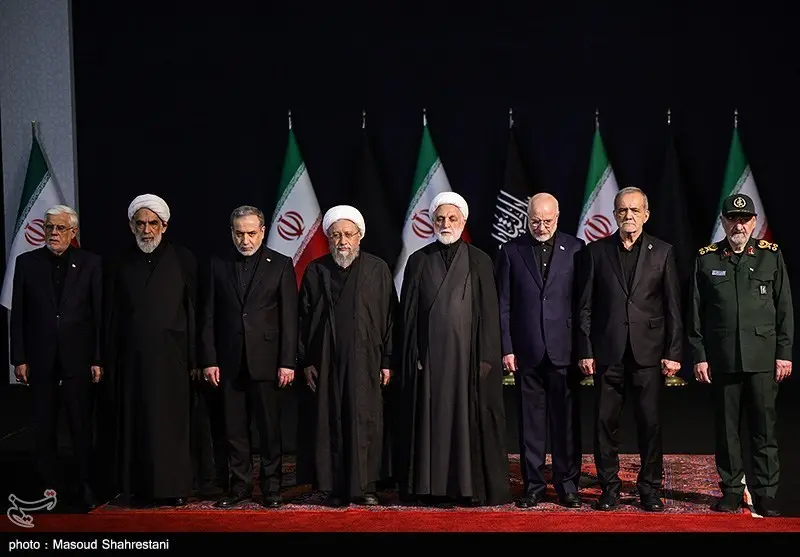
Beneath the pageantry lies a regime acutely aware of its vulnerabilities. Khamenei’s son, Mojtaba, now Iran’s third supreme leader, has kept a conspicuously low profile. Reports suggest security concerns—fears of further Israeli strikes or the exposure of his whereabouts—have kept him from public appearances, including potentially the burial itself. The smooth transition, managed by an interim council and the Assembly of Experts, followed constitutional form. Yet dynastic undertones sit uneasily with the Islamic Republic’s founding ideals. Mojtaba, long a shadowy figure rumoured to wield influence through hardline networks, inherits a system tested by war, sanctions, and internal discontent. The funeral’s emphasis on unity papers over questions about whether he possesses his father’s stature or if fissures within the clerical and Revolutionary Guard elite could widen.
The scale of the mourning—officials speak of millions expected in Tehran alone—evokes the 1989 funeral of Ayatollah Ruhollah Khomeini, the revolution’s founder. Then, as now, vast crowds affirmed the system’s popular legitimacy at a moment of transition. But today’s event carries an added geopolitical charge. Foreign delegations from Russia, Pakistan, China, and even Taliban representatives have arrived, while Western absences are glaring. Processions in Iraq underscore Iran’s enduring influence among Shia communities across borders, a reminder that its “axis of resistance” persists despite battlefield setbacks. Chants for revenge against Israel and America are not mere ritual; they reinforce the regime’s ideological core and rally domestic support amid economic hardship.
Between the lines, the spectacle reveals a state managing multiple balancing acts. The war inflicted significant damage: infrastructure ruined, proxies strained, and an economy already burdened by sanctions pushed closer to the brink. A naval blockade and supply shortages have been cited in internal deliberations. President Masoud Pezeshkian, a relative moderate, has reportedly warned of resignation risks if ceasefire talks falter. The funeral pauses diplomacy but also buys time, projecting strength to extract better terms. Yet the very need for such a grand display hints at underlying fragility. Decades of Khamenei’s rule saw crushed protests, a nuclear programme that invited isolation, and a reliance on hard power that ultimately invited devastating retaliation. Mourners’ grief is genuine for many, especially among the conservative base, but others watch with a mixture of resignation and quiet scepticism.
Historically, Iran’s theocracy has proven adept at survival. After Khomeini’s death, the system adapted by elevating Khamenei despite his relatively modest clerical rank. The IRGC’s institutional depth and parallel structures have similarly buffered this latest shock. But adaptation has often come at the cost of reform. Mojtaba’s presumed hardline instincts suggest continuity rather than change, even as a younger generation chafes against restrictions and yearns for economic relief. The funeral’s transnational elements—rites in Iraq—also highlight a paradox: while projecting regional power, they risk entangling Iran further in sectarian tensions.
For the wider world, the event is a barometer of Middle Eastern realignments. America and Israel achieved a tactical success in eliminating Khamenei, yet the regime’s swift succession and ability to mobilise masses demonstrate that decapitation alone does not topple entrenched systems. Russia and China, by sending high-level representatives, signal their stake in preventing Iranian collapse. Europe, largely sidelined, watches warily as energy markets and migration patterns could yet be disrupted.
In Mashhad next week, as Khamenei is laid to rest beside Shia luminaries, the Islamic Republic will close one chapter while opening another. The coffin will be interred, but the questions it leaves behind—about the sustainability of theocratic rule, the wisdom of confrontation, and the true loyalties of a war-weary populace—will linger. This defiant farewell is less a coda than a bridge, carrying Iran into an uncertain future where resilience and rigidity remain locked in uneasy embrace. The crowds will disperse, the banners will fade, but the regime’s determination to endure, on its own uncompromising terms, is written plainly in the streets of Tehran.