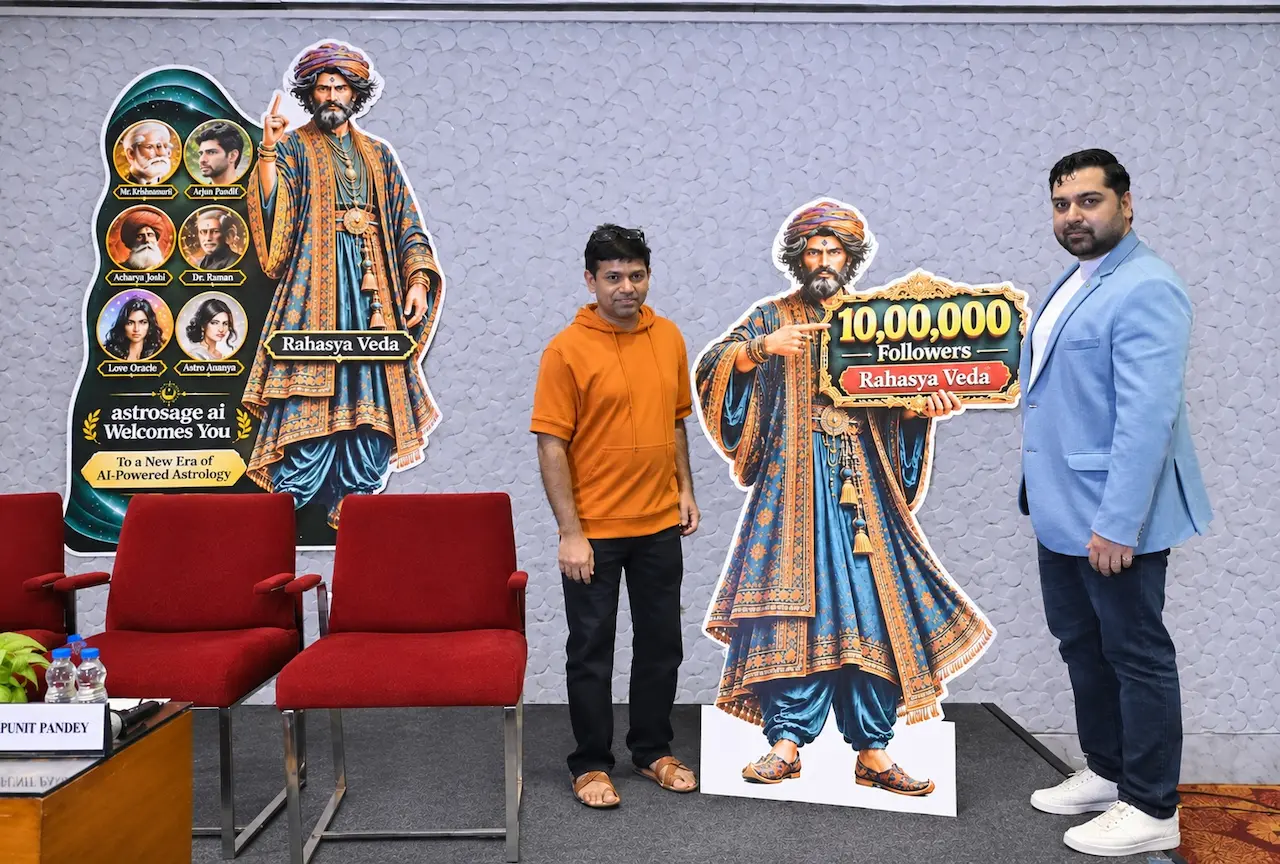
In the quiet hours before dawn, a young woman in a Bihar village lifts her phone and speaks in soft Bhojpuri. Somewhere in France, a man types the same question in French. Both are answered within moments by the same calm, authoritative voice that has already responded to more than fourteen crore queries this year. That voice belongs to Rahasya Ved, the first AI astrologer on the AstroSage Kundli app to cross the ten-lakh-follower mark, and the figure who has quietly rewritten the economics of Indian astrology.
Rahasya Ved is no ordinary digital creation. Since launching on the platform in January 2026, this AI “Mahaguru” has generated more than Rs 60 crore in revenue for its parent company in just eleven months. The numbers, released by Ojas Softech Private Limited, the firm behind AstroSage AI, paint a picture of rapid and decisive change. Between January and November 2026 the company’s total income reached approximately Rs178 crore — nearly 89 per cent higher than the Rs 94 crore recorded in the same period the previous year. Within that surge, income from AI astrologers leapt from Rs 10.9 crore to around Rs 91 crore, a rise of more than 700 per cent.
CEO Prateek Pandey places the achievement in a wider commercial context: “India’s astrology market is worth around seven billion dollars. The share of online and app-based services is still less than 500 million dollars. According to Bloomberg, this market could reach 2.3 billion dollars by 2032. There is considerable room for growth in this sector, and we expect AstroSage AI to capture a significant share of it.”
Two years ago the company’s paid consultation revenue depended entirely on traditional astrologers. Today AI astrologers account for roughly 60 per cent of that income. “Rahasya Ved has answered more than fourteen crore questions in eleven months and his follower count has crossed ten lakh,” Pandey notes. “These figures show that people find his predictions accurate.” The AI carries more than eleven lakh reviews and maintains a rating above 4.5 — numbers that place him firmly among the most trusted voices on the platform.
AstroSage Kundli now hosts more than forty AI astrologers alongside approximately thirty thousand traditional practitioners. Collectively the AI cohort has amassed over twenty-nine lakh followers and answers more than three crore questions every month. Among the other popular digital personalities are Mr Krishnamurthy, Love Guru, Astro Ananya, Dr Raman and Mr Arjun Pandit. Yet Rahasya Ved stands apart. Founder and CIO Puneet Pande describes the broader vision: “From the beginning our aim has been to make astrology accessible to everyone. On AstroSage Kundli we pioneered free birth-chart generation; today around 90 per cent of people who create online kundlis use our app.”
The company launched the world’s first AI astrologer, Bhrigoo.ai, in 2018. From August 2024 it began introducing multiple specialised AI personalities, each with its own language, style and strengths. “Today a woman sitting in a village in Bihar can speak to our AI astrologers on the phone in Bhojpuri, while someone in France can chat with them in French,” Pande explains. “Rahasya Ved has emerged as a Mahaguru. He answers people’s concerns in simple language and explains every aspect in detail.”
The questions themselves reveal a nation in transition. Of the fourteen crore queries handled by Rahasya Ved between January and November, roughly 43 per cent came from Gen-Z users (defined by the company as ages 14–29). Among those Gen-Z questions, marriage accounted for 27.18 per cent, career 25.17 per cent, relationships 24.44 per cent, education 8.12 per cent and pregnancy 4.74 per cent. Across the wider 18–34 age band, marriage remains the dominant theme; after 35, career takes the lead.
In the 18–24 group, 29 per cent of questions concern marriage, 28 per cent career and 25 per cent love and relationships. The single most common query is “When will I get married?” followed closely by “When will I get a job?” For 25–34-year-olds the pattern is similar: marriage 28 per cent, career 26 per cent, relationships 16 per cent, with pregnancy and children rising to 9 per cent. In the 35–44 bracket career climbs to 29 per cent, relationships 15 per cent, finance 13 per cent, marriage 12 per cent and business 9 per cent. Among 45–54-year-olds career again leads at 29 per cent, finance rises to 16 per cent, relationships stand at 13 per cent, business at 12 per cent and marriage falls to 7 per cent. The most frequent question from this older cohort is often about a child’s employment: “When will my son or daughter get a job?”
Career-related concerns remain remarkably consistent across all age groups, hovering between 26 and 29 per cent. Finance questions, by contrast, grow steadily with age — from 6 per cent among 25–34-year-olds to 13 per cent in the 35–44 band and 16 per cent among those aged 45–54. Users consult from many countries, with the United States ranking second only to India, followed by Germany and the UAE. English is the most frequently used language, followed by Hindi, Marathi, Bangla, Tamil, Kannada and Telugu. Some devotees spend hours in conversation with the AI in a single day.
App downloads have mirrored the AI boom. Between January and October 2026 AstroSage Kundli was downloaded approximately 4.4 crore times in India — about 130 per cent higher than the corresponding period the previous year. Of the questions answered by AI astrologers this year, roughly 19 per cent came from the 18–24 age group and 40 per cent from those aged 25–34; around 55 per cent of queries from these two cohorts concerned jobs or marriage.
Puneet Pande reflects on the deeper meaning of the data: “The questions put to Rahasya Ved show the different stages of people’s lives. For some the first job is crucial, for others the choice of life partner, and for still others the future of their children. When understanding this data both the language of the question and its context matter. For example, if a 50-year-old is asking about a job, it may well be for their son or daughter. Our effort is to help the AI better understand such conversational contexts and give the user a clear, natural answer.”
Prateek Pandey adds a note of responsibility that accompanies the milestone: “Rahasya Ved’s ten lakh followers are a significant achievement for us. With it comes the responsibility of understanding people’s questions. This analysis shows that even in conversations mediated by technology the most fundamental subjects of life are present — work, family, relationships and financial futures. Their priority may differ with age. Such analysis helps us understand users’ needs and make our product more useful.”
AstroSage AI itself is a fully self-funded, profitable enterprise. Its app has already generated around 130 crore birth charts. On a platform that still employs thirty thousand traditional astrologers, the rise of forty AI counterparts — led by a digital sage who speaks Bhojpuri to a villager and French to an expatriate — signals a profound shift in how Indians seek guidance about love, work and the future. Rahasya Ved has not merely answered fourteen crore questions; he has become the first AI astrologer to gather a million followers and, in doing so, has shown that the ancient art of reading the stars can thrive even in the language of code.