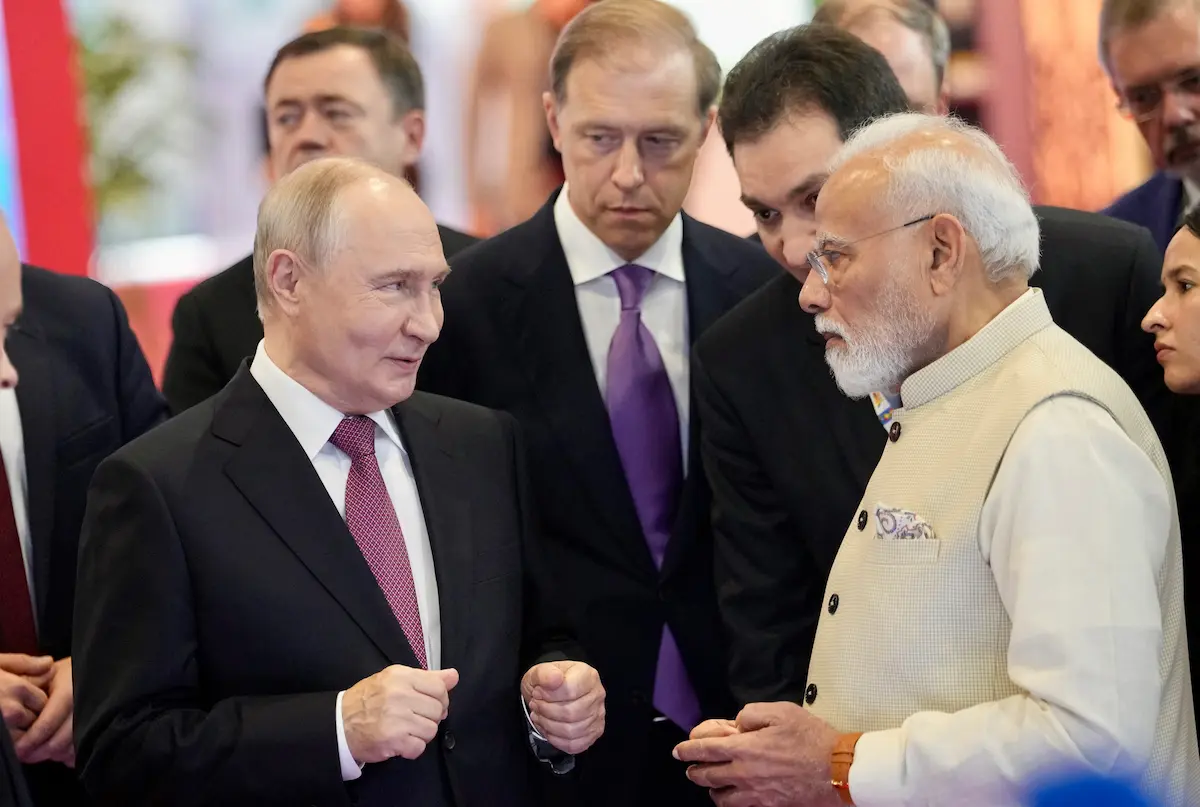
Russian President Vladimir Putin arrived in New Delhi on Friday determined to show that neither Moscow nor the BRICS grouping is in the business of isolation. Hours after landing for the three-day 18th BRICS summit, he sat down with Prime Minister Narendra Modi and told business leaders that the club of emerging economies “is not against anyone.” It is simply in favour of its own interests—and open to working with the whole world.
The message was carefully calibrated. Russia remains under more than 30,000 Western sanctions. Its president has not attended a BRICS summit outside his own country since the full-scale invasion of Ukraine in 2022. In the Indian capital he sought both to deepen a vital partnership and to present the expanded bloc as a constructive force rather than a rival axis.
In their roughly 45-minute talks at Bharat Mandapam, Modi and Putin agreed to strengthen the “Special and Privileged Strategic Partnership.” They set a target of raising annual bilateral trade to $100 billion by 2030 from the current level of about $65 billion, driven largely by discounted Russian oil. The two sides also committed to closer co-operation in defence, critical minerals, civil nuclear energy, fertiliser supplies, infrastructure, technology and people-to-people exchanges. Modi accepted Putin’s invitation to visit Russia for the 24th annual bilateral summit; dates will be fixed through diplomatic channels.
India has long insisted that its relationship with Russia is guided by national interest rather than Western pressure. New Delhi has continued to buy Russian crude, helping Moscow offset the impact of sanctions while securing affordable energy for its own economy. At the same time it has expanded defence and technology ties with the United States and Europe. The Delhi meeting illustrated the same balancing act. Modi raised the safety of Indian seafarers in the Black Sea, where five Indian nationals have died in recent months amid the fighting. He reiterated that dialogue and diplomacy remain the only path to resolving the conflicts in Ukraine and West Asia, and that India stands ready to support peace efforts.
Putin used the BRICS Business Forum to paint a broader picture of shifting economic power. Over the past five years, he claimed, BRICS countries had accounted for more than 40 per cent of global GDP and more than half of world growth, while the G7’s share had shrunk. He proposed an investment platform based on the New Development Bank to mobilise private capital for infrastructure and logistics projects, including the Arctic Transport Corridor and the International North-South Transport Corridor. Russia, he said, was ready to work with partners on technology, artificial intelligence, unmanned systems, finance, tourism and industry. Competition, he added, was taking “ugly forms”—trade restrictions, pressure on transport routes and secondary sanctions.
BRICS itself has grown. Originally Brazil, Russia, India, China and South Africa, it now includes Egypt, Ethiopia, Iran, the United Arab Emirates, Saudi Arabia and Indonesia, with a longer list of partner countries. India holds the chair this year under the theme of resilience, innovation, cooperation and sustainability. The summit will test whether the enlarged group can maintain coherence amid wars in Ukraine and the Middle East and rising US-China tensions.
For India the relationship with Russia remains strategically useful even as New Delhi diversifies. For Russia, Delhi offers a large market, diplomatic cover and a platform from which to argue that multipolarity is already a reality. Putin’s insistence that BRICS is open rather than oppositional is partly rhetorical. Yet it also reflects a recognition that isolation is costly. In the halls of Bharat Mandapam the two leaders signalled that pragmatic engagement, rather than ideological confrontation, still has room to grow.