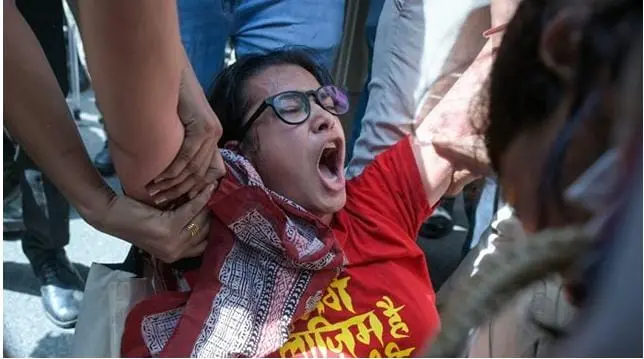
On Gandhi Jayanti, Delhi’s iconic Jantar Mantar area turned into a heavily policed stage on Friday. Opposition leaders, student activists and members of the youth-led Cockroach Janta Party were detained in large numbers as they sought to protest against Chief Election Commissioner Gyanesh Kumar and the Election Commission’s Special Intensive Revision of electoral rolls. Parallel demonstrations took place in Mumbai and other cities. The charge, driven primarily by the Congress and amplified by its allies, is direct: “vote theft” or “vote chori,” through alleged mass deletions and unilateral decisions that, they argue, tilt the electoral field towards the ruling Bharatiya Janata Party.
The controversy, which was there for the last one year, drew strength from a recent Indian Express investigation that revealed repeated written objections by the other two Election Commissioners to decisions taken during the SIR process. Opposition parties claim more than 13 crore names have been removed from draft rolls, with a disproportionate impact on the poor and marginalised. They demand Kumar’s resignation, a freeze on the revision, and restoration of the deleted names. The Election Commission maintains that its decisions were collective and lawful, aimed at cleaning outdated lists of deceased, shifted and duplicate voters.
Any serious questioning of the integrity of India’s electoral machinery carries weight in the world’s largest democracy. Yet the sharper political question is whether this institutional critique can generate the broad public support needed to challenge Prime Minister Narendra Modi’s NDA government.
The evidence from India’s socio-economic landscape and voting patterns points to a cautious and limited prospect in the near term.
Rural India still accounts for the bulk of the electorate. Here, electoral choices have long been shaped less by debates over institutional procedure and more by tangible delivery. Free food grains under the public distribution system, cash transfers to women and farmers, subsidised gas cylinders, housing schemes and electricity connections form the practical language of politics. Post-election surveys consistently show that beneficiaries of these schemes are more likely to reward the party associated with their delivery. In recent state contests, including Bihar, targeted cash transfers to women coincided with higher female turnout and a clear advantage for the incumbents offering them.
This does not mean rural voters ignore questions of fairness. Concerns over jobs, inflation, farm incomes and local governance surface regularly. Youth unemployment remains a structural challenge even as official labour force participation has edged higher and overall unemployment has eased in recent months. Real rural wages have faced pressure at times, and household surveys continue to register perceptions of economic stress. Yet when families weigh these anxieties against direct material support that arrives in bank accounts or ration shops, the latter frequently carries greater immediate weight.
The Congress and its allies have framed the SIR episode as an existential threat to democracy. Rahul Gandhi has repeatedly described it as institutionalised “vote chori,” linking the Chief Election Commissioner, the Prime Minister and the Home Minister in a narrative of institutional capture. The protests seek to keep the issue visible, energise urban and student constituencies, and force greater transparency. Among elite and middle-class circles, and within sections of the opposition’s traditional base, the charge has gained traction. It has also offered a rare point of convergence among otherwise divided allies.
Translating that into a rural electoral majority is harder. Abstract arguments about electoral rolls compete with the lived experience of welfare. Many rural voters assess governments by whether the state has eased hardship in daily life. When freebies and schemes are widely delivered and credited to the ruling side, institutional critiques struggle to displace that assessment. Recent election outcomes have shown that even extensive welfare does not guarantee permanent victory — delivery quality, local issues and anti-incumbency matter — yet it remains a powerful cushion against purely procedural or moral campaigns.
The Opposition therefore faces a dual task. It must sustain pressure on the Election Commission and keep the “vote theft” charge in public view. At the same time, it needs a credible economic alternative that speaks to jobs, incomes and dignity beyond the language of freebies. Without that, the institutional critique risks remaining concentrated in urban protest sites, television studios and social media, while rural voters continue to weigh the tangible against the abstract.
India’s political contest remains competitive. The NDA’s dominance is not absolute, and questions over institutional independence can accumulate. Yet the route to dislodging a government that has mastered the politics of direct benefit transfers still runs through the villages and small towns that decide national outcomes. There, the currency of support is measured more in rations, cash and concrete than in the finer points of electoral procedure. The October 2 protest have raised the volume of the debate. Whether they shift the underlying arithmetic remains a longer and harder test.