Global attention is fixed on the Houthis. Their rapid advances along Yemen’s Red Sea coast, strikes on Saudi infrastructure and growing grip near the Bab al-Mandab Strait have dominated news cycles this week. Shipping insurers are on edge, oil markets are twitchy and Western capitals are scrambling to respond. Yet hundreds of kilometres to the north-east, something quieter and potentially more consequential is unfolding inside Iran.
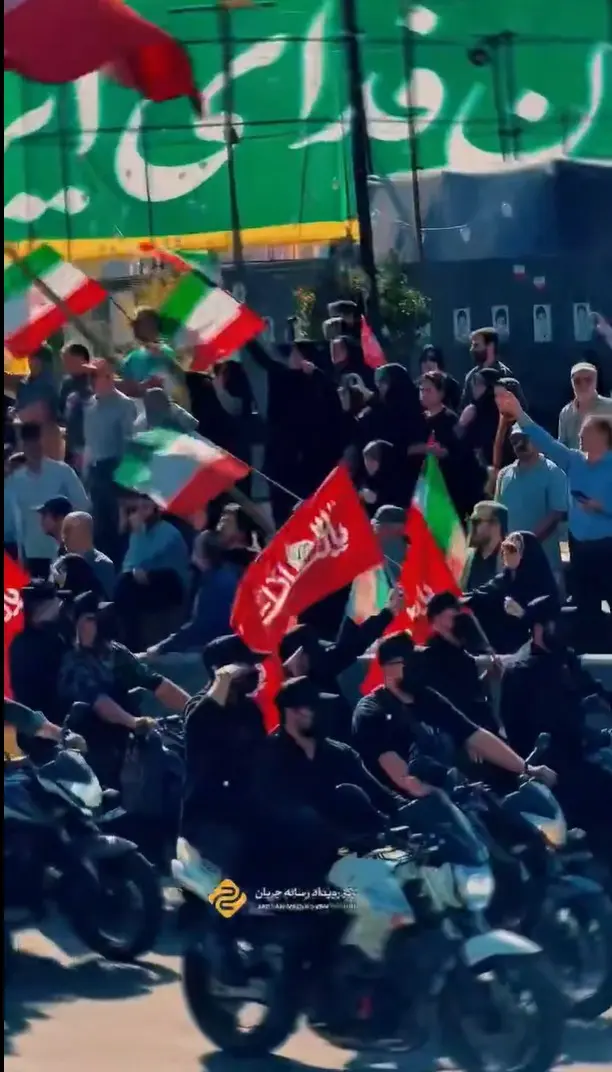
On 18 September, Tehran’s streets filled with a carefully staged show of force. Officials claimed 313,000 people took part in the “Janfada-ye Iran” exercise—literally “those who sacrifice their lives for Iran”—organised by the Basij paramilitary force under its newly appointed commander, Hossein Taeb. Volunteers in combat gear marched between Imam Hossein Square and Enqelab Square. Senior figures, including President Masoud Pezeshkian, looked on. State media spoke of hundreds of thousands more already registered for training in ground, air and naval defence, with ambitions to expand the network nationwide. (UPI photo report, IranWire, Al Jazeera)
The symbolism was deliberate. The number 313 carries religious weight in Shia tradition. The practical purpose appears more hard-headed. With year-on-year inflation officially recorded at 84.4 per cent in August and living standards under severe pressure from the ongoing conflict and blockade, the regime is expanding a loyal, population-based reserve. The Basij has long served dual roles: external defence and internal security. This mobilisation looks designed for both—preparing civilians for prolonged crisis while ensuring the state can suppress any domestic unrest sparked by economic pain. IranWire inflation report
That visible display is only the surface. Behind the scenes, satellite imagery and intelligence assessments reveal a more methodical effort to restore and harden strategic capabilities damaged earlier in the war.
At the Parchin military complex south-east of Tehran, the Taleghan 2 facility—previously linked to high-explosive testing relevant to nuclear research—is undergoing rapid reconstruction. Imagery from mid-September shows construction vehicles, concrete pours, new blast-protection aprons and tarpaulins erected to conceal work from overhead view. Repair efforts began in June after earlier strikes. The site is being reinforced rather than simply restored. Similar hardening measures have been noted at other sensitive locations. Analysts interpret this not as proof of imminent weaponisation, but as a determined bid to preserve a strategic nuclear option, improve survivability and retain bargaining leverage. (Institute for Science and International Security report, Jerusalem Post, Times of Israel)
Missile production tells a parallel story. According to assessments shared with Western and regional officials, Iran has resumed limited assembly of ballistic missiles using stockpiled components inside underground facilities, including sites around Khojir. Both liquid- and solid-propellant systems are involved. New underground assembly points are reportedly under development. The emphasis is on dispersal, concealment and resilience—exactly the approach needed for a war of attrition rather than a single dramatic strike. (Wall Street Journal exclusive via archive, Times of Israel)
These quiet moves sit alongside the more public Houthi campaign. The Yemeni group is not a simple puppet. It pursues its own goals: territorial control, economic concessions and influence over Red Sea shipping. Yet its offensive serves Iranian interests neatly. It pressures Saudi Arabia, raises global energy costs, complicates American military planning and opens a second front that stretches opponents. Tehran has little incentive to restrain partners whose actions impose costs it cannot currently extract alone through the Strait of Hormuz, where its control remains incomplete. (Christian Science Monitor, Reuters)
The pattern is consistent. Iran is not preparing one spectacular, imminent attack. It is rebuilding the capacity to endure, deter and negotiate from a stronger position. Mass mobilisation shores up internal control and signals resolve. Underground missile work restores the ability to launch salvos. Hardened nuclear-related sites protect a long-term strategic asset. Support for, or alignment with, Houthi operations multiplies pressure abroad.
Taken together, these steps suggest a regime that expects the confrontation to continue and is organising accordingly—against external strikes, covert action and the risk of protests at home. The Houthis provide the noise and the headlines. Iran is using the distraction to dig in deeper. The risk of further escalation remains high, not because Tehran has decided on an all-out offensive tomorrow, but because it is methodically preparing for several possible tomorrows at once.