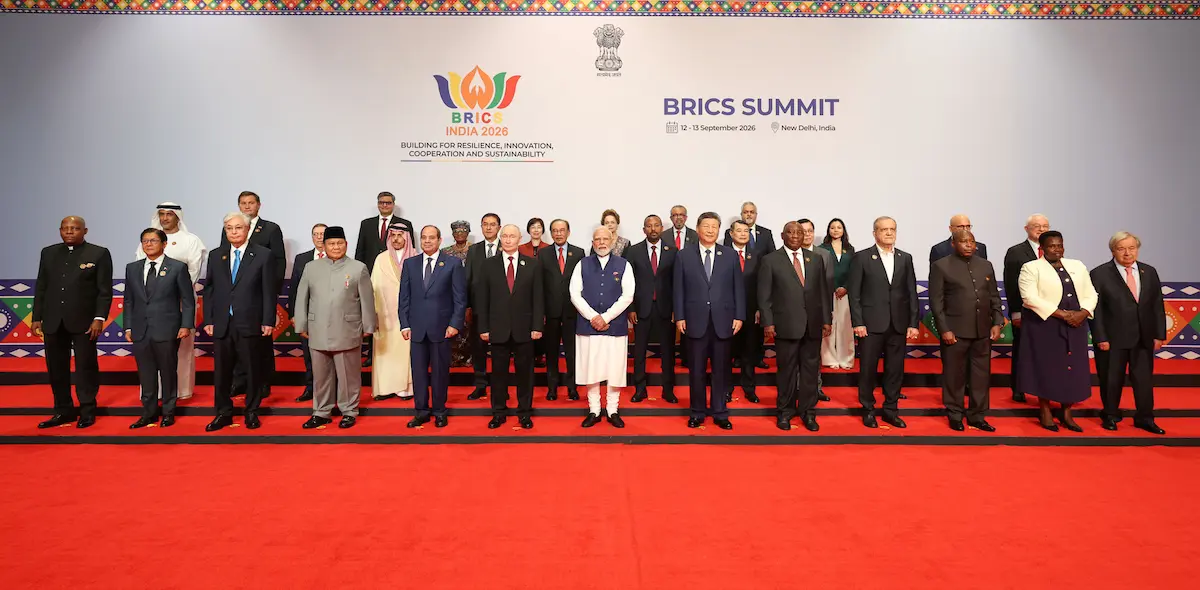

The 18th BRICS Summit, hosted by India in 2026, comes at a defining moment for the global economy. Geopolitical tensions, trade fragmentation, supply-chain disruptions, energy uncertainties and changing investment patterns are reshaping the international economic landscape. In this environment, India’s BRICS Chairship is significant not merely as a diplomatic responsibility, but as an opportunity to deepen economic cooperation among emerging economies and strengthen India’s integration with the global economy. Indian Prime Minister Narendra Modi said BRICS had reached a “coming of age” moment and called on the Global South to become a “rule-shaper” rather than simply accept rules set elsewhere.
The BRICS nations constitute nearly half the world’s population and account for approximately 40 percent of global gross domestic product (GDP). India’s 2026 BRICS agenda, centred on Resilience, Innovation, Cooperation and Sustainability, reflects the need for a more balanced, inclusive and people-centred approach to global economic development. The extensive programme undertaken during the Chairship demonstrates India’s effort to translate BRICS cooperation into practical outcomes. The 11member bloc has sought greater influence for developing economies in institutions traditionally dominated by Western powers and has pushed for reforms to bodies, including the World Bank, the International Monetary Fund and the World Trade Organization.
Since India enters the Summit with strong economic foundations. Robust growth, expanding infrastructure, rising investment, a dynamic services sector, growing manufacturing capabilities and rapid digitalisation have strengthened India’s position as an important engine of global growth. Therefore, In the context of the contemporary realities of the multipolar world, it becomes crucial that developing countries should strengthen their efforts to promote dialogue and consultations for more just and equitable global governance and mutually beneficial relations among nations.
India’s Domestic Strength and the Global Opportunity
The next phase, however, will increasingly depend on India’s ability to connect these domestic strengths with international markets. Greater participation in global trade, investment flows, technology networks and global value chains will be critical to converting domestic economic momentum into sustained international competitiveness.
With the growing share of EMDEs in global output and growth, reform of global economic governance remains a consistent BRICS priority. India will continue to strengthen coordination among BRICS members to make international financial institutions more representative, transparent and accountable. The BRICS block made consensus on urgent need to reform the Bretton Woods Institutions (BWI) to make them more agile, effective, credible, inclusive, fit for purpose, unbiased, accountable, and representative, to enhance their legitimacy. It further led that BWI governance structure should be reformed to reflect the transformation of the global economy since their establishment. The voice and representation of EMDEs in the BWI must reflect their relative position in the global economy. The BRICS also reiterated to call for improved management procedures, including through a merit-based, inclusive and transparent selection process that would increase regional diversity and representation of EMDEs in the leadership of the IMF and the World Bank.
This is where BRICS acquires particular importance. The grouping provides India with an additional platform to deepen engagement with emerging markets while complementing its wider economic relationships with the United States, European Union, Japan, ASEAN and other partners. Its expanding geographical and economic footprint can create opportunities for diversification of trade, investment, technology partnerships, energy cooperation and production networks.
BRICS should therefore not be viewed as an alternative economic bloc, but as an additional channel through which India can expand its global economic engagement.
From Domestic Growth to Global Value Chains
One of the most important opportunities for India lies in strengthening its participation in global value chains (GVCs). Global production is increasingly being reorganised around resilience, diversification and supply-chain security. This creates an opportunity for India to position itself as a competitive manufacturing and services hub.
BRICS cooperation can support greater engagement in sectors such as electronics, pharmaceuticals, automobiles and components, food processing, renewable energy, critical minerals, information technology and digitally delivered services. The objective should extend beyond increasing exports. India needs greater participation in international production, value addition, technology and knowledge networks.
This can help diversify export markets, strengthen supply-chain resilience and create new opportunities for domestic enterprises.
MSMEs and Digitalisation: Expanding Global Participation
The BRICS agenda’s focus on export-oriented MSME finance, digital trade finance and invoice-discounting mechanisms is therefore particularly relevant. Stronger access to trade finance, market intelligence, technology and cross-border business networks can help Indian enterprises move from “Made in India for India” to “Made in India for the world.”
Digitalisation offers another powerful pathway. India’s experience with digital public infrastructure, fintech, digital payments and technology-enabled services provides a strong foundation for cooperation. Greater interoperability of digital systems and payment mechanisms can reduce transaction costs and improve cross-border commerce.
BRICS can also contribute to India’s investment ambitions. Investment becomes more transformative when it generates technology transfer, productivity gains, employment, domestic value addition and export competitiveness. India’s BRICS engagement should therefore focus on partnerships that strengthen productive capacity and help Indian industries move higher up global value chains and led to sustainable growth. Sustainability, therefore, is not merely an environmental objective; it is increasingly a core component of India’s long-term economic competitiveness.
Strengthening the Global South and Trade Architecture
Since India’s BRICS Chairship also carries significance for the Global South. BRICS has emphasised greater representation of emerging and developing economies in global governance and reforms that reflect the changing structure of the world economy. A predictable trading environment is particularly important for India’s export growth and deeper integration into global value chains. BRICS’s emphasis on an open, equitable and transparent rules-based trading system therefore has direct relevance for India.
Tourism is another important economic connector, linking trade, employment, foreign exchange, culture, local livelihoods and investment. BRICS cooperation in sustainable, smart and resilient tourism can support India’s potential in cultural and heritage tourism, wellness, gastronomy, ecotourism and MICE tourism. The sector can connect international demand with a wide domestic ecosystem of hotels, restaurants, transport providers, travel businesses, artisans and local enterprises.
Ultimately, the significance of India’s BRICS Chairship will depend on its ability to translate commitments into tangible economic outcomes. The BRICS Summit 2026 offers India an important opportunity to connect its domestic growth story with the wider global economy. India’s large market, expanding manufacturing base, strong services sector, digital capabilities, entrepreneurial ecosystem and infrastructure provide a strong foundation for deeper international economic integration.
At a time when the global economy is becoming increasingly multipolar, India has an opportunity to move from being an important participant in globalisation to becoming an active contributor to shaping its future.
(Dr Bhavana Rai, author of this article, is an eminent Economist. Currently, she serves as Joint Director at the FHRAI Centre of Excellence for Research in Tourism and Hospitality (CERTH), She has previously been associated with reputed institutions such as ASSOCHAM, PHD Chamber of Commerce and Industry, and the Institute of Economic Growth)