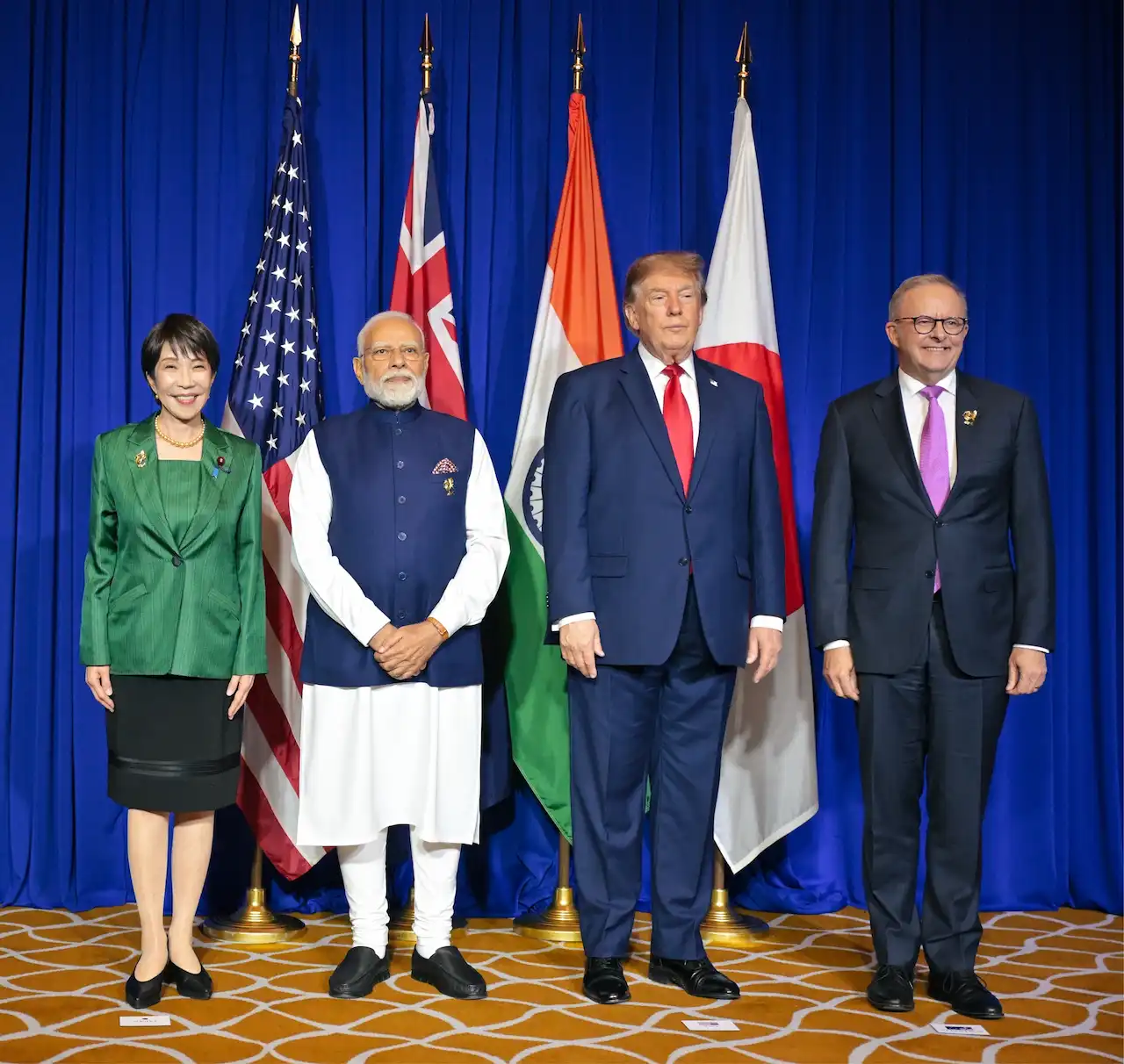

The QUAD Leaders’ Summit, held in Manila on 17 November 2026, brought together Prime Minister Narendra Modi, US President Donald Trump, Japanese Prime Minister Sanae Takaichi and Australian Prime Minister Anthony Albanese. The meeting comes as 2026 marks nearly 10 years since the revival of the Quad and a decade since the vision of a Free and Open Indo-Pacific was first articulated by former Japanese Prime Minister Shinzo Abe in 2016.
The meeting, the first at leaders’ level in two years, comes at a time when the Indo-Pacific is witnessing growing geopolitical competition, uncertainty in global trade and increasing concerns over the security of critical supply chains.
What makes this summit particularly relevant is the changing nature of the QUAD’s priorities. Emphasising the outcomes of the summit, the Prime Minister said the leaders had identified specific targets to guide the next phase of cooperation. “Today’s meeting has given fresh momentum to our shared vision for a free, open, peaceful and prosperous Indo-Pacific, with concrete goals for the next phase of our cooperation.”
The summit underscored the importance of the AI Accelerator, which will coordinate and fund initiatives to expand access to trusted artificial intelligence, its deployment and technical assistance across the Indo-Pacific. The leaders further announced steps to strengthen cybersecurity cooperation among Quad countries. The Quad leaders strongly condemned terrorism and violent extremism in all forms, including cross-border terrorism, and pledged to deepen cooperation to counter the threat.
The leaders also voiced opposition to attempts to unilaterally alter the status quo through force or coercion. They raised concerns over economic coercion, particularly arbitrary restrictions on exports, and other actions that could undermine regional stability.
On the economic front, the grouping announced the first-ever Quad Business Leaders’ Forum, scheduled for early 2027. The platform will bring together business representatives, government officials and policy experts to encourage private-sector collaboration and facilitate commercial partnerships.
On maritime security, the leaders welcomed the launch of the Indo-Pacific Maritime Surveillance Collaboration, an initiative aimed at improving information sharing and strengthening awareness of developments across the region’s waters. As a matter of fact For a region that carries a substantial share of global trade and energy shipments, ensuring safe and uninterrupted maritime movement will have direct implications for international commerce and economic stability.
One of the key areas of discussion was critical minerals and supply-chain resilience. Minerals such as lithium, cobalt and rare earth elements are essential for electric vehicles, batteries, semiconductors, renewable energy and advanced manufacturing. Their supply and processing are concentrated in a limited number of countries, creating vulnerabilities for industries dependent on them. The QUAD’s renewed emphasis on diversifying these supply chains is therefore not simply an economic initiative; it is also a strategic response to growing global dependencies and trade-related uncertainties.
An important development was also the announcement of the inaugural QUAD Business Leaders’ Forum, scheduled for early 2027. The initiative seeks to bring businesses, policymakers and experts together to encourage commercial partnerships. This is particularly relevant because government-level agreements alone cannot create resilient supply chains. Private investment, technology partnerships and industry participation will be essential to translating these commitments into economic opportunities.
For India, the changing QUAD agenda presents both strategic and economic opportunities. Stronger cooperation with the United States, Japan and Australia can support India’s efforts to diversify supply chains, attract investment, strengthen domestic manufacturing and expand its role in the Indo-Pacific. It also creates opportunities in areas such as clean energy, digital technologies, infrastructure and advanced manufacturing. At the same time, India will have to strategize its internal autonomy and ensure that its engagement with the QUAD complements its wider economic and diplomatic relationships.
The China factor, although not explicitly named in the summit’s joint statement, remains an important part of the larger geopolitical context. Concerns over economic coercion, export restrictions and attempts to alter the regional status quo reflect the broader strategic challenges facing the Indo-Pacific. However, the QUAD is not a formal military alliance, and its members have different economic and diplomatic relationships with China. Maintaining cooperation without narrowing the grouping into an exclusively confrontational framework will remain important.
Since The Quad has evolved into a platform for global good, delivering tangible and positive outcomes for the peoples of the Indo-Pacific across the four pillars of cooperation: maritime and transnational security; economic prosperity and security; critical and emerging technologies; and humanitarian assistance and disaster response.
The larger takeaway from the Manila summit is that the QUAD is gradually moving beyond a predominantly security-oriented dialogue towards a wider partnership linking security with economic growth, technology and regional connectivity.
The real test, however, will be implementation. Whether the commitments translate into actual investments, stronger supply chains, technological collaboration and safer trade routes will determine the grouping’s relevance in the years ahead. For India, this is an opportunity to participate more smartly and pugnaciously in shaping the region’s emerging economic and strategic landscape while retaining the flexibility that has long characterised its foreign policy.
(Dr Bhavana Rai, author of this article, is an eminent Economist. Currently, she serves as Joint Director at the FHRAI Centre of Excellence for Research in Tourism and Hospitality (CERTH), She has previously been associated with reputed institutions such as ASSOCHAM, PHD Chamber of Commerce and Industry, and the Institute of Economic Growth)